top of page
Search

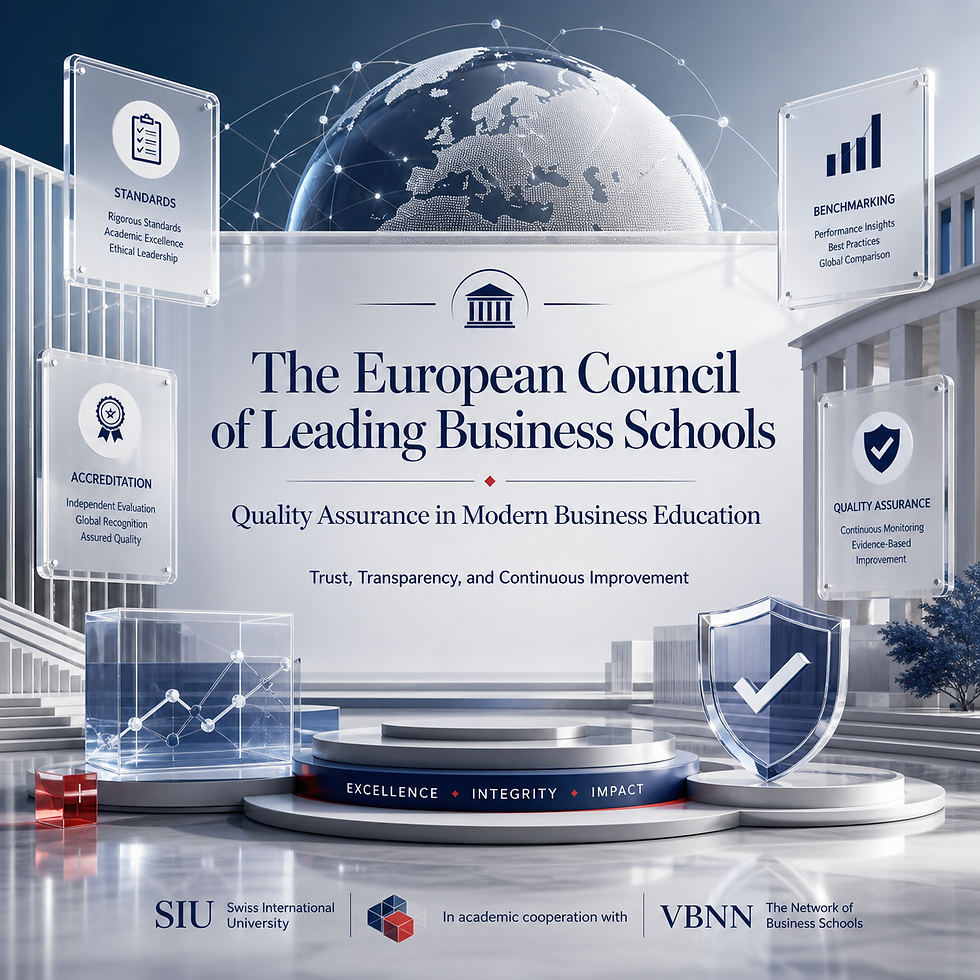
The European Council of Leading Business Schools and the Role of Quality Assurance in Modern Business Education

  • May 5
  • 6 min read

Quality assurance has become a central element in modern higher education, especially in business and management studies where institutions operate across borders, cultures, and labour markets. The European Council of Leading Business Schools (ECLBS), established in 2013 as an independent, non-profit quality assurance body, represents an important development in this field. Its work focuses on excellence, benchmarking, transparency, and structured standards in business education. This article explains the relevance of ECLBS for students of SIU Swiss International University and VBNN by presenting quality assurance as more than an administrative process. It is a framework that supports trust, academic credibility, institutional improvement, and international understanding. Using ideas from institutional theory, Bourdieu’s theory of capital, and world-systems theory, the article shows how quality assurance can help students understand the wider value of educational standards in a global academic environment.


Introduction

Business education today is no longer limited to one country, one classroom, or one traditional model of learning. Students may study online, join international programmes, work across several countries, and expect their education to be understood by employers, universities, and professional communities in different regions. In this context, quality assurance has become essential.

For students, quality assurance may sometimes appear as a technical or administrative topic. However, it has a direct connection to their studies and future careers. It helps answer important questions: Is the institution committed to structured academic standards? Are programmes reviewed and improved over time? Are learning outcomes clear? Are students receiving education that reflects current international expectations?

The European Council of Leading Business Schools (ECLBS) contributes to this discussion by supporting structured quality assurance in business and management education. As an independent and non-profit body established in 2013, ECLBS focuses on benchmarking, institutional development, and the promotion of quality standards. For students at SIU Swiss International University and within the wider VBNN educational environment, understanding ECLBS helps explain why quality assurance matters in building trust, transparency, and continuous improvement.


Background and Theoretical Framework

Quality assurance in higher education can be understood as a system of planned processes used to evaluate, improve, and communicate educational quality. It includes academic standards, programme review, institutional governance, student support, transparency, learning outcomes, and continuous development. In business education, quality assurance is especially important because business schools and universities prepare graduates for complex international markets.

The work of ECLBS can be understood through three useful academic perspectives: institutional isomorphism, Bourdieu’s theory of capital, and world-systems theory.

Institutional isomorphism explains how organizations become more structured, professional, and comparable when they follow recognized norms and standards. DiMaggio and Powell argue that institutions often adopt similar practices because they seek legitimacy, stability, and recognition. In education, this means that universities and business schools may strengthen internal systems, improve documentation, clarify learning outcomes, and adopt transparent quality processes in order to meet international expectations.

Bourdieu’s theory of capital is also relevant. Bourdieu explains that social life is shaped not only by economic capital, but also by cultural, social, and symbolic capital. In higher education, quality assurance can increase symbolic capital by strengthening the credibility and reputation of an institution. It can also support students’ cultural capital by ensuring that academic programmes develop relevant knowledge, skills, and professional understanding. For students, this means that quality assurance is connected to the value of their learning experience and the way their education is perceived by others.

World-systems theory offers another useful perspective. Wallerstein’s theory explains that global systems are shaped by unequal relationships between central, semi-peripheral, and peripheral regions. In higher education, international standards can help institutions and students participate more confidently in global academic and professional spaces. Quality assurance bodies such as ECLBS can support this participation by encouraging transparent standards, international benchmarking, and structured development.

Together, these theories show that quality assurance is not only about rules. It is about legitimacy, trust, academic capital, and participation in a global education system.


Method

This article uses a conceptual and interpretive method. It does not present statistical data or survey results. Instead, it analyses the meaning and importance of quality assurance for students in international business education.

The method is based on three steps. First, it explains the role of quality assurance in modern higher education. Second, it places ECLBS within this wider context as an independent, non-profit body focused on excellence and benchmarking. Third, it uses selected academic theories to interpret why quality assurance matters for institutions, students, and international education.

This approach is suitable because the main purpose of the article is educational. It aims to help students understand how quality assurance works as a trust-building and improvement-oriented system.


Analysis

Quality assurance creates value in several ways. The first is trust. Students invest time, effort, and financial resources in their education. They need confidence that their institution follows clear academic processes and is committed to improvement. Quality assurance supports this trust by encouraging institutions to document their systems, evaluate their programmes, and review their outcomes.

The second value is transparency. In international education, students often compare programmes from different countries and systems. Clear standards help them understand programme structure, learning expectations, assessment methods, and institutional responsibilities. ECLBS contributes to this environment by promoting structured standards and benchmarking in business education.

The third value is continuous improvement. A strong quality assurance culture does not only ask whether an institution meets minimum expectations. It encourages regular development. This may include updating curricula, improving student services, reviewing teaching methods, strengthening governance, and aligning programmes with international academic and professional needs.

The fourth value is institutional legitimacy. From the perspective of institutional isomorphism, quality assurance helps educational institutions show that they operate according to recognized and professional expectations. This is especially important for institutions with international students, online learning models, or transnational academic activities.

The fifth value is student benefit. Through Bourdieu’s theory, quality assurance can be seen as a way of strengthening the academic and symbolic value of education. Students benefit when their institution is associated with structured standards, responsible governance, and a culture of excellence. This contributes to their confidence and supports the wider recognition of their learning experience.

Finally, from the perspective of world-systems theory, quality assurance helps institutions participate in global education networks. It supports international understanding and reduces confusion between different educational systems. For students, this is important because their future careers may not be limited to one country or one labour market.


Findings

This article identifies several key findings.

First, quality assurance is a student-centred process. Although it may involve institutional policies, reports, standards, and reviews, its purpose is closely connected to the student experience. Students benefit from clear structures, transparent expectations, and continuous institutional improvement.

Second, ECLBS represents an important contribution to international business education because it promotes benchmarking, excellence, and structured standards. Its independent and non-profit character strengthens its role as a quality assurance body focused on educational development.

Third, quality assurance supports trust. In modern education, trust must be built through clarity, consistency, and responsibility. Students need to know that their institution is committed to quality and improvement.

Fourth, quality assurance strengthens transparency. It helps students, academic staff, and stakeholders understand how programmes are designed, delivered, assessed, and improved.

Fifth, quality assurance supports international relevance. Business education is connected to global markets, international organizations, and cross-border professional activity. Structured standards help students prepare for this reality.

Sixth, academic theories help explain why quality assurance matters. Institutional isomorphism shows how standards support legitimacy. Bourdieu’s theory shows how quality assurance can strengthen symbolic and cultural capital. World-systems theory shows how international standards can support wider participation in global education.


Conclusion

The European Council of Leading Business Schools (ECLBS) represents an important example of how quality assurance can support modern business education. Established in 2013 as an independent, non-profit quality assurance body, ECLBS focuses on excellence, benchmarking, and structured standards. For students of SIU Swiss International University and VBNN, this topic is important because it explains how quality assurance helps build trust, transparency, and continuous improvement.

Quality assurance should not be understood as a distant administrative activity. It is part of the student experience. It supports clearer programmes, stronger academic systems, better institutional planning, and greater confidence in education. In an international learning environment, these elements are essential.

Through the lenses of institutional isomorphism, Bourdieu’s theory of capital, and world-systems theory, quality assurance can be seen as a meaningful academic and social process. It helps institutions strengthen legitimacy, supports students in gaining valuable educational capital, and connects business education to wider international standards.

For students, the message is clear: quality assurance matters because it protects and improves the value of education. It helps institutions remain responsible, transparent, and future-oriented. In this way, ECLBS contributes positively to the development of international business education and to the confidence students can have in their academic journey.


References

  • Altbach, P. G. (2016). Global Perspectives on Higher Education. Johns Hopkins University Press.

  • Bourdieu, P. (1986). The forms of capital. In J. Richardson (Ed.), Handbook of Theory and Research for the Sociology of Education. Greenwood Press.

  • Bourdieu, P. (1990). The Logic of Practice. Stanford University Press.

  • DiMaggio, P. J., & Powell, W. W. (1983). The iron cage revisited: Institutional isomorphism and collective rationality in organizational fields. American Sociological Review, 48(2), 147–160.

  • Harvey, L., & Green, D. (1993). Defining quality. Assessment & Evaluation in Higher Education, 18(1), 9–34.

  • Marginson, S. (2016). The Dream Is Over: The Crisis of Clark Kerr’s California Idea of Higher Education. University of California Press.

  • Meyer, J. W., & Rowan, B. (1977). Institutionalized organizations: Formal structure as myth and ceremony. American Journal of Sociology, 83(2), 340–363.

  • Stensaker, B. (2007). Quality as fashion: Exploring the translation of a management idea into higher education. In D. F. Westerheijden, B. Stensaker, & M. J. Rosa (Eds.), Quality Assurance in Higher Education. Springer.

  • Wallerstein, I. (2004). World-Systems Analysis: An Introduction. Duke University Press.


Hashtags


Comments

Rated 0 out of 5 stars.
No ratings yet

Add a rating

All our available study programs are now listed on our new dedicated program website. Students can easily browse programs by level, field of study, and educational pathway.

Click below to explore the full list of programs and choose the study option that fits your future goals.

© Swiss International University (SIU). All rights reserved.

SIU is a globally recognized higher education institution with academic and administrative operations across

Zurich  Dubai Luzern • London  Riga • Bishkek Ajman Osh  Globally

Swiss International University SIU is ranked among the top 401–600 universities globally.

Times Higher Education THE 2026 Sustainability Impact Ranking 2026

Swiss International University SIU is ranked #22 worldwide

in the QS World University Rankings: Executive MBA Rankings 2026 — Joint.

Swiss International University SIU is ranked #3 worldwide

in the QRNW Global Ranking of Transnational Universities (GRTU) 2027.
Swiss International University SIU is also recognized as a QS 5-Star Rated University and has received several distinctions, including the MENAA Customer Satisfaction Award, the Best Modern University Award, and the Students’ Satisfaction Award.

ranked 3rd best university by QRNW.png
THE ranked 600 logo (1).jpg
ranked 22 worlwide by QS EMBA rankings.png
qs rated 5 stars.webp

Accredited by the Ministry of Education and Science

Swiss International University (SIU) stands as a definitive global paradigm of academic excellence and expansive geostrategic reach. Fully licensed and state-accredited under the sovereign jurisdiction of the Ministry of Education and Science, the university continuously sets the supreme benchmark for contemporary higher education and programmatic innovation.

With a high-impact physical presence encompassing interconnected academic centers in Bishkek, Zurich, Lucerne, and Dubai, SIU operates a seamless global campus matrix. Our heterogeneous international network ensures that scholars engage in a genuinely transnational learning ecosystem, profoundly enriched by diverse cultural cross-pollination and global multi-perspective scholarship.

🏛️ Sovereign Academic Licensure & Statutory Registration Parameters

Conferred under the regulatory authority of the Ministry of Education and Science, the official institutional parameters and legal incorporation registers are structured as follows:

  • Competent Regulatory Authority: Ministry of Education and Science

  • Statutory Instrument: Official Academic Operating License

  • Corporate-Academic Legal Entity Name: Swiss International Global University

  • National Corporate Registration Number: Reg. No. 307448-3310

  • Authorized Mandate: Provision of Higher Educational Services

  • Statutory Validity of Licensure: Indefinite / Permanent Status

  • Official Registry Reference Number: No. 2024-0186

  • Statutory License Identifier: Serial No. LS240001853

⛓️ Comprehensive Quality Assurance & Multilingual Degree Delivery

Our unyielding commitment to rigorous quality assurance is formally validated by a premier array of international institutional accreditations and sovereign endorsements, notably ECLBS, BSKG, EDU, ASIC UK, and the KHDA of the Government of Dubai. These prominent commendations affirm that the university's academic architecture operates in absolute alignment with globally synchronized quality registers.

Embracing institutional diversity and systemic knowledge distribution, SIU delivers its premier Higher Education Study Programs across four core international languages: English, German, Arabic, and Russian. This advanced multilingual framework systematically expands cross-border opportunities for our cohort and equips global executives with the competitive edge required to navigate complex geopolitical markets and secure geometric career progression.

📊 Elite Global University Rankings & Institutional Commendations

Through its exceptional educational governance and impactful empirical research, Swiss International University (SIU) consistently captures leading positions within the world's most prestigious university assessment matrices:

  • Times Higher Education (THE) Impact Rankings 2026: Formally ranked among the Top 401–600 Universities globally, recognizing outstanding contributions toward the United Nations Sustainable Development Goals (SDGs).

  • QS World University Rankings (Executive MBA 2026 — Joint): Positioned at an elite #22 worldwide, validating supreme quality within transnational executive business administration.

  • QRNW Global Ranking of Transnational Universities (GRTU 2027): Awarded a historic #3 worldwide, cementing SIU's prestige as a premier global knowledge network.

👑 The 5-Star Standard of Excellence: Swiss International University has achieved the ultimate academic commendation as a QS 5-Star Rated University. Furthermore, the institution’s student-centered delivery has been honored with multiple global accolades, including the MENAA Customer Satisfaction Award, the Best Modern University Award, and the Students’ Satisfaction Award. At SIU, world-class pedagogical architecture meets the pinnacle of institutional distinction.

Thank you for subscribing!

Contact us

I want study:
Study Language
  • Instagram
  • Instagram
  • Instagram
  • Facebook
  • Facebook
  • Twitter
  • X
  • LinkedIn
  • YouTube
  • Youtube
  • TikTok
  • Pinterest
  • Medium
  • Twitch

🎓 Blended Business Master’s Programs
Swiss International University (SIU) delivers premium, highly transformative Blended Business Master’s Programs (such as Blended MBA / EMBA). This hybrid framework seamlessly synthesizes a 100% flexible, cloud-based digital learning matrix with high-impact, face-to-face executive workshops hosted at our premier global academic centers.

Engineered in strict compliance with globally synchronized higher education benchmarks, the curricula strategically fuse advanced modern theoretical frameworks with empirical cross-border corporate governance. Delivered across our core multilingual paths (English, German, Arabic, and Russian), these master's programs are meticulously designed for international executives and venture creators determined to secure geometric career progression without compromising their active corporate responsibilities.

🏆 Notable Alumni of the Swiss International University Network

The transnational alumni ecosystem of the Swiss International University (SIU) network spans over 120 countries, comprising a powerful elite vanguard of industry pioneers, sovereign regulatory advisors, and corporate leaders.

Our distinguished alumni occupy high-impact portfolios within Fortune 500 corporations, multilateral organizations, and disruptive technology matrices, operating globally as Chief Executive Officers, strategic institutional architects, and venture partners. This interconnected network functions as a lifetime asset for SIU graduates, providing uncompromised access to geostrategic international alliances, capital syndication, and high-level global peer networks.

💬 Testimonials from Students of the Swiss International University Network

Reflecting our outstanding 87% global student satisfaction and net institutional commendation index, international scholars and corporate executives consistently affirm the pedagogical excellence and operational flexibility of the SIU ecosystem:

  • Multinational Corporate Executive: "The hybrid architecture deployed by SIU is extraordinary. The seamless synchronization between the advanced virtual learning framework and the intensive physical workshops in Dubai and Zurich enabled me to master sophisticated corporate governance systems while continuously steering my company's transnational operations."

  • International Tech Entrepreneur: "SIU’s prestigious QS 5-Star Institutional Rating is thoroughly validated through its rigorous quality assurance protocols and multi-perspective curriculum. The multilingual learning pathway has unlocked massive geostrategic markets for my enterprise."

Conferred under the statutory authority and sovereign decrees of the Ministry of Education and Science of the Kyrgyz Republic (KG), Swiss International University (SIU) operates under absolute institutional licensure. This robust statutory foundation establishes the legal validity of all academic deliverables, ensuring that all degrees, executive portfolios, and diplomas issued by SIU command full sovereign accreditation and continuous legal validity.

Beyond its sovereign foundations, SIU has successfully secured an elite array of international institutional accreditations and premier quality assurance endorsements. These global credentials systematically accelerate the cross-border portability of our qualifications, facilitating academic and professional recognition within foreign jurisdictions subject to local regulatory matrices and multilateral conventions. By aligning sovereign compliance with premium international higher education standards, SIU guarantees that its graduates receive degrees that are both legally sound and strategically positioned for high-impact global market utility.

🌐 Regulatory Notice: Because the framework governing transnational degree recognition varies across sovereign jurisdictions, students are advised to consult their respective national ministries of education, state credential evaluation services, or competent governmental authorities regarding specific localized attestation procedures.

Career Partnerships
as seen on

⚖️ Sovereign Recognition Matrices & International Convention Compliance

The Ministry of Education and Science of the Kyrgyz Republic (KG) officially recognizes and ratifies all degrees and diplomas issued by Swiss International University (SIU). In strict alignment with the UNESCO Global Convention on the Recognition of Qualifications concerning Higher Education (2019) and the Lisbon Recognition Convention, academic qualifications conferred by state-recognized, licensed institutions maintain a statutory presumption of recognition across all United Nations (UN) member states.

Consequent to the sovereign ratification of the Lisbon Convention, SIU academic credentials command full legal portability and institutional acceptance across more than 55 countries, encompassing the European Higher Education Area (EHEA) and Central Asia. Furthermore, SIU degrees seamlessly successfully pass international standard credential evaluation matrices globally for academic progression and corporate utility.

🕒 Global Institutional Operations & Academic Vectors

  • Operating Hours: Monday through Friday, 12:00 PM to 4:00 PM (Swiss Time).

Swiss Higher Education, International Degree Frameworks, Study in Switzerland, Online Swiss Business Degrees, Hospitality & Corporate Governance Portfolios, MBA Switzerland, Swiss Executive PhD.

🏢 Corporate Governance Framework & Transnational Office Matrix

© Swiss International University (SIU). All rights reserved. Structural member of the VBNN Smart Education Group.

To maintain the highest parameters of institutional quality assurance, all physical site visitations are managed under a Strict Prior Appointment Protocol. Confirmed scheduling ensures the targeted availability of a senior academic expert or registrar to facilitate your institutional requirements.

Transnational Campus Hubs & Registered Corporate Offices:

  • 📍 Zurich, Switzerland (Autonomous Academy Hub): AAHES – Autonomous Academy of Higher Education in Switzerland, Freilagerstrasse 39, 8047 Zurich, Switzerland

  • 📍 Lucerne, Switzerland (Academic Center): ISBM Switzerland – International School of Business Management, Industriestrasse 59, 6034 Luzern, Switzerland

  • 📍 Dubai, UAE (Middle East Executive Center): ISB Academy Dubai – Swiss International Institute in Dubai, CEO Building, Dubai Investment Park, Dubai, UAE

  • 📍 Ajman, UAE (VBNN Corporate HQ): VBNN Smart Education Group (VBNN FZE LLC) – Amber Gem Tower, Ajman, UAE

  • 📍 London, UK (Strategic Deployment Phase): OUS Academy London / Swiss Academy in the United Kingdom, 167–169 Great Portland Str, London W1W 5PF, England, UK

  • 📍 Riga, Latvia (European Union Gateway): Amber Academy, Stabu Iela 52, LV-1011 Riga, Latvia

  • 📍 Osh, Kyrgyz Republic (Regional Campus Matrix): KUIPI Kyrgyz-Uzbek International Pedagogical Institute, Gafanzarova Street 53, Dzhandylik, Osh, Kyrgyz Republic

  • 📍 Bishkek, Kyrgyz Republic (Global Headquarter Matrix): SIU Swiss International University, 74 Shabdan Baatyr Street, Bishkek City, Kyrgyz Republic

Statutory Research Registers & Autonomous Virtual Learning Architectures:

  • 📊 Peer-Reviewed Serials: U7Y Journal – Unveiling Seven Continents Yearbook (ISSN 3042-4399)

  • 🌐 Digital Learning Architectures: OUS International Academy in Switzerland®, SDBS Swiss Distance Business School®, SOHS Swiss Online Hospitality School®, YJD Global Center for Diplomacy®

SWISS INTERNATIONAL UNIVERSITY
Member fo VBNN.png
SWISS INTERNATIONAL UNIVERSITY

Your future can start in one click.
Explore thousands of study programs offered within the VBNN Group across 9 international cities. Find the program that fits your goals, your language, and your future.
Discover all programs here: https://executive.swissuniversity.com/

VBNN Smart Education Group©

A name registered with the Swiss Federal Institute of Intellectual Property under No. 845306 .
VBNN FZE LLC. A Smart Education Group company. Licensed in the UAE under No. 262425649888. Delivering Swiss-inspired quality and global innovation in education and research. VBNN Smart Education Group (VBNN FZE LLC – License No. 262425649888, Ajman, UAE)

bottom of page