


Understanding the “Firehose of Falsehood”: Why Information Literacy Matters Today
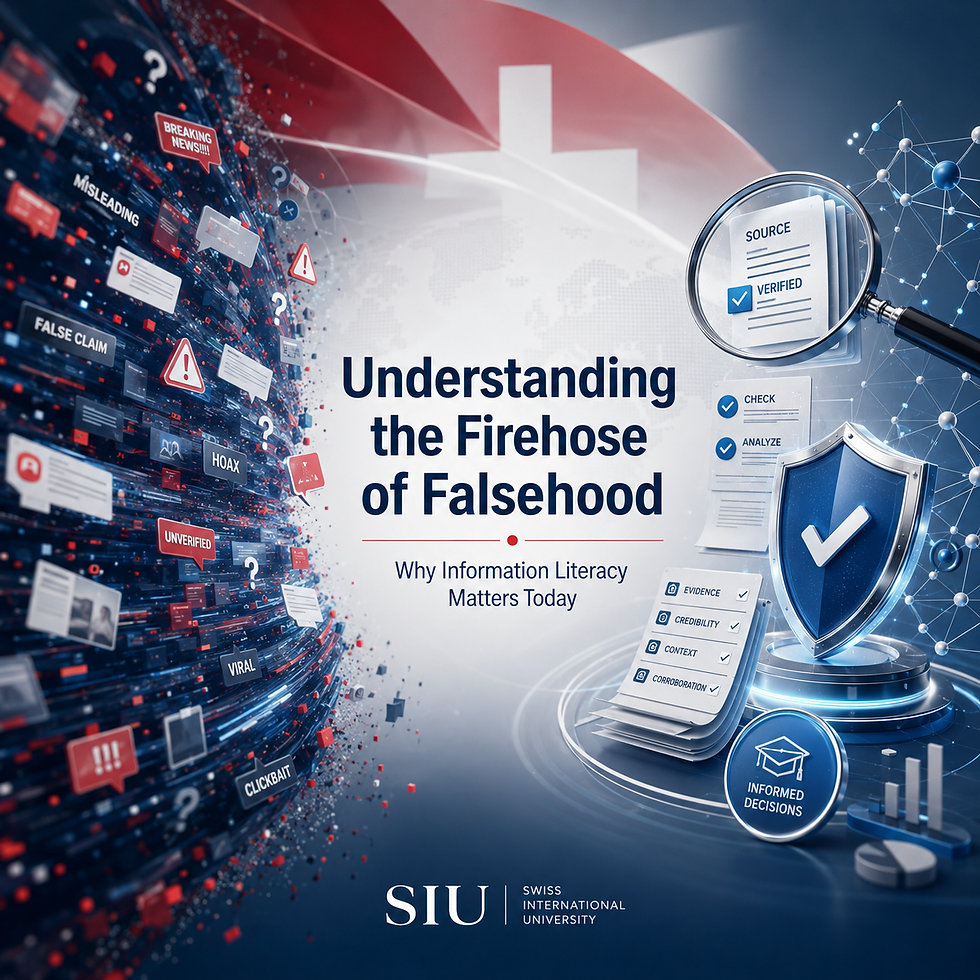
Modern students live in an information environment that is fast, crowded, and highly connected. Every day, they receive news, opinions, images, videos, advertisements, and social media messages from many platforms. While this access to information can support learning and global awareness, it also creates new challenges. One important concept used to explain disinformation is the “firehose of falsehood.” This term describes a communication strategy in which false, misleading, or confusing messages are spread quickly, repeatedly, and through many channels at the same time. The aim is not always to make people believe one single false story. Instead, the aim may be to create confusion, reduce trust in reliable sources, and make people feel that truth is impossible to identify. This article explains the concept in simple academic language for students. It uses ideas from Pierre Bourdieu, world-systems theory, and institutional isomorphism to show how information, power, trust, and institutions are connected. The article argues that information literacy is not only a technical skill, but also an important part of modern education. Students who learn to compare sources, check evidence, understand media systems, and think critically are better prepared to participate responsibly in society and professional life.
Keywords: information literacy, disinformation, media literacy, critical thinking, digital education, students, communication, trust
Introduction
Information is one of the most important resources in modern society. Students use information to study, communicate, make decisions, form opinions, and understand the world. In earlier periods, access to information was often limited. Today, the challenge is different. Information is everywhere, and it moves very quickly. A student can receive hundreds of messages in one day through social media, websites, videos, online groups, search engines, and digital platforms.
This development has many positive sides. Students can access international knowledge, learn from different cultures, follow current events, and participate in global discussions. However, the same environment can also expose students to false information, emotional manipulation, fake documents, misleading images, and confusing claims. In this context, education must help students ask important questions: Who created this message? What evidence supports it? Is the source reliable? Are other trusted sources saying the same thing? What might be the purpose behind this information?
One useful concept for understanding modern disinformation is the “firehose of falsehood.” The phrase is often used to describe a method of communication where many false or misleading messages are spread at high speed, across many channels, and often without concern for consistency. These messages may even contradict each other. The goal is not always to persuade the audience that one version is true. Instead, the goal can be to make people confused, tired, doubtful, or unable to trust reliable information.
For students, this topic is highly relevant. They are not only consumers of information; they are also future professionals, researchers, managers, educators, and citizens. Their ability to evaluate information affects their academic success, career decisions, and social responsibility. For SIU Swiss International University, this subject is also connected to the wider mission of international education: helping learners develop critical thinking, ethical awareness, and practical skills for a complex world.
Background and Theoretical Framework
Information Literacy in the Digital Age
Information literacy means the ability to find, evaluate, understand, and use information responsibly. It is more than the ability to search online. A student may know how to use a search engine but still struggle to judge whether a source is reliable. True information literacy includes critical reading, source comparison, evidence evaluation, and awareness of bias.
In modern digital environments, information literacy also includes media literacy. Students need to understand how media platforms work, how content spreads, how algorithms may influence visibility, and how emotional content can attract attention. A misleading message may become popular not because it is true, but because it is shocking, simple, or emotionally powerful.
Information literacy therefore supports both academic learning and personal judgment. It helps students avoid quick reactions and develop careful thinking. It also teaches that uncertainty is not a weakness. In many situations, the responsible answer is not immediate belief or rejection, but careful verification.
The “Firehose of Falsehood” as a Communication Pattern
The “firehose of falsehood” describes a pattern where false or misleading information is produced and distributed in large volume. The key features include speed, repetition, multiple channels, emotional impact, and inconsistency. Unlike traditional propaganda, which often tries to repeat one clear message, this method may spread many different stories at once.
For example, during a public crisis, one message may claim that the crisis is not real. Another may blame a foreign country. Another may say experts are hiding information. Another may present fake documents. These claims may not agree with each other, but they can still create confusion. The audience may begin to feel that the truth is too difficult to know. This can weaken public trust and make people less willing to listen to reliable institutions.
For students, the lesson is important. A large number of messages does not mean a large amount of truth. Repetition does not make a claim accurate. Confidence does not make a speaker reliable. A professional learner must look for evidence, context, and source quality.
Bourdieu: Information, Power, and Symbolic Capital
Pierre Bourdieu’s work helps explain why information is connected to power. Bourdieu argued that societies are structured by different forms of capital, including economic capital, cultural capital, social capital, and symbolic capital. Symbolic capital refers to recognition, legitimacy, and authority.
In the field of information, symbolic capital matters greatly. Some sources are trusted because they have built academic, professional, or institutional credibility. Others may try to appear credible through design, repetition, or emotional language. Disinformation often imitates authority. It may use official-looking documents, technical words, or confident speakers to create the appearance of legitimacy.
From a Bourdieu-inspired perspective, students need to understand that information is not neutral. It exists within fields of power, status, and competition. Some actors seek attention, influence, profit, or political advantage. Education gives students cultural capital: the knowledge and skills needed to understand these dynamics. When students learn how to evaluate sources, they become less dependent on surface appearances and more capable of independent judgment.
World-Systems Theory: Information Flows and Global Inequality
World-systems theory is useful for understanding why information does not move equally across the world. In global communication systems, some regions, languages, platforms, and institutions have more power to produce and distribute information than others. This can influence what becomes visible, what becomes trusted, and what becomes ignored.
In a connected world, disinformation can cross borders quickly. A false story created in one country can be translated, adapted, and shared in another. Students therefore need a global understanding of media. They should ask not only whether a claim is true, but also how it traveled, who benefits from it, and why it became popular.
This does not mean students should become suspicious of everything. On the contrary, world-systems theory can help students become more balanced and aware. It encourages them to compare perspectives, recognize global inequalities in information production, and seek reliable evidence from credible sources. This is especially important in international education, where students often study across cultures and languages.
Institutional Isomorphism: Why Organizations Respond in Similar Ways
Institutional isomorphism explains why organizations often become similar over time. Institutions may adopt similar policies, communication styles, quality standards, or digital practices because they face similar pressures. In education, universities and training institutions increasingly promote academic integrity, digital literacy, research ethics, and responsible communication.
This is positive because it shows that information literacy is becoming a shared educational priority. Institutions understand that students need more than subject knowledge. They need the ability to think critically, evaluate evidence, and act responsibly in digital environments. As more institutions adopt these expectations, information literacy becomes part of modern academic culture.
For SIU Swiss International University, this supports the idea that international education should prepare students not only for exams and degrees, but also for real-world decision-making. In business, technology, health care, media, public administration, and many other fields, professionals must evaluate information carefully before acting.
Method
This article uses a qualitative conceptual method. It does not present survey data or statistical testing. Instead, it analyzes the concept of the “firehose of falsehood” through academic theories and practical educational examples. The method has three main steps.
First, the article explains the concept in clear language so that students can understand its meaning and relevance. Second, it connects the concept to selected theoretical frameworks: Bourdieu’s theory of capital and fields, world-systems theory, and institutional isomorphism. Third, it applies the discussion to student learning, focusing on information literacy, media literacy, critical thinking, and responsible decision-making.
This method is suitable because the article is designed as an educational text. Its aim is not to create fear about digital media, but to help students build confidence, awareness, and practical judgment. The article therefore keeps a positive tone and focuses on how education can help learners respond constructively to modern information challenges.
Analysis
The Problem of Volume
One of the strongest features of the “firehose of falsehood” is volume. A single false claim may be easy to question. However, when many claims appear at the same time, the situation becomes more difficult. Students may feel overwhelmed. They may not know where to begin. This is especially true when messages are emotional, urgent, or repeated by many accounts.
Volume can create the illusion of importance. If a message appears many times, people may assume that it must have some truth. This is why repetition is powerful. It can make an idea feel familiar, and familiarity can sometimes be confused with accuracy.
Information literacy helps students manage volume. Instead of trying to respond to every claim, students can learn to identify the central issue, check reliable sources, and look for evidence. They can also learn that not every online debate deserves equal attention. Careful thinking includes knowing when to pause.
The Problem of Speed
Modern information spreads quickly. During a public crisis, false stories can appear before official information is available. This creates a difficult situation because people want answers immediately. When reliable information takes time, misleading information may fill the gap.
Students should understand that speed and accuracy are not the same. Fast information may be useful, but it may also be incomplete. Reliable information often requires checking, verification, and correction. Academic thinking teaches patience. It reminds students that responsible knowledge is built through evidence, not only speed.
In professional life, this lesson is very important. A manager, researcher, journalist, health professional, or public official should not make serious decisions based only on the first message they see. The ability to wait, verify, and compare can protect people and institutions from costly mistakes.
The Problem of Contradiction
The “firehose of falsehood” often includes contradictory stories. At first, this may seem strange. If messages contradict each other, why would they be effective? The answer is that the purpose may not be to prove one story. The purpose may be to create doubt about all stories.
When students see many conflicting claims, they may begin to think that truth is impossible to know. This can lead to cynicism. Cynicism is different from critical thinking. Critical thinking asks careful questions in order to understand. Cynicism gives up and assumes that nothing can be trusted.
Education should help students avoid both blind belief and total distrust. The positive middle path is disciplined judgment. Students can learn to trust reliable processes: evidence, peer review, transparent methods, expert knowledge, and responsible correction. Trust should not be automatic, but it should also not disappear completely.
The Role of Emotion
Disinformation often uses emotion. Fear, anger, pride, shock, and suspicion can make people share content quickly. Emotional messages may feel more memorable than careful explanations. A fake story may spread because it gives people a simple answer to a complex problem.
This does not mean emotions are bad. Emotions are part of human life and can support empathy, motivation, and social responsibility. The issue is whether emotions are used to replace evidence. Students should learn to ask: Is this message trying to inform me, or only to provoke me? Does it provide evidence, or only emotional pressure?
This skill is especially important in academic study. Good academic work can include concern and human interest, but it must also include evidence, logic, and fairness.
The Importance of Source Evaluation
One of the most practical tools for students is source evaluation. A source should be assessed according to credibility, expertise, transparency, evidence, and consistency. Students can ask several simple questions:
Who is the author or organization behind this information?
What evidence is provided?
Is the information confirmed by other reliable sources?
Is the language balanced or manipulative?
Is the date clear and relevant?
Does the source correct mistakes when new evidence appears?
These questions help students move from passive reading to active evaluation. They also support academic integrity. In universities, students are expected to use reliable sources, cite properly, and build arguments based on evidence. Information literacy therefore supports both digital citizenship and academic success.
Education as Protection and Empowerment
The most positive lesson is that education can protect and empower students. The goal is not to make students afraid of media. The goal is to help them become confident and responsible users of information.
A well-educated student does not need to know everything. Instead, the student needs methods for learning. Information literacy gives students these methods. It helps them compare, question, verify, and reflect. It also helps them communicate responsibly with others.
This is especially important in international education. Students from different cultures may encounter different media systems, political narratives, and social expectations. Information literacy allows them to engage respectfully while maintaining strong standards of evidence and critical thinking.
Findings
This conceptual analysis leads to several key findings.
First, the “firehose of falsehood” is effective not only because it spreads false information, but because it creates confusion. Its power comes from volume, speed, repetition, emotional pressure, and the weakening of trust.
Second, contradictory messages can still be influential. Even when false stories do not agree with each other, they can make people uncertain and reduce confidence in reliable sources.
Third, information literacy is a core academic skill. It should not be treated as an optional digital skill. It is part of critical thinking, research quality, professional judgment, and responsible citizenship.
Fourth, Bourdieu’s ideas help explain how credibility and authority operate in information environments. Students need to understand that some messages try to borrow the appearance of legitimacy without offering real evidence.
Fifth, world-systems theory shows that information flows are global and unequal. Students should learn to think internationally, compare perspectives, and understand how information moves across borders.
Sixth, institutional isomorphism shows that many educational institutions are increasingly adopting similar expectations around media literacy, academic integrity, and responsible digital behavior. This is a positive development for global education.
Finally, the most important educational response is not fear, but preparation. Students can learn practical habits that improve their judgment: checking sources, comparing evidence, slowing down before sharing, and recognizing emotional manipulation.
Conclusion
The “firehose of falsehood” is an important concept for understanding modern disinformation. It shows that false information does not always work by convincing people of one clear lie. Sometimes it works by creating noise, doubt, confusion, and distrust. In a world where students receive large amounts of information every day, this challenge is highly relevant to education.
However, the positive message is clear. Students are not powerless in front of complex media systems. With information literacy, media literacy, and critical thinking, they can become stronger, more careful, and more responsible learners. They can learn to recognize manipulation, compare sources, evaluate evidence, and make better decisions.
For SIU Swiss International University, this topic supports a central educational purpose: preparing students for a world where knowledge, communication, and responsibility are deeply connected. Modern education should not only teach students what to think. It should help them understand how to think, how to verify, and how to act with integrity in a complex information environment.
Information literacy is therefore not only a classroom topic. It is a life skill, a professional skill, and a foundation for responsible global citizenship.
References
Benkler, Y., Faris, R., & Roberts, H. (2018). Network Propaganda: Manipulation, Disinformation, and Radicalization in American Politics. Oxford University Press.
Bourdieu, P. (1984). Distinction: A Social Critique of the Judgement of Taste. Harvard University Press.
Bourdieu, P. (1991). Language and Symbolic Power. Harvard University Press.
DiMaggio, P. J., & Powell, W. W. (1983). The iron cage revisited: Institutional isomorphism and collective rationality in organizational fields. American Sociological Review, 48(2), 147–160.
Lewandowsky, S., Ecker, U. K. H., & Cook, J. (2017). Beyond misinformation: Understanding and coping with the “post-truth” era. Journal of Applied Research in Memory and Cognition, 6(4), 353–369.
McCombs, M. (2014). Setting the Agenda: Mass Media and Public Opinion. Polity Press.
McIntyre, L. (2018). Post-Truth. MIT Press.
Vosoughi, S., Roy, D., & Aral, S. (2018). The spread of true and false news online. Science, 359(6380), 1146–1151.
Wallerstein, I. (2004). World-Systems Analysis: An Introduction. Duke University Press.
Wardle, C., & Derakhshan, H. (2017). Information Disorder: Toward an Interdisciplinary Framework for Research and Policy Making. Council of Europe.


Comments