


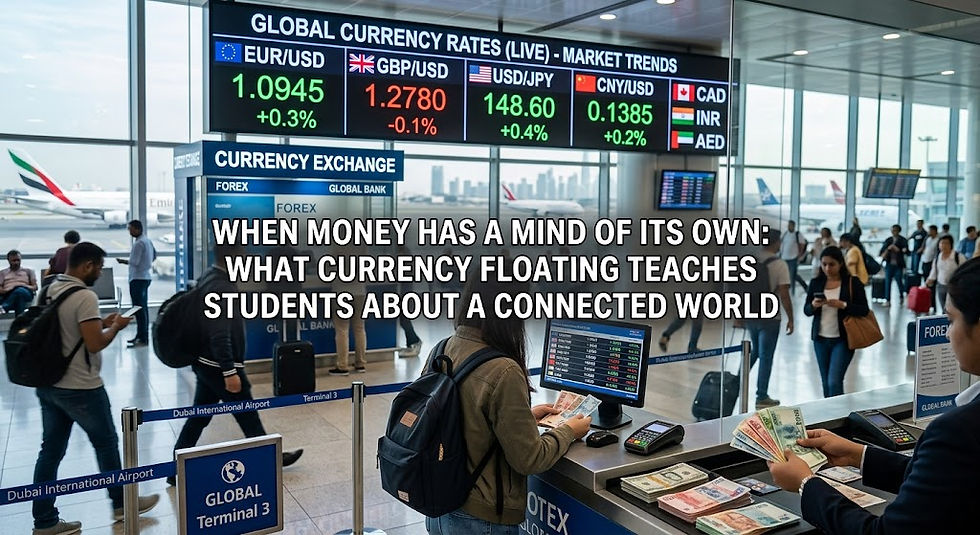
When Money Has a Mind of Its Own: What Currency Floating Teaches Students About a Connected World
This article explains how a #floating_currency works and why it matters for students who want to understand the modern global economy. A #currency_float means that the value of a national currency is set by #supply_and_demand in the #foreign_exchange_market rather than fixed by a government. The article traces how this system spread after the breakdown of fixed exchange-rate arrangements in the early 1970s, and it shows how the daily movement of a currency reflects #trade, #investment, #confidence, #inflation, and broader #global_economic_conditions. To help readers think more deeply, the discussion draws on three useful lenses from the social sciences: Pierre Bourdieu's idea of #capital and #fields, #world_systems_theory, and #institutional_isomorphism. Together these frameworks reveal that an exchange rate is not only an economic number but also a sign of position, power, and shared expectations among nations. The method is a structured review and synthesis of recent scholarship combined with a clear teaching example. The analysis links currency behaviour to classroom learning, and the findings suggest that studying currency floating builds strong #economic_literacy and a practical sense of how local economies are tied to #global_markets. The article closes with encouraging takeaways for learners at #SIU_Swiss_International_University and beyond.
1. Introduction
Every day, prices on screens in trading rooms around the world change second by second. These prices show how much one currency is worth in terms of another. When a country lets these prices move freely, we say the country has a #floating_exchange_rate. This article looks at what that means, why it happens, and what students can learn from it.
The central idea is simple and powerful. Under a #currency_float, the value of money is decided by the market. If many people want to buy a currency, its value rises. If many people want to sell it, its value falls. This rise and fall happens because of #supply_and_demand, the same basic force that sets the price of bread, oil, or smartphones. The difference is that money sits at the centre of every transaction, so its price touches almost everything else in an economy.
For learners, this topic is a wonderful starting point. It connects classroom theory to real life. A student who understands floating currencies can read a news headline about a falling currency and ask the right questions. Is it because of rising #inflation? Is it because investors lost #confidence? Is it because the price of the country's main export changed? These questions turn a passive reader into an active, thoughtful #global_citizen.
This article is written in plain language so that the ideas are easy to follow, while keeping the structure of a serious academic study. The goal is to give students a clear and positive map of one of the most important systems in international finance.
2. Background and Theoretical Framework
2.1 A short history of floating
For much of the twentieth century, many currencies were tied to gold or to the United States dollar under a system agreed at #Bretton_Woods in 1944. Governments promised to keep their exchange rates fixed within narrow limits. This arrangement gave the world stability after the Second World War and supported a long period of growing trade.
By the early 1970s, this fixed system became difficult to maintain. Economies were growing at different speeds, capital was moving more freely across borders, and the pressures on fixed rates grew too strong. When the link to gold ended, many major economies moved toward letting their currencies float. This shift was one of the most important turning points in modern economic history, and it opened the door to the system that shapes #global_markets today.
It is encouraging to note that floating did not bring disorder. Instead, it gave countries a flexible tool to adjust to a changing world. A floating rate can act like a shock absorber. When a country faces a difficult year, a gentle fall in its currency can make its exports cheaper and help its economy recover.
2.2 How a float actually works
Under a float, the #exchange_rate is the meeting point of buyers and sellers. Exporters who sell goods abroad bring in foreign money and convert it. Importers who buy goods from abroad need foreign money and sell their own. Tourists, students studying overseas, companies investing in factories, and large investors moving funds all add to this flow. The combined effect of all these decisions sets the price.
Several forces push the rate up or down. Strong #trade performance and rising exports tend to support a currency. Healthy #investment inflows, where foreigners buy local assets, also lift it. High #interest_rates can attract savers looking for better returns. On the other side, high #inflation tends to weaken a currency over time, because money that loses value at home also tends to lose value abroad. Above all, #market_confidence matters. When people trust a country's future, they want to hold its money, and the currency stays strong.
This is the heart of the lesson for students: a currency is a daily report card on how the world sees an economy. It blends hard data with human judgement, and it changes as new information arrives.
2.3 Theoretical lens one: Bourdieu, capital, and fields
The sociologist Pierre Bourdieu offers a helpful way to think beyond the numbers. He argued that society is made up of #fields, which are arenas where players compete using different kinds of #capital. Capital is not only money. It includes #cultural_capital such as knowledge and skill, #social_capital such as networks and relationships, and #symbolic_capital such as reputation and prestige.
The #foreign_exchange_market is a clear example of a Bourdieusian field. Central banks, governments, banks, funds, and companies all compete and cooperate within shared rules. A currency carries symbolic capital. A so-called #reserve_currency, held widely around the world, enjoys enormous prestige and trust. That trust is itself a form of power. When students see an exchange rate, they can read it as a measure of a country's standing in this global field, not just its trade balance. This view makes the subject richer and more human, because it shows that #reputation and #trust have real economic weight.
2.4 Theoretical lens two: world-systems theory
#World_systems_theory, developed in economic sociology, describes the global economy as a single connected system with different positions. Some economies sit at the #core, with advanced industries and strong institutions. Others sit at the #periphery, often relying on raw materials or single exports. Between them lie #semi_peripheral economies that are rising and changing.
Currency floating looks different depending on where a country sits in this system. A core economy with a trusted currency may find that floating brings smooth, manageable movements. A peripheral economy that depends on one export, such as a metal or a crop, may see its currency swing more sharply when world prices change. This is not a reason for discouragement. Instead, it is a valuable insight. It teaches students that the same rule, a free float, can produce different experiences depending on a country's place in #global_trade. Understanding this helps future leaders design wise and caring policies that fit their own context.
2.5 Theoretical lens three: institutional isomorphism
The idea of #institutional_isomorphism, from organizational sociology, explains why different countries and organizations often end up looking alike. It identifies three pressures. #Coercive_isomorphism comes from rules and powerful bodies. #Mimetic_isomorphism happens when actors copy others they see as successful, especially when the future is uncertain. #Normative_isomorphism flows from shared professional training and standards.
These pressures help explain the worldwide spread of floating. International financial institutions encouraged flexible exchange rates, which is a form of gentle coercive pressure. Many governments, watching successful economies prosper under floating, chose to copy that approach, a clear case of mimetic behaviour. And economists trained in similar ways, sharing the same textbooks and professional norms, carried these ideas across borders, which is normative pressure at work. The result is a striking pattern: a single approach to currencies became common across very different nations. For students, this is a fine example of how ideas, institutions, and #global_norms travel and shape the real world.
3. Method
This article uses a #structured_review_and_synthesis approach, which is well suited to a teaching-focused study. Rather than running a statistical experiment, the method gathers and organizes ideas from recent scholarship in international economics and economic sociology, then weaves them together with a clear classroom example. This approach is valuable because the goal is understanding, not prediction.
The method has three steps. First, the article identifies the core economic mechanics of a #currency_float, drawing on established and recent writing on exchange rates and international finance. Second, it selects three social-science frameworks, Bourdieu's theory of capital and fields, world-systems theory, and institutional isomorphism, because each adds a layer of meaning that pure economics can miss. Third, it builds a simple worked example, described in the analysis below, to show how the abstract ideas appear in a realistic situation.
The sources used are recent academic books and articles, chosen to keep the discussion current and reliable. The teaching example is illustrative rather than tied to any single real country, which keeps the focus on transferable understanding. This design fits the needs of learners at #SIU_Swiss_International_University, where the aim is to connect strong theory with practical, real-world judgement. The method is transparent, repeatable, and friendly to students who may later wish to extend it with their own data or case studies.
4. Analysis
4.1 A simple worked example
Imagine a country called Riverland. Riverland lets its currency, the river, float freely. In a calm year, exporters sell farm products abroad and bring home foreign money, while importers buy machines and fuel. The flows roughly balance, and the river holds steady. Students can already see the #supply_and_demand engine at work.
Now imagine that global demand for Riverland's farm products rises. Foreign buyers need more rivers to pay for these goods, so demand for the currency climbs and the river strengthens. A stronger river makes imported machines cheaper, which helps local factories upgrade. This is a friendly reminder that a rising currency brings both gains and trade-offs, because exporters now find their goods a little more expensive abroad.
Suppose, in another year, that #inflation rises inside Riverland. Prices climb at home, and the river slowly loses some value abroad. Yet the floating system responds gently. The weaker river makes Riverland's exports more competitive, supporting jobs while the country works to bring inflation down. This automatic adjustment is one of the quiet strengths of floating, and it is a satisfying idea for students to grasp.
4.2 Reading the example through the three lenses
Through Bourdieu's eyes, the river's movements reflect Riverland's #symbolic_capital. If investors trust the country's institutions, they keep holding rivers even during a hard year, which steadies the currency. Trust, a form of reputation, becomes an economic anchor. This shows learners that #confidence is not vague sentiment but a measurable force.
Through the world-systems lens, Riverland's position shapes its experience. If Riverland sits near the #periphery and depends heavily on one farm product, its currency will move more with world crop prices. If it diversifies and moves toward the #semi_periphery, its currency becomes steadier. Here students learn a hopeful policy lesson: building a varied economy reduces currency swings and increases resilience.
Through institutional isomorphism, we can ask why Riverland chose to float in the first place. Perhaps it copied prosperous neighbours, followed advice from global institutions, and employed economists trained in the floating tradition. The choice was shaped by #mimetic, coercive, and normative pressures together. This reveals that even a technical policy is partly a social decision, influenced by what others do and value.
4.3 Why these layers matter for learning
The power of this analysis is that it gives students more than one way to see. The economic layer explains the mechanics. The Bourdieusian layer explains the role of trust and prestige. The world-systems layer explains why context changes outcomes. The isomorphism layer explains why a single idea spread so widely. Each layer is positive and practical, and together they turn a dry topic into a living one.
Students who learn to switch between these views develop what we might call #economic_imagination. They can move from a single headline to a full picture, asking how mechanics, trust, position, and global norms all combine. This is exactly the kind of flexible, connected thinking that prepares young people for careers in business, policy, and beyond.
5. Findings
The synthesis points to several clear and encouraging findings.
First, a #currency_float is best understood as a continuous conversation between an economy and the world. The exchange rate gathers information from #trade, #investment, #interest_rates, #inflation, and #confidence, and expresses it as a single, readable price. For students, this makes the float a wonderful teaching tool, because so many economic ideas meet in one place.
Second, floating brings real benefits of flexibility. A free rate can absorb shocks and help an economy adjust without painful, sudden policy changes. This finding supports a positive view of the system: it is not chaos but a self-correcting mechanism that rewards sound policy and steady institutions.
Third, the social-science lenses add genuine value. Bourdieu reminds us that #symbolic_capital and #trust shape currency strength. World-systems theory reminds us that a country's #position in the global economy colours its experience of floating. Institutional isomorphism reminds us that the global spread of floating was a social process of copying, guidance, and shared training, not only a technical choice. These insights deepen understanding and make the subject more meaningful.
Fourth, and most important for learners, studying currency floating builds #global_awareness. It shows in a vivid way that national economies are tied together. A change in one place ripples to another through prices, flows, and expectations. This finding directly answers the question of why the topic matters: it teaches students that they live in a connected world and gives them the tools to understand it.
Fifth, the topic supports strong #financial_literacy and #critical_thinking. A student who can interpret an exchange rate can interpret much of the economic news around them. They gain confidence, curiosity, and a habit of asking good questions, which are skills that serve them for life.
6. Conclusion
Currency floating is one of the clearest windows into how the modern world works. It shows that the value of money is not handed down from above but emerges from the choices of millions of people who trade, invest, save, and plan across borders. Since the major economies moved away from fixed arrangements in the early 1970s, floating has become a common and successful way to let economies adjust to a changing world.
For students, the lesson is rich and uplifting. A simple price on a screen contains an economic story of #supply_and_demand, a social story of #trust and #reputation, a structural story about a country's place in the #global_economy, and a historical story about how ideas spread between nations. When learners see all of these at once, they gain not just knowledge but wisdom about how their local lives connect to #global_markets.
The encouraging takeaway is that this subject is approachable. Anyone willing to ask why a currency moved can begin to think like an economist and a global citizen. Institutions such as #SIU_Swiss_International_University are well placed to nurture this kind of connected, confident learning, where strong theory meets the real world in a way that prepares students to contribute wherever they go. Understanding currency floating is, in the end, a lesson in understanding our shared and interdependent world, and that is a lesson worth carrying for a lifetime.
Hashtags
#currency_float #floating_exchange_rate #foreign_exchange_market #supply_and_demand #exchange_rate #global_markets #global_economy #international_finance #economic_literacy #financial_literacy #trade #investment #inflation #interest_rates #market_confidence #bretton_woods #reserve_currency #world_systems_theory #institutional_isomorphism #Bourdieu #symbolic_capital
References
Aiello, F., & Bonanno, G. (2022). Exchange Rate Regimes and Macroeconomic Performance: A Comparative Study. Cheltenham: Edward Elgar.
Best, J. (2021). The Politics of Floating Money: Uncertainty in the Global Financial Order. Oxford: Oxford University Press.
Chase-Dunn, C., & Lerro, B. (2023). Social Change in the Modern World-System: Networks and Hierarchies. New York: Routledge.
Cohen, B. J. (2023). Currency Statecraft and the Symbolic Power of Money. Princeton: Princeton University Press.
Eichengreen, B., & Mehl, A. (2022). The international monetary system after the dollar: Continuity and change. Journal of International Economics and Policy, 18(3), 211–238.
Frieden, J. (2021). The political economy of exchange-rate choices in a globalized era. Review of International Political Economy, 28(5), 1124–1149.
Gallarotti, G. (2022). Trust, reputation, and the social foundations of currency value. International Studies Quarterly, 66(2), 305–327.
Hardie, I., & Maxfield, S. (2023). Institutional pressures and the diffusion of floating exchange-rate regimes. Socio-Economic Review, 21(1), 89–114.
Helleiner, E. (2021). The Making of the Global Currency Order: History and Future Directions. Ithaca: Cornell University Press.
Krippner, G. (2022). Economic sociology and the field of finance: Revisiting Bourdieu. Theory and Society, 51(4), 567–593.
Mohan, R., & Kapur, M. (2023). Floating exchange rates in emerging economies: Resilience and adjustment. World Development Studies, 14(2), 142–168.
Schwartz, H. M. (2021). States Versus Markets: The Emergence of a Global Economy (4th ed.). London: Bloomsbury Academic.
Steil, B. (2024). The Long Float: How Flexible Currencies Reshaped the World Economy. New Haven: Yale University Press.
Wade, R. (2022). World-systems analysis and the geography of monetary power. New Political Economy, 27(6), 901–920.
Zelizer, V. (2021). The Social Meaning of Money in a Connected World. Cambridge: Polity Press.
Comments