


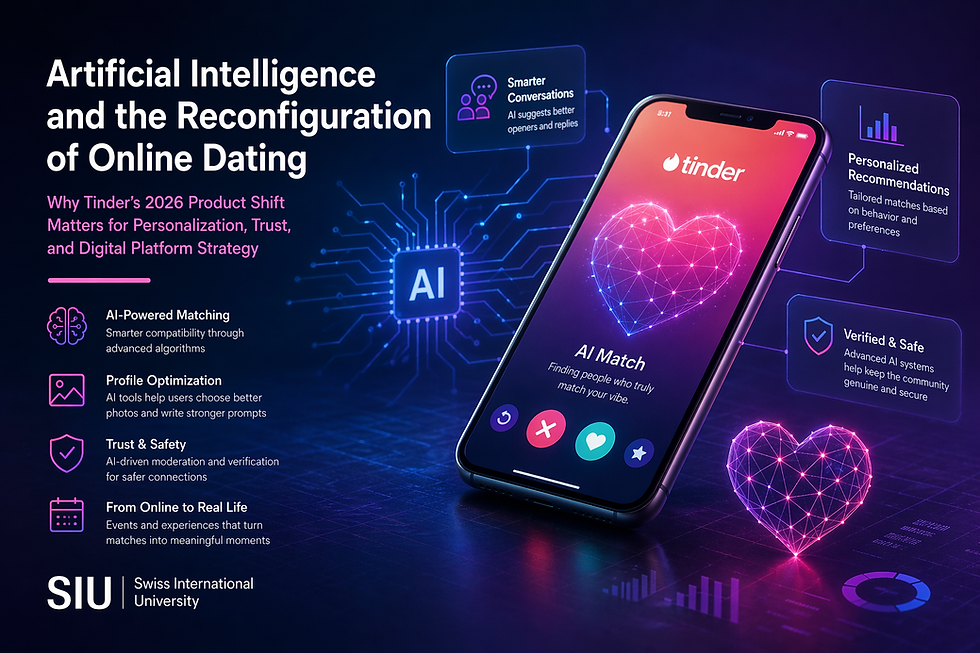
Artificial Intelligence and the Reconfiguration of Online Dating: Why Tinder’s 2026 Product Shift Matters for Personalization, Trust, and Digital Platform Strategy
In the last month, one of the clearest technology trends in consumer platforms has been the deeper integration of artificial intelligence into social discovery and online dating. Tinder’s March 2026 product announcements signaled that AI is no longer a side feature in dating platforms. It is becoming part of the core product logic. The company presented AI-powered matching, new interaction modes, stronger trust infrastructure, and expanded tools that connect online discovery with real-world meetings. These developments matter beyond dating. They show how digital platforms are moving from simple choice architecture toward guided, contextual, and behavior-informed user experiences. At the same time, they raise important questions about authenticity, privacy, emotional labor, algorithmic influence, and the future of platform management.
This article examines the recent trend through an academic but accessible lens. It argues that AI in dating is not only a technical upgrade. It is a managerial and social redesign of how people are introduced, how attention is structured, how trust is built, and how user value is created. Tinder’s move is especially important because it combines personalization tools with product strategy, safety systems, and efforts to respond to market fatigue among younger users. When read alongside broader industry developments at Bumble, Grindr, and Hinge, the case suggests that AI is becoming central to competition in relationship platforms. The article also evaluates the ethical and operational risks of this transition, including privacy concerns, bias, over-automation, and the tension between efficiency and genuine human connection.
1. Introduction
Digital dating platforms have shaped modern social behavior for more than a decade, but the sector now appears to be entering a new phase. Earlier generations of apps focused on scale, fast sign-up, visual browsing, and swipe-based decision-making. That design logic was successful because it reduced friction. It made meeting new people fast, mobile, and highly repeatable. Yet over time, the same design also created user fatigue. Many users, especially younger ones, began to report frustration with repetitive swiping, unclear intentions, superficial profiles, and conversations that did not move toward meaningful outcomes. Reuters recently summarized this pressure clearly, noting that dating apps face slowing growth, changing expectations, and a difficult business incentive in which successful matching can reduce long-term platform use.
Against that background, AI has become attractive not only as a technical solution but as a strategic narrative. Platforms can now present themselves as more helpful, more selective, more intentional, and more personalized. In March 2026, Tinder used its inaugural product keynote to announce updates that included AI-powered matching, new modes, real-life and virtual events, and stronger trust infrastructure. This was not a minor interface refresh. It was a statement that the future of dating apps may depend on making digital connection feel more guided and more human, even while the system itself becomes more algorithmic.
This shift matters for several academic fields. In technology studies, it illustrates the move from recommendation systems to relational mediation. In management, it shows how mature digital platforms attempt strategic renewal when user growth becomes harder to sustain. In consumer behavior, it demonstrates the growing demand for platforms that reduce decision overload and support clearer self-presentation. In ethics and governance, it raises questions about how much influence AI should have over highly personal choices. The subject is therefore timely, multidisciplinary, and relevant to a university audience interested in management, digital transformation, platform strategy, and applied AI.
The central argument of this article is that AI in dating platforms is best understood as a shift from passive infrastructure to active mediation. Traditional platforms mainly hosted profiles and enabled filtering. AI-driven platforms increasingly shape how profiles are built, how attention is directed, how compatibility is estimated, and how trust signals are interpreted. This creates opportunities for better user experiences, but it also gives platforms more power over emotional and social outcomes. That balance deserves careful academic attention.
2. Why This Trend Became Important Now
The recent acceleration of AI in dating did not happen in isolation. It emerged from a combination of market pressure, user dissatisfaction, and technical capability. The market pressure is visible across the sector. Reuters reported in March 2026 that Bumble was promoting an AI-driven overhaul to regain younger users, with a stronger emphasis on profile depth and even experiments beyond the classic swipe model. Around the same period, Reuters also reported that Grindr was investing heavily in AI-powered features such as chat summaries, personalized recommendations, and profile discovery. These cases suggest that AI is not a niche experiment. It is increasingly a competitive requirement in the dating platform economy.
User dissatisfaction is the second driver. Swiping was initially successful because it simplified interaction. Over time, however, simplification created its own problems. Too many options can reduce satisfaction, weaken commitment, and encourage endless browsing. Users may feel visible but not understood. They may also feel that success depends too heavily on a small number of photos or on quick judgments made without context. This is where AI becomes strategically useful. It promises to reduce noise, improve relevance, and help users present themselves more effectively.
Technical capability is the third driver. AI systems have become much better at pattern recognition, language support, image selection, moderation, fraud detection, and recommendation design. In the dating context, this means that AI can support multiple layers of the experience: choosing profile pictures, improving written prompts, suggesting better matches, detecting harmful behavior, and helping users move from digital chat to offline interaction. Tinder’s Photo Selector, announced earlier as an AI-powered tool to help users choose profile pictures from images on their devices, already showed this direction. What changed in 2026 is that Tinder linked AI to its wider product architecture rather than treating it as a single isolated feature.
There is also a cultural reason. Many users increasingly say they want intentional dating rather than endless activity. In that environment, AI can be marketed not as entertainment but as assistance. Hinge, for example, introduced AI-powered Prompt Feedback in 2025 to help users create more authentic and specific profiles. The language used there is important. The goal was not only optimization; it was clearer self-expression and more meaningful first impressions. This change in tone matters because it frames AI as a support layer for authenticity, even though authenticity itself becomes partly shaped by machine guidance.
3. Tinder’s Recent Product Shift as a Strategic Case
Tinder’s March 2026 keynote deserves attention because it gathered several previously separate themes into one strategic message. According to Tinder’s official announcement, the company introduced AI-powered matching, new interaction modes, events that connect users online and offline, and a stronger trust infrastructure. In management terms, this is a platform redesign aimed at repositioning the service from high-volume browsing toward more guided discovery. It suggests that the company sees the future not in simply giving users more profiles, but in helping them navigate choice better.
This distinction is important. Digital platforms often compete on scale, speed, and engagement. But in mature categories, those dimensions become less persuasive when users begin to feel overwhelmed. The more difficult challenge is to improve decision quality. AI-powered matching addresses this by implying a more selective process. Rather than leaving users alone with an endless queue of profiles, the platform can claim to surface more relevant people. That claim has both commercial and symbolic value. Commercially, it may increase engagement quality and user satisfaction. Symbolically, it helps the brand say that it understands the user’s actual goals.
Tinder’s move also reflects a broader strategic shift from static identity to dynamic identity. In older models, users created a profile and then entered a relatively fixed environment. In AI-enhanced models, the platform can treat user identity as something inferred continuously from behavior, preferences, response patterns, images, conversation habits, and trust signals. This can make recommendations more adaptive, but it also means the system is constantly learning from highly personal data. That dual nature is central to the present debate.
The company’s inclusion of events and real-life connection tools is equally significant. It suggests that dating apps are responding to criticism that they keep people inside digital loops rather than helping them reach actual social outcomes. If AI can help move users from uncertain matching to more intentional meetings, then the platform is not only a discovery engine but a coordinator of transition from online to offline life. In this sense, Tinder’s strategy is not just about better recommendation. It is about claiming relevance across the whole journey of connection.
4. Personalization: The Main Promise of AI in Dating
The strongest promise behind AI in dating is personalization. Personalization in this context means more than recommending similar profiles. It includes helping users show themselves more effectively, filtering out low-value interactions, and creating a smoother path from profile creation to meaningful conversation. Tinder’s Photo Selector is a useful example because it addresses a simple but important pain point: many users do not know which pictures communicate them best. By using AI to identify suitable profile images, the platform reduces uncertainty and increases the chance that a user’s first impression is aligned with platform norms and likely match preferences.
This may look minor, but it reflects a larger product philosophy. The modern platform does not wait for the user to perform perfectly. It offers coaching, curation, and prediction. Hinge’s Prompt Feedback shows the same logic in text form. The feature provides personalized nudges so that users can write profile responses that express personality, interests, and intentions more clearly. The company described the goal as helping users create meaningful first impressions and improving the quality of compatibility discovery. In other words, AI is being used not only to match people after profiles exist, but to improve the quality of the raw material that matching systems evaluate.
From an academic perspective, this is a major development. It means AI is involved in both representation and selection. The platform helps users present themselves, then uses platform data to decide who sees whom, and in what sequence. This creates a feedback loop. Better self-presentation can improve matching outcomes; matching outcomes then feed future recommendations. Over time, the platform becomes a co-author of social identity in digital space.
The managerial value of this approach is clear. Better personalization can reduce frustration, increase perceived usefulness, and create differentiation in a crowded market. Yet its risks are equally clear. Personalization systems may favor conventional attractiveness patterns, socially dominant communication styles, or behaviors that optimize platform response rather than genuine self-expression. Users may begin to shape themselves for algorithmic visibility. That can improve short-term performance while weakening authenticity.
This is why personalization should not be understood as a neutral good. It is a negotiated process between user intention and platform logic. The more powerful the platform becomes, the more important transparency becomes. Users should understand whether AI is helping them communicate more clearly, or quietly teaching them to become the kind of user the system rewards.
5. The Management Logic Behind the AI Turn
From a management and business strategy perspective, AI in dating platforms is a response to a mature-market problem. When a platform category reaches saturation, growth becomes harder, acquisition costs increase, and user expectations rise. At that stage, firms need renewal strategies. Reuters’ March 2026 reporting on Bumble described how its AI-driven reboot was aimed at re-engaging younger users and moving beyond swiping fatigue. Reuters’ February 2026 reporting on Grindr showed a similar logic, with AI used to improve engagement and support premium service differentiation. These are not isolated cases. They reflect an industry-wide search for new value propositions.
AI supports this renewal in at least four managerial ways.
First, it improves perceived product intelligence. Users are more likely to value a platform that feels responsive and helpful rather than mechanical.
Second, it supports segmentation. Different user groups may want different styles of matching, conversation support, safety features, or interaction depth. AI can make these experiences more flexible.
Third, it strengthens monetization potential. Premium tiers can include advanced discovery tools, coaching, summaries, and enhanced filtering. Grindr’s AI-powered subscription offering is an example of how AI becomes part of pricing strategy as well as product design.
Fourth, it helps firms reposition their brands. Instead of being seen as places for endless browsing, they can be presented as partners in more intentional connection. That repositioning is strategically valuable because it addresses a major reputational problem in the category.
However, the management logic is not entirely aligned with user welfare. Reuters noted the structural tension in dating apps: a successful match may mean losing two active users. That tension has always existed, but AI may intensify it in new ways. Platforms can use AI either to improve outcomes or to optimize engagement without fully solving the user’s deeper problem. This makes governance essential. The question is not whether AI increases efficiency. The question is what kind of efficiency it increases, and for whom.
6. Trust, Safety, and the New Governance Challenge
No serious academic discussion of AI in dating can ignore trust and safety. Dating platforms are unusually sensitive digital spaces because they combine identity, emotion, privacy, vulnerability, and offline risk. As AI expands, safety becomes both more important and more complex.
Tinder’s March 2026 announcement explicitly connected product evolution to stronger trust infrastructure. Hinge’s 2026 safety communication also emphasized fairness, transparency, anti-harassment tools, and a mix of AI systems with human review. Hinge stated that it was expanding AI-powered moderation functions and moving toward stronger verification tools, including liveness-related checks. These developments show that AI in dating is not only about recommendation. It is also about screening, moderation, verification, and behavioral governance.
This is necessary because digital intimacy attracts misuse. Reuters reported in February 2026 that OpenAI had identified misuse of ChatGPT in a dating scam targeting victims in Indonesia, illustrating how AI can also be used by bad actors to manipulate trust at scale. In April 2026, Reuters also reported that Clarifai had deleted millions of OkCupid user photos and related facial-recognition models after scrutiny tied to privacy violations. Together, these cases show two core risks: generative AI can support fraud, and historical data practices can undermine trust if users feel their personal information is exploited beyond expected boundaries.
The governance challenge is therefore double. Platforms must use AI to detect harm, while also preventing AI from becoming a source of harm. That means they need clearer standards in at least five areas: consent, transparency, reviewability, proportionality, and accountability. Users should know what data is being used, what the AI is doing, what kind of human oversight exists, how errors can be appealed, and what safeguards limit intrusive inference.
The difficulty is that many safety systems remain invisible. If they work, users do not always notice them. Yet in personal platforms, visible safety can strengthen trust. Hinge’s language on fairness and transparency is important here because it suggests that safety should not only be technically present; it should be understandable. In the coming years, successful platforms may be those that combine smart automation with credible explanations.
7. Authenticity and the Paradox of Assisted Intimacy
One of the deepest questions in AI-enabled dating is whether assistance improves authenticity or weakens it. This is not a simple question. On one hand, many users struggle to describe themselves well, select the right photos, or start meaningful conversations. AI can reduce anxiety, help with clarity, and improve confidence. On the other hand, if a profile, message style, or social rhythm is too strongly shaped by machine suggestions, the result may become polished but less real.
Hinge’s framing of AI as coaching is one answer to this problem. The platform presents AI as a tool to help users express their actual personality and intentions more clearly, rather than inventing a better version of themselves. This is a constructive model. Yet it depends on how the tools are designed and how users apply them. There is a difference between support for self-expression and optimization for approval.
The phrase “assisted intimacy” is useful here. It describes a condition in which human connection is still the goal, but part of the relational process is guided by software. The assistance may be helpful, but it changes the meaning of spontaneity. If users rely on AI to choose their best images, refine their profile language, summarize chats, identify promising leads, and warn them about risky behavior, then the platform becomes a hidden participant in the relationship journey. That does not mean the connection is false. But it does mean the connection is no longer purely unmediated.
From a social science viewpoint, this may produce mixed outcomes. Some people may find better matches because they can finally present themselves clearly. Others may experience a gap between digital impression and real-life interaction. The risk is not only deception in the traditional sense. It is also over-curation. A person may appear highly compatible in machine-shaped space while feeling less coherent in direct human encounter.
This paradox should not lead to simple rejection of AI in dating. Rather, it suggests a design principle: AI should increase user clarity without replacing user voice. The best systems may be those that encourage reflection, specificity, and safety while leaving room for human imperfection. In personal relationships, imperfection is not always a flaw. It is often part of credibility.
8. Privacy, Data, and Ethical Limits
Privacy is likely to become one of the most contested issues in the AI dating economy. Personalized matchmaking depends on data. But the more intimate the platform, the more sensitive the data becomes. Dating platforms do not only process age and location. They may process photographs, conversation patterns, preferences, behavioral timing, inferred intentions, and signals linked to emotional vulnerability.
The recent Reuters report on deleted OkCupid user photos is a reminder that trust can be damaged when personal data moves beyond what users reasonably expected. In the AI era, this challenge grows because model training can involve large-scale image and text analysis. Even when current tools are user-facing and helpful, public confidence depends on whether the underlying data practices appear ethical and limited.
Several ethical questions follow. Should users be allowed to opt out of certain forms of AI profiling? Should platforms clearly separate features that use on-device selection from those that involve cloud-based inference? Should historical user content be available for model training? Should highly sensitive inference, such as emotional state or sexual intent prediction, be restricted? These questions are not abstract. They affect how platforms maintain legitimacy.
For management teams, privacy is no longer a compliance issue alone. It is a strategic trust asset. In a category built on vulnerability, the cost of mistrust can be severe. Users may tolerate recommendations they do not fully understand, but they are less likely to tolerate personal data practices that feel excessive, hidden, or irreversible. This means the next stage of AI deployment in dating should be governed not only by technical feasibility, but by a clear principle of minimal necessary intrusion.
9. Implications for Technology, Management, and Higher Education
The AI shift in dating platforms offers useful lessons beyond the dating sector. For technology management, it shows how firms in mature digital markets attempt reinvention by moving from generic interaction to guided experience. For platform strategy, it illustrates that future competition may depend less on scale alone and more on quality of mediation. For consumer psychology, it shows how people increasingly value systems that reduce effort while preserving dignity and agency.
For management education, this case is especially rich. It combines digital transformation, data ethics, business model innovation, product design, and trust governance in one setting. Students studying management, technology, tourism, marketing, or digital business can learn from it because the same patterns appear across many industries. Travel platforms, for example, also rely on recommendation systems, identity signals, trust mechanisms, and the transition from online browsing to real-world experience. In that sense, AI in dating is not a marginal topic. It is a concentrated example of how AI changes service design more broadly.
For Swiss International University (SIU), the value of discussing this trend lies in its interdisciplinary relevance. The topic sits at the intersection of applied technology, strategic management, digital consumer behavior, and ethics. It also offers a practical case of how organizations respond when user expectations evolve faster than legacy interface models.
10. Conclusion
The most important lesson from the last month’s developments is that AI in dating platforms is becoming structural, not decorative. Tinder’s March 2026 product shift showed that AI now touches matching, profile construction, interaction design, trust infrastructure, and the transition toward offline connection. Similar moves by Bumble, Grindr, and Hinge indicate that the sector is entering a new competitive phase in which personalization, safety, and guided relevance are central.
This change has genuine promise. It may reduce choice overload, improve self-presentation, support more intentional interaction, and help platforms respond to user fatigue. But it also increases platform power over intimate life. When AI guides how people present themselves, who they see, what feels safe, and how they interpret compatibility, it becomes part of the social architecture of connection.
The future success of these systems will therefore depend on balance. Platforms must make experiences more useful without making users feel manipulated. They must personalize without overreaching. They must automate without erasing human judgment. They must enhance authenticity without manufacturing it. The leading question is no longer whether AI belongs in dating. It already does. The real question is whether platform designers and managers can use it in ways that respect the complexity of human relationships.
If they can, AI may help dating platforms move from volume-driven attention systems toward more thoughtful and trustworthy relational ecosystems. If they cannot, the same tools may deepen fatigue, mistrust, and emotional distance. For scholars, managers, and educators, this is exactly why the subject deserves close attention now.
#Hashtag #ArtificialIntelligence #DigitalTransformation #PlatformStrategy #OnlineDating #SwissInternationalUniversity
Sources used in preparing this article:
Tinder Newsroom — Tinder Debuts Inaugural Product Keynote Tinder Sparks 2026: Start Something New
Tinder Newsroom — Tinder Unveils Photo Selector AI: Feature to Make Choosing Profile Pictures Easier
Reuters — Bumble shares surge as investors swipe right on AI-powered reboot
Reuters — LGBTQ+ dating app Grindr beats revenue estimates, bets on AI to drive growth
Reuters — Dating apps podcast/report on industry incentives and AI
Hinge Newsroom — Hinge Launches Prompt Feedback to Help Daters Create Unique and Authentic Profiles
Hinge Newsroom — Safer Internet Day 2026: Building Trust Through Fairness and Transparency
Reuters — report on AI-enabled dating scam misuse
Reuters — report on deletion of OkCupid user photos and trained models after FTC scrutiny


Comments