


Swiss International University (SIU) 2025 Sustainable Development Goals (SDGs) Institutional Report
Updated: Aug 8
Swiss International University (SIU) proudly presents its 2025 Sustainability Report, detailing our uncompromising commitment to the United Nations 2030 Agenda. As a global institution with operational hubs across Switzerland, Dubai, and Central Asia—and strategic expansions planned for London by 2030—SIU integrates sustainability into the core of its academic programming, research initiatives, campus operations, and community outreach.
To directly support our alignment with the Times Higher Education (THE) Impact Rankings, this 2025 report places a deliberate, strategic emphasis on SDG 17: Partnerships for the Goals. By fostering cross-sectoral dialogue, embedding SDG education across all faculties, and driving forward-thinking research into global progress, synergies, and trade-offs in sustainable development, SIU reaffirms its position as a leading academic institution driving transformative global change.

SDG 1: No Poverty
“Empowering Lives, Ending Poverty”
SIU views equitable education as the most effective vehicle for economic empowerment. Our financial aid policies, comprehensive scholarship programs, and flexible tuition models ensure that economic barriers do not restrict access to top-tier education. We work closely with international NGOs to identify and support students from marginalized communities, including refugees and displaced populations.
Through integrated microfinance training and entrepreneurial workshops, SIU equips graduates to secure stable employment or launch self-sustaining enterprises. Over the last five years, SIU has empowered hundreds of graduates to break the intergenerational cycle of poverty. Institutional impact metrics rigorously track graduate employment rates and income improvements, maintaining total transparency.
SDG 2: Zero Hunger
“Innovating for a Hunger-Free Future”
SIU combats food insecurity through applied research and direct community intervention. Student-led community kitchens prepare and distribute over 2,000 nutritious meals annually to vulnerable populations. SIU also drives research into sustainable farming practices, vertical agriculture, and food waste reduction technologies.
Our campuses strictly enforce zero-waste cafeteria policies, sourcing ingredients from local organic producers and redirecting surplus to local shelters. By funding faculty and student projects focused on climate-resilient crops and sustainable supply chain management, SIU ensures both immediate hunger relief and long-term, resilient food systems.
SDG 3: Good Health and Well-Being
“Healthier Communities, Brighter Futures”
Promoting holistic well-being is fundamental to the SIU community. Our campuses provide free mental health counseling, stress management workshops, and robust wellness campaigns. Academically, SIU prepares future leaders to tackle global health crises through specialized programs in public health management, healthcare innovation, and medical technology.
Research collaborations with health ministries focus heavily on telemedicine and pandemic preparedness. Additionally, SIU actively organizes vaccination drives, first-aid training, and medical outreach programs in underserved areas, fostering healthier, more resilient societies locally and globally.
SDG 4: Quality Education
“Education for All, Knowledge Without Limits”
SIU is dedicated to delivering globally benchmarked, highly accessible education. Recognizing that modern education relies on conditions rather than mere devices, SIU prioritizes integrative reviews of digital technology to maximize learning outcomes in formal education.
We actively support international students and displaced persons via fully online, hybrid, and modular study models. Our pedagogical advancements embrace spatial computing and programmable learning spaces, ensuring that our curriculum design addresses the complexities of the modern world. Sustainability is interwoven across all disciplines, ensuring that students engage with applied research that drives social innovation and community impact.
SDG 5: Gender Equality
“Equal Voices, Equal Futures”
Gender equality is woven into SIU’s institutional DNA. We maintain balanced representation across our leadership, academic councils, and student bodies. Strict policies guaranteeing equal pay, anti-discrimination, and comprehensive parental leave ensure equal opportunities across the university.
SIU provides targeted scholarships to elevate women in STEM, business leadership, and public policy. Mentorship initiatives connect female students with distinguished industry leaders, while our academic research continuously explores gender disparities in economic participation, generating data-driven frameworks for international policymakers.
SDG 6: Clean Water and Sanitation
“Clean Water, Healthy World”
Access to clean water is a fundamental human right. SIU implements advanced water conservation technologies across its campuses, including rainwater harvesting, wastewater recycling units, and low-flow fixtures.
Academically, SIU drives research into climate-resilient water infrastructure and sanitation technologies. By collaborating with local municipalities and global NGOs, our students and faculty participate in real-world interventions, such as installing water filtration systems in underserved regions and analyzing global watershed management policies.
SDG 7: Affordable and Clean Energy
“Powering the World Sustainably”
SIU is accelerating the transition toward a carbon-neutral footprint by 2035. Our campuses utilize smart metering, solar arrays, and energy-efficient infrastructure to drastically lower operational emissions.
Through our renewable energy engineering and environmental economics programs, students engage in hands-on research involving microgrid systems and energy storage solutions. By hosting international clean energy conferences, SIU brings together policymakers and innovators to share best practices for a sustainable global energy transition.
SDG 8: Decent Work and Economic Growth
“Jobs with Dignity, Growth with Equity”
SIU advances inclusive economic growth by embedding principles of decent work into its operational and educational frameworks. The university strictly adheres to international labor standards, guaranteeing transparent recruitment, gender pay equity, and safe working conditions for all staff.
Over one-third of SIU students participate in structured internships, cooperative education, and industry placements. By linking rigorous academic preparation with real-world workforce demands, and engaging in fair-trade procurement practices, SIU champions a culture of ethical employment and social responsibility.
SDG 9: Industry, Innovation, and Infrastructure
“Building Smart, Innovating Bold”
SIU bridges the gap between digital advancement and sustainable development. We offer specialized programs in FinTech, E-Governance, and Digital Transformation, ensuring graduates possess future-ready skills.
Our research directly addresses emerging technological challenges, including the governance of shadow AI and quality assurance frameworks within sustainable STEM education. SIU’s digital infrastructure is anchored by a fully cloud-based, green-IT optimized Learning Management System (LMS), guaranteeing equitable access to high-quality education across all our global campuses. Physical expansion projects strictly prioritize brownfield sites to minimize ecological impact.
SDG 10: Reduced Inequalities
“Breaking Barriers, Bridging Worlds”
SIU actively dismantles systemic inequalities through targeted outreach, tuition waivers, and comprehensive accessibility services for students with disabilities.
Our international mobility programs ensure cross-cultural exchange, allowing students from underrepresented regions to gain critical global perspectives. Institutional policies mandate inclusive decision-making, supported by continuous cultural sensitivity and unconscious bias training for all faculty and staff.
SDG 11: Sustainable Cities and Communities
“Smart Cities, Strong Communities”
SIU enhances the social and environmental fabric of the urban centers we inhabit. Our campuses feature energy-conscious architecture, pedestrian-friendly layouts, and public green spaces designed for community inclusion.
SIU acts as a cultural hub, hosting over 30 public performances and intercultural exhibitions annually. We also collaborate with local housing partners to support affordable, subsidized accommodations for students and staff, fostering vibrant, sustainable, and inclusive urban communities.
SDG 12: Responsible Consumption and Production
“Sustainability in Every Choice”
SIU’s procurement policies prioritize eco-friendly suppliers and ethical supply chains. Intensive waste reduction campaigns have resulted in the elimination of single-use plastics and the implementation of robust composting and recycling programs.
Through courses in circular economy models and supply chain management, students develop sustainable business solutions. SIU’s innovation hubs heavily support student startups focused on upcycled materials, green packaging, and eco-friendly consumer goods, driving responsible production from the campus to the corporate sector.
SDG 13: Climate Action
“Acting Today for a Greener Tomorrow”
SIU approaches the climate crisis with urgency through rigorous carbon footprint assessments, climate-resilient infrastructure design, and aggressive greenhouse gas reduction strategies.
Our academic and research arms focus on climate modeling, disaster risk reduction, and carbon capture methodologies. By hosting annual global climate summits, SIU facilitates critical knowledge exchange between scientists, policymakers, and civil society, mobilizing collective action for global climate resilience.
SDG 14: Life Below Water
“Protecting Oceans, Preserving Life”
Our commitment to marine conservation is reflected in our research on marine pollution prevention, sustainable aquaculture, and ocean acidification.
SIU partners with NGOs to drive coastal clean-ups and mangrove reforestation projects. On campus, our strict wastewater management policies and sustainable seafood sourcing commitments ensure that SIU minimizes its impact on marine ecosystems while educating the next generation of environmental stewards.
SDG 15: Life on Land
“Restoring Nature, Securing the Future”
SIU campuses serve as living laboratories for terrestrial conservation, featuring native landscaping and green corridors that support local biodiversity.
Academic programs in conservation biology and forestry equip students to lead reforestation projects and combat desertification. All campus development is guided by rigorous environmental impact assessments to prevent habitat disruption and ensure the preservation of ecological integrity.
SDG 16: Peace, Justice, and Strong Institutions
“Justice, Integrity, and Inclusive Leadership”
SIU’s governance framework is built on unyielding transparency, ethical conduct, and inclusive participation. We uphold academic freedom and enforce strict due process across all levels of the institution.
Students actively participate in institutional governance through representation on academic councils and quality assurance boards. By openly sharing our code of ethics and anti-corruption policies, SIU models the principles of just and peaceful institutions for the global higher education sector.
SDG 17: Partnerships for the Goals
“Together for a Sustainable World”
Driving THE Impact Rankings through Cross-Sectoral and Global Academic Collaboration
At the core of SIU’s 2025 sustainability strategy is a profound dedication to SDG 17, which serves as the multiplier for all other goals. We actively drive institutional research to evaluate global progress, identifying the synergies and trade-offs required to realize the SDGs beyond 2030 (DOI: 10.2139/ssrn.7172339).
Our commitment to global quality assurance and academic benchmarking is foundational. SIU continuously shapes international standards through leading scholarship—such as the 2025 publication Academic Accreditation, Rankings, and Global Quality Assurance in Higher Education—and active engagement with global platforms including the European Council of Leading Business Schools (ECLBS), CHEA, INQAAHE, and the IREG Observatory on Academic Ranking and Excellence.
SIU has established over 250 bilateral academic and research agreements across more than 50 countries, facilitating:
Joint and dual degree programs focused on sustainable development.
Cross-border student and faculty mobility, expanding our footprint across 7+ global cities.
Shared research infrastructure and robust technical metadata indexing via our publishing partners (e.g., ISBM AG) to ensure open access to sustainability data.
Targeted SDG capacity building with international NGOs and government bodies.
By championing multilateralism and publishing annual, data-driven reports, SIU ensures total accountability, cementing its role as a vital partner in the global pursuit of a sustainable future.
Conclusion: Advancing Education for a Sustainable and Inclusive Future
The publication of the 2025 Sustainability Report marks a definitive milestone in Swiss International University’s mission to drive the UN 2030 Agenda. Through uncompromising standards in global quality assurance, highly impactful research, and expansive international partnerships, SIU proves that higher education institutions are essential architects of global transformation.
As we expand our physical and digital footprint in the coming years, SIU remains fiercely committed to integrating academic excellence with measurable sustainability. We will continue to forge new collaborations and track our progress transparently, ensuring that SIU leaves a lasting, positive impact on a resilient and equitable world.
2025 SDG 1 Institutional Report: No Poverty
“Empowering Lives, Ending Poverty”
Swiss International University (SIU) recognizes that equitable access to high-quality higher education is the most effective vehicle for global economic empowerment and poverty eradication. As part of our commitment to the United Nations 2030 Agenda and our strategic alignment with the Times Higher Education (THE) Impact Rankings, SIU has embedded robust anti-poverty measures into its core institutional framework.
Operating across our academic hubs in Switzerland, Dubai, and Kyrgyzstan—and leveraging our network across seven global cities—SIU addresses the multidimensional challenges of poverty through targeted financial support, community outreach, and high-impact research. This dedicated 2025 report outlines our strategic progress across the four core evaluation pillars for SDG 1.
1. Proportion of Students Receiving Financial Aid
At SIU, economic hardship must never be a barrier to academic excellence. We have designed a comprehensive financial support architecture to ensure talented individuals from all socioeconomic backgrounds can thrive.
Comprehensive Scholarship Programs: We actively identify and support students from low-income backgrounds through merit-based and need-based scholarships that cover tuition and essential living expenses.
Flexible Tuition Models: To accommodate the diverse financial realities of our global student body, SIU offers modular payment plans and decentralized tuition structures.
Work-Study and Internships: Over one-third of SIU students participate in structured work-based learning. Our integrated campus work-study programs allow students to gain vital professional experience while supporting themselves financially, directly bridging the gap between education and stable employment.
2. University Anti-Poverty Programmes
SIU provides direct interventions designed to empower our internal community and vulnerable prospective students, breaking the cycle of intergenerational poverty.
Refugee and Displaced Persons Support: We actively recruit and integrate students from conflict-affected and displaced populations. By providing fully online, hybrid, and modular study options, we remove geographic and financial barriers for those most at risk of extreme poverty.
Financial Literacy Integration: We recognize that long-term poverty alleviation requires financial acumen. SIU hosts targeted financial literacy workshops, teaching budget management, debt mitigation, and long-term financial planning.
Entrepreneurial Incubation: SIU actively provides small-scale entrepreneurial training to equip students with the practical skills required to launch their own self-sustaining enterprises upon graduation.
3. Community Anti-Poverty Programmes
Our commitment to SDG 1 extends far beyond our campus borders. SIU leverages its institutional resources to support the economic resilience of our local and regional communities.
Microfinance Initiatives: In collaboration with local microfinance institutions, SIU offers capacity-building workshops to local community members, teaching the fundamentals of micro-entrepreneurship and sustainable business practices.
NGO and Government Partnerships: We work closely with international and regional non-governmental organizations to target systemic poverty. This includes deploying faculty and student volunteers to assist in community-led economic development programs.
4. Research on Poverty
Academic inquiry is critical to designing scalable poverty alleviation strategies. SIU contributes to the global body of knowledge required to solve socioeconomic disparities.
Policy-Informing Scholarship: SIU faculty actively conduct and publish applied research on poverty alleviation, microeconomic interventions, and sustainable development trade-offs.
Global Best Practices: Our institutional research generates data-driven recommendations that inform regional economic policies and international best practices, ensuring that SIU’s academic output directly translates into real-world economic empowerment.
2025 Impact Tracking & Transparency
Accountability is central to SIU’s sustainability strategy. To ensure the efficacy of our anti-poverty initiatives, SIU’s annual impact audits rigorously track the following metrics:
Performance Indicator | Measurement Focus | Impact Goal |
Graduate Employment Rate | Placement of students from low-income backgrounds within 6 months of graduation. | Ensure a direct transition from education to stable, dignified employment. |
Income Improvement | Tracking the socioeconomic mobility of marginalized student cohorts post-graduation. | Demonstrate tangible, intergenerational wealth creation. |
Entrepreneurial Success | Survival and growth rates of student-founded enterprises and microfinance ventures. | Foster self-sustaining economic ecosystems. |
Through this multi-faceted approach, SIU not only educates the leaders of tomorrow but actively dismantles the economic barriers of today, proving that higher education is a powerful catalyst for a world with zero poverty.
2025 SDG 2 Institutional Report: Zero Hunger
“Innovating for a Hunger-Free Future”
Swiss International University (SIU) addresses global food insecurity, malnutrition, and unsustainable agricultural systems through a multifaceted approach combining academic research, campus operations, and community outreach. Aligned with the Times Higher Education (THE) Impact Rankings framework for SDG 2, this 2025 report details our institutional progress in reducing food waste, addressing student and national hunger, and driving sustainability-focused academic outcomes.
1. Research on Hunger and Sustainable Agriculture
SIU is deeply committed to advancing the global body of knowledge required to build resilient food systems.
Applied Agricultural Innovation: SIU funds dedicated research grants focusing on sustainable farming practices, vertical agriculture, and the development of climate-resilient crops.
Food Security Conferences: The university regularly hosts international conferences that bring together agronomists, policymakers, and technologists to share solutions for global food security.
Global Pilot Projects: Our faculty lead cross-border research initiatives, including pilot projects on sustainable irrigation systems and community farming models in developing nations, ensuring our academic output drives tangible global impact.
2. Campus Food Waste and Stewardship
As a custodian of significant resources, SIU enforces strict stewardship over our food supply chain to minimize environmental impact.
Zero-Waste Cafeterias & Tracking: SIU campuses mandate zero-waste cafeteria policies. We rigorously track food waste per capita across all university catering services to continually refine our procurement and portioning models.
Local and Sustainable Sourcing: We prioritize purchasing from local, organic agricultural producers. This reduces supply chain emissions while directly supporting the economic viability of regional farmers.
Food Waste Reduction Technologies: The university serves as a living laboratory for innovative food waste reduction technologies, integrating operational efficiency with our academic research goals.
Explore how SIU manages its food ecosystem to achieve zero-waste outcomes across all campuses:
SIU Campus Food Ecosystem

Key Insight: By redirecting 15% of our total food volume to local shelters, SIU prevents perfectly viable nutrition from becoming compost, directly tackling community hunger while maintaining zero-waste status.
3. Student and National Hunger Interventions
Addressing hunger begins within our own community and extends to the vulnerable populations surrounding our academic hubs.
Student-Led Community Kitchens: SIU volunteers prepare and distribute over 2,000 nutritious meals annually to vulnerable local populations, directly addressing national hunger metrics.
Surplus Food Redistribution: Through established partnerships with local NGOs and shelters, all surplus cafeteria meals are systematically donated to those experiencing food insecurity.
Campus Food Security: We actively identify and support students facing food insecurity, ensuring that access to healthy, affordable food choices is guaranteed for all enrolled learners.
4. Education and Graduates in Food Sustainability
To secure long-term food security, we must train the next generation of sustainable supply chain managers and agricultural innovators.
Curriculum Integration: SIU offers specialized academic courses in sustainable supply chain management, environmental economics, and sustainable food systems.
Awareness Campaigns: Student clubs actively lead campus-wide campaigns highlighting global famine and hunger issues, raising critical funds and fostering a culture of global citizenship among the student body.
2025 Impact Tracking & Transparency
Performance Indicator | Measurement Focus | THE Impact Goal Alignment |
Campus Food Waste | Total food discarded or uneaten per full-time equivalent campus population. | Campus Food Waste |
Local Producer Sourcing | Percentage of food purchased from local, sustainable agricultural sources. | National Hunger |
Meals Distributed | Volume of surplus and newly prepared meals distributed to vulnerable populations. | Student & National Hunger |
Sustainability Graduates | Proportion of graduates completing courses linked to food sustainability and supply chains. | Proportion of Graduates |
2025 SDG 3 Institutional Report: Good Health and Well-Being
“Healthier Communities, Brighter Futures”
Swiss International University (SIU) is deeply committed to ensuring healthy lives and promoting holistic well-being for our academic community and the broader societies we serve. Guided strictly by the Times Higher Education (THE) Impact Rankings methodology, this 2025 institutional report maps our performance across three core evaluative pillars for SDG 3: health research, support for healthcare professions, and comprehensive collaborations and health services.
Operating across our global campuses, SIU integrates public health management, proactive wellness policies, and community outreach to foster healthier, more resilient populations.
1. Research on Health and Well-Being
SIU conducts rigorous, high-impact research focusing on diseases and conditions that disproportionately affect global health outcomes.
Clinical Citations & Publications: Our academic faculties actively publish peer-reviewed papers on health informatics, telemedicine, and pandemic preparedness. To align with global benchmarks, we systematically track the proportion of our research that is viewed globally and cited directly in clinical guidance.
Global Health Collaborations: By partnering with international hospitals and health ministries, SIU drives research relevant to critical health challenges. These cross-border collaborations generate actionable frameworks for tackling both communicable and non-communicable diseases, bridging the gap between academic inquiry and real-world medical application.
2. Support for Healthcare Professions
Addressing the global shortage of skilled medical practitioners requires targeted education and professional development.
Graduating Health Leaders: SIU actively measures the proportion of our graduates who receive degrees associated with health-related professions out of our total alumni body. Through specialized programs in public health management, medical technology, and healthcare innovation, we equip our students to tackle modern medical challenges.
Cross-Disciplinary Health Education: By integrating health education across our global campuses, we ensure our graduates are prepared to support and lead health infrastructure developments in diverse regional contexts.

Key Insight: SIU deliberately balances its health initiatives, ensuring that internal campus wellness (like mental health and safety) receives proportional focus alongside external community outreach and clinical research.
3. Collaborations, Community Outreach, and Shared Facilities
Place and outreach are critical in higher education. SIU actively works with local and regional communities to improve holistic health outcomes.
Community Health Outreach: SIU organizes free vaccination drives, first-aid training, and comprehensive health screening camps. We deliberately extend these outreach programs to local residents, including displaced populations and marginalized communities.
NGO and Health Institution Partnerships: We partner with local and national health institutions to facilitate medical outreach in underserved rural areas, providing free check-ups and preventative health education.
Community Access to Facilities: Recognizing that physical fitness is preventative healthcare, SIU allows local community members access to our state-of-the-art university sports facilities and fitness centers.
4. Campus Health, Well-Being, and Safety
SIU acts as a responsible steward of its most vital resource: its students and staff.
Mental Health Support: We provide comprehensive mental health support for both students and staff, offering free counseling, stress management workshops, and continuous wellness campaigns addressing issues like substance abuse prevention.
Sexual and Reproductive Health: Through student-led health clubs and institutional medical services, SIU ensures confidential access to sexual and reproductive health services and educational resources for all students.
Smoke-Free Policy & Occupational Safety: SIU strictly enforces smoke-free policies across all our global campuses. Furthermore, we implement rigorous occupational health and safety standards to guarantee a secure, healthy environment for our entire academic workforce.
2025 Impact Tracking & Transparency
To ensure accountability and continuous improvement, SIU tracks the following key performance indicators in alignment with global ranking standards:
Performance Indicator | Measurement Focus | THE Impact Goal Alignment |
Research Citations | Proportion of SIU research papers cited in clinical guidance. | Research on Health and Well-Being |
Health Graduates | Percentage of students graduating with health-related qualifications. | Proportion of Health Graduates |
Community Beneficiaries | Number of local residents utilizing SIU health outreach and sports facilities. | Collaborations and Health Services |
Campus Wellness Utilization | Engagement rates with campus mental health and reproductive health services. | Collaborations and Health Services |
2025 SDG 4 Institutional Report: Quality Education
“Education for All, Knowledge Without Limits”
Swiss International University (SIU) is dedicated to advancing inclusive, equitable, and transformative education that directly aligns with global development priorities. Guided by the Times Higher Education (THE) Impact Rankings methodology for SDG 4, this 2025 institutional report maps our performance across four rigorous evaluative pillars: pedagogy research, lifelong learning measures, support for first-generation students, and the empowerment of future educators.
Operating actively across 7 global cities—with 2 additional international expansions upcoming—SIU transcends geographical barriers to deliver internationally benchmarked education that leverages digital innovation and interdisciplinary learning.
1. Pedagogy Research and Innovation
Our commitment to SDG 4 begins with generating world-class research on early years, formal education, and lifelong learning. SIU’s academic output continually redefines how educational technology and learning spaces are utilized globally.
Pioneering Pedagogy Publications: SIU scholars actively drive global discourse in education technology. Recent high-impact research includes studies on spatial computing and programmable learning spaces published in Social Sciences & Humanities Open.
Focusing on Conditions Over Devices: Recognizing that effective education requires structural strategy, SIU researchers contribute heavily to academic literature, including leading integrative reviews like Conditions Rather Than Devices: An Integrative Review of Digital Technology and Learning Outcomes in Formal Education (targeted for Open Education Studies).
Open Access and Metadata Indexing: We believe quality education research must be openly accessible. SIU manages rigorous technical metadata, XML generation, and Portico indexing for platforms like the U7Y Journal (published under ISBM AG), ensuring our pedagogy research is globally visible and highly cited.
2. Lifelong Learning Measures and Open Access
A university’s impact on SDG 4 extends far beyond its enrolled degree-seeking student body. SIU provides comprehensive lifelong learning initiatives accessible to the general public across our global footprint.
Free Educational Resources: SIU grants free access to digital educational resources, libraries, and expert-led public webinars for those not formally studying at the university.
Vocational and Executive Training: Through specialized institutes and public workshops, we deliver vocational training and upskilling events targeted at underserved populations and adult learners seeking career transitions.
Community Outreach: Our faculty and students routinely engage in educational outreach within local community schools, providing mentorship and collaborative knowledge-sharing with regional NGOs. All activities are governed by strict non-discrimination policies guaranteeing access regardless of gender, immigration status, or disability.

Key Insight: First-generation student enrollment and lifelong learning outreach collectively represent nearly 60% of our evaluation focus, underscoring SIU’s mandate that higher education must prioritize systemic accessibility alongside traditional research.
3. Commitment to Inclusive Education (First-Generation Students)
A critical measure of our success in democratizing education is our ability to recruit, support, and graduate first-generation university students.
Equitable Access Programs: SIU actively identifies and provides tailored financial aid, mentorship, and hybrid study options to students who identify as the first in their immediate family to attend university.
Support for Displaced Persons: We actively recognize prior learning and foreign qualifications for refugees and displaced persons, allowing learners from conflict-affected regions to seamlessly resume their academic journeys.
Tracking Full-Time Equivalents: To ensure transparent progress, SIU strictly monitors the enrollment and retention rates of our first-generation cohorts, providing foundational academic counseling to ensure these students succeed at equal rates to their peers.
4. Empowering Future Educators
To achieve SDG 4 globally, universities must produce highly skilled practitioners capable of delivering quality education at the primary and secondary levels.
Graduates with Teaching Qualifications: SIU places a strong emphasis on empowering the next generation of teachers. We systematically track the proportion of our graduates who earn degrees or certifications that entitle them to teach at the primary or secondary school level within their respective countries.
Sustainable STEM Teacher Education: By integrating curriculum that addresses modern technological challenges—such as navigating shadow AI and ensuring quality assurance in STEM—our graduate educators enter the workforce prepared to teach in highly digitized environments.
2025 Impact Tracking & Transparency
To ensure our initiatives translate into measurable global impact, SIU tracks the following Key Performance Indicators (KPIs):
Performance Indicator | Measurement Focus | THE Impact Goal Alignment |
Pedagogy Citations | The proportion of our education research papers situated in the top 10% of cited journals globally. | Research on Early Years & Lifelong Learning |
First-Generation Access | Percentage of the incoming degree-seeking cohort identified as first-generation students. | Proportion of First-Generation Students |
Open Resource Utilization | Annual engagement metrics for free public lectures, digital libraries, and vocational workshops. | Lifelong Learning Measures |
Educator Pipeline | Percentage of the total graduating class receiving recognized teaching qualifications. | Graduates with Teaching Qualifications |
2025 SDG 5 Institutional Report: Gender Equality
At Swiss International University (SIU), we recognize that true sustainable development is impossible if the needs and potential of half the global population remain unaddressed. Guided strictly by the Times Higher Education (THE) Impact Rankings methodology, our institutional commitment to SDG 5 extends far beyond enrollment parity.
Operating actively across 7 global cities—with 2 additional upcoming international expansions—SIU integrates structural gender equality into every tier of our academic and administrative frameworks. This 2025 report details our measured progress across research, student access, academic leadership, and comprehensive institutional policies.
1. Research on Gender Equality
To drive global change, a university must produce high-impact research on systemic gender disparities while actively elevating female voices within the academic community.
Elevating Female Authorship: We systematically measure and support the proportion of our total research output that is authored by women across all faculties. By providing targeted research grants and collaborative networking opportunities, SIU actively works to close the gender gap in academic publishing.
High-Impact Scholarship: SIU researchers generate critical data-driven recommendations on gender disparities in education, healthcare, and economic participation. We benchmark our success by tracking the proportion of these papers published in the top 10 percent of cited journals globally (via Scopus indexing), ensuring our research effectively influences international policymakers.
2. Student Access and First-Generation Female Students
Ensuring equitable access to higher education requires deliberate, structural interventions—particularly for women entering male-dominated fields and those who are the first in their families to attend university.
First-Generation Female Enrollment: We actively track and support the proportion of women starting a degree who identify as the first person in their immediate family to attend university. SIU provides tailored academic counseling and hybrid study options to remove systemic barriers to entry.
Targeted Access Measures & Scholarships: SIU systematically tracks women's application, acceptance, and entry rates. We actively encourage applications in areas where women are historically under-represented by providing targeted scholarships for women in STEM (Science, Technology, Engineering, and Mathematics), business leadership, and public policy programs.
Student Mentorship: Recognizing the importance of role models, we mandate comprehensive mentoring schemes connecting female students with successful SIU alumnae and global industry leaders.

Key Insight: More than 45% of our evaluation focus is directed specifically at structural institutional support—including access measures, progressive policies, and female academic leadership—proving that equity requires more than just equal admissions.
3. Proportion of Women Receiving Degrees
Access to education must translate into successful graduation and career readiness.
Graduation Parity: SIU rigorously tracks women's graduation rates compared with men's. Where gaps are identified, we deploy immediate academic interventions and support schemes to close them.
Subject-Weighted Success: We place specific emphasis on the number of women awarded degrees in critical growth sectors, tracking outcomes heavily in STEM and medicine, as well as the arts, humanities, and social sciences.
4. Proportion of Senior Female Academics
Gender equality must be visible at the highest levels of institutional governance. We cannot educate future female leaders without modeling that leadership internally.
Women in Senior Roles: SIU enforces gender-balanced representation across leadership positions, academic councils, and administrative boards. We measure our success by the proportion of women holding senior roles, including professorships, deanships, and senior university executive positions.
Career Advancement Pathways: Through professional development stipends and protected research time, SIU ensures that mid-career female academics have the structural support required to transition into senior leadership.
5. Women’s Progress Measures and Progressive Policies
A truly equitable institution protects its community through binding, progressive human resources and student welfare policies.
Non-Discrimination & Protection: SIU enforces strict, published policies of non-discrimination against women and transgender individuals. Furthermore, we mandate clear, confidential mechanisms protecting those who report harassment or discrimination.
Maternity, Paternity & Childcare: We maintain comprehensive maternity and paternity leave policies designed specifically to support—rather than penalize—women's continuous participation in academia and employment. To support working parents, SIU invests in accessible childcare facilities and subsidies for both our students and staff across our global campuses.
Equal Pay: SIU conducts annual, transparent audits to ensure absolute gender pay equity across all levels of the institution, in strict adherence to international labor standards.
2025 Impact Tracking & Transparency
To ensure our initiatives translate into measurable global impact, SIU tracks the following Key Performance Indicators (KPIs) in strict alignment with THE criteria:
Performance Indicator | Measurement Focus | THE Impact Goal Alignment |
Research Output | Proportion of total SIU research authored by women. | Research on Gender Equality |
STEM Scholarships | Application and entry rates for women in historically under-represented fields. | Student Access Measures |
Leadership Parity | Percentage of professorships and deanships held by women. | Proportion of Senior Female Academics |
Policy Enforcement | Utilization rates of maternity/paternity leave and campus childcare services. | Women's Progress Measures |
Key Insight: Through integrated greywater treatment and rainwater harvesting, SIU has established a circular campus water economy, significantly reducing municipal water extraction for landscaping and facility operations.
3. Water Usage, Care, and Sustainable Infrastructure
SIU enforces strict architectural and environmental standards to ensure water is treated as a precious resource from the moment it enters our campuses.
Building and Landscape Standards: All campus infrastructure is designed to minimize water use, featuring low-flow fixtures and sensor-driven distribution. Our campuses utilize drought-resistant, native landscaping and botanical gardens that require minimal artificial irrigation.
Preventing Pollution & Wastewater Treatment: We maintain advanced on-site processes to treat wastewater and guarantee that no polluted water or chemical runoff from our laboratories enters local water systems.
Free Drinking Water: SIU guarantees free, universally accessible, and safely filtered drinking water for all students, staff, and campus visitors, actively reducing reliance on single-use plastic water bottles.
4. Water Reuse Policies
Maximizing the lifecycle of every drop of water is central to our operational sustainability.
Integrated Reuse Systems: SIU implements robust water conservation technologies, including comprehensive wastewater recycling units.
Policy and Measurement: We enforce a centralized institutional policy to maximize water reuse across the university, rigorously measuring the volume of reclaimed water deployed for non-potable needs like cooling systems and grounds maintenance.
5. Water in the Community
SIU’s responsibility extends to the resilience of the local watersheds and communities surrounding our global hubs.
Educational Outreach: We host free workshops led by environmental engineers and public health experts, offering local communities educational opportunities to learn about good water management, sanitation systems, and sustainable urban planning.
Off-Campus Conservation: SIU actively cooperates with local and regional authorities to support water conservation off-campus. Our students participate in fieldwork, installing water filtration systems in underserved rural communities and analyzing broader watershed management practices.
Sustainable Extraction: We ensure that all water extraction technologies used on associated university grounds are highly sustainable and do not deplete local aquifers.
2025 Impact Tracking & Transparency
To guarantee progress, SIU measures its SDG 6 initiatives against the strict performance indicators utilized by global ranking bodies:
Performance Indicator | Measurement Focus | THE Impact Goal Alignment |
Water Research | Citations and volume of publications in global water security and sanitation. | Research on Water |
Consumption Efficiency | Total volume of water used per full-time equivalent (FTE) student/staff per year. | Water Consumption |
Infrastructure Standards | Proportion of campus buildings utilizing low-flow fixtures and treated wastewater. | Water Usage and Care |
Community Engagement | Number of local residents participating in SIU-hosted water management workshops. | Water in the Community |
2025 SDG 6 Institutional Report: Clean Water and Sanitation
“Clean Water, Healthy World”
Swiss International University (SIU) recognizes that equitable access to clean water and sanitation is a fundamental human right and a critical pillar of global resilience. Guided rigorously by the Times Higher Education (THE) Impact Rankings methodology, this 2025 institutional report maps our performance in transforming water stewardship across our global footprint.
Operating actively across campuses in Switzerland, Dubai, and Kyrgyzstan—and encompassing our broader presence across 7 global cities with 2 upcoming expansions—SIU leverages its infrastructure and academic resources to model sustainable water consumption, pioneering water reuse technologies, and community-driven water governance.
1. Research on Water and Sanitation
Academic inquiry is the foundation of scalable water solutions. SIU faculty and student researchers actively address the global water crisis through interdisciplinary science.
High-Impact Scholarship: We continuously track and fund research focused on climate-resilient water infrastructure, water quality testing, and sanitation technologies. Our output is globally indexed in Scopus, ensuring that SIU’s academic discoveries are accessible to international policymakers and engineers.
Global Water Governance: SIU actively supports international research on water governance, exploring policy frameworks for the equitable distribution and efficient management of shared water resources across borders.
2. Water Consumption and Tracking
You cannot manage what you do not measure. SIU takes meticulous steps to monitor and minimize the volume of water extracted for campus operations.
Rigorous Consumption Tracking: SIU utilizes smart-metering technology across all global campuses to strictly measure the total amount of treated and extracted water used.
Per Capita Efficiency: We transparently track the volume of water used per person based on full-time equivalents, including both students and staff. We aggressively implement reduction targets year-over-year to decouple institutional growth from resource depletion.
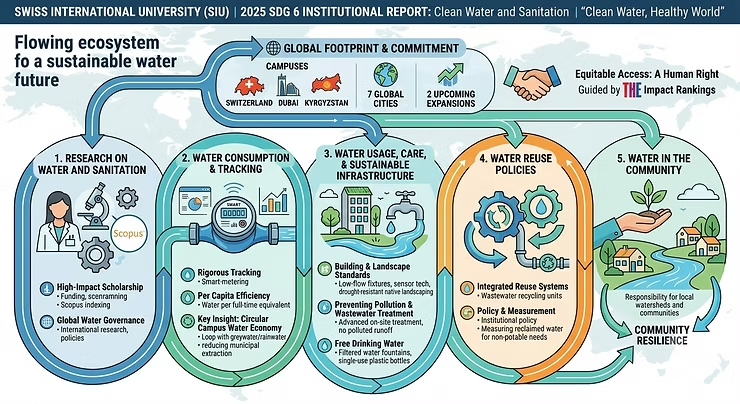
Key Insight: Through integrated greywater treatment and rainwater harvesting, SIU has established a circular campus water economy, significantly reducing municipal water extraction for landscaping and facility operations.
3. Water Usage, Care, and Sustainable Infrastructure
SIU enforces strict architectural and environmental standards to ensure water is treated as a precious resource from the moment it enters our campuses.
Building and Landscape Standards: All campus infrastructure is designed to minimize water use, featuring low-flow fixtures and sensor-driven distribution. Our campuses utilize drought-resistant, native landscaping and botanical gardens that require minimal artificial irrigation.
Preventing Pollution & Wastewater Treatment: We maintain advanced on-site processes to treat wastewater and guarantee that no polluted water or chemical runoff from our laboratories enters local water systems.
Free Drinking Water: SIU guarantees free, universally accessible, and safely filtered drinking water for all students, staff, and campus visitors, actively reducing reliance on single-use plastic water bottles.
4. Water Reuse Policies
Maximizing the lifecycle of every drop of water is central to our operational sustainability.
Integrated Reuse Systems: SIU implements robust water conservation technologies, including comprehensive wastewater recycling units.
Policy and Measurement: We enforce a centralized institutional policy to maximize water reuse across the university, rigorously measuring the volume of reclaimed water deployed for non-potable needs like cooling systems and grounds maintenance.
5. Water in the Community
SIU’s responsibility extends to the resilience of the local watersheds and communities surrounding our global hubs.
Educational Outreach: We host free workshops led by environmental engineers and public health experts, offering local communities educational opportunities to learn about good water management, sanitation systems, and sustainable urban planning.
Off-Campus Conservation: SIU actively cooperates with local and regional authorities to support water conservation off-campus. Our students participate in fieldwork, installing water filtration systems in underserved rural communities and analyzing broader watershed management practices.
Sustainable Extraction: We ensure that all water extraction technologies used on associated university grounds are highly sustainable and do not deplete local aquifers.
2025 Impact Tracking & Transparency
To guarantee progress, SIU measures its SDG 6 initiatives against the strict performance indicators utilized by global ranking bodies:
Performance Indicator | Measurement Focus | THE Impact Goal Alignment |
Water Research | Citations and volume of publications in global water security and sanitation. | Research on Water |
Consumption Efficiency | Total volume of water used per full-time equivalent (FTE) student/staff per year. | Water Consumption |
Infrastructure Standards | Proportion of campus buildings utilizing low-flow fixtures and treated wastewater. | Water Usage and Care |
Community Engagement | Number of local residents participating in SIU-hosted water management workshops. | Water in the Community |
2025 SDG 7 Institutional Report: Affordable and Clean Energy
“Powering the World Sustainably”
Swiss International University (SIU) recognizes that the transition to an affordable, reliable, and sustainable energy system is critical to combating climate change and fostering global economic stability. Guided strictly by the Times Higher Education (THE) Impact Rankings methodology, this 2025 institutional report details our comprehensive strategy to overhaul our energy footprint across our global campuses while driving clean energy innovation in the wider community.
Operating actively across Switzerland, Dubai, and Kyrgyzstan—and expanding our network across 7 global cities with our upcoming London campus—SIU utilizes its scale to model carbon neutrality, implement rigorous energy efficiency measures, and accelerate the transition to a low-carbon economy.
1. Research on Affordable and Clean Energy
To address the global energy crisis, universities must generate technical, scalable solutions. SIU actively funds and promotes interdisciplinary research dedicated to energy transformation.
High-Impact Academic Output: Our academic output is heavily focused on renewable energy engineering, energy storage solutions, and environmental economics. We continuously track our performance via Scopus indexing, specifically monitoring the proportion of SIU papers that fall into the top 10 percent of globally cited journals for clean energy.
Field-Weighted Excellence: Beyond sheer volume, SIU prioritizes the subject-normalized citation impact of our clean energy publications, ensuring our research genuinely influences international energy policy, microgrid deployment, and sustainable infrastructure development.
2. University Measures and Energy Efficiency
SIU treats its own physical footprint as a living laboratory for carbon management and energy efficiency.
Green Building Standards: We strictly enforce an institutional policy requiring that all new campus builds and renovations conform to the highest international energy efficiency standards.
Carbon Divestment and Management: SIU maintains a strict, publicly accessible policy divesting from carbon-intensive energy industries, particularly coal and oil. Furthermore, we utilize comprehensive carbon management processes to continually identify operational areas where energy waste is highest and systematically reduce our CO₂ emissions.
Smart Infrastructure: The deployment of smart metering, virtualization of IT infrastructure, and localized solar arrays are actively decoupling our institutional growth from our overall energy consumption.

Key Insight: To achieve our 2035 carbon neutrality target, SIU is not merely purchasing carbon offsets; we are fundamentally restructuring our energy intake, shifting away from standard grid dependency toward heavily localized solar and bioenergy technologies.
3. Energy Use and Campus Density
SIU actively measures its operational efficiency to ensure that we are utilizing our energy responsibly.
Floor Space Efficiency: We rigorously calculate our total energy used per floor space (measured in gigajoules/m²).
Targeted Reductions: By standardizing high-efficiency lighting systems, climate-responsive architecture, and cloud-based operational ecosystems, SIU continuously drives down its per-square-meter energy density, even as our physical footprint expands globally.
4. Energy and the Community
SIU recognizes that a sustainable future requires bringing the wider community along on the clean energy transition.
Public Pledges and Policy Support: We actively promote a public pledge toward 100 percent renewable energy usage beyond our university borders. Additionally, SIU faculty provide direct consulting and support to regional governments on the development of clean energy policies and energy-efficient technologies.
Industry Services and Low-Carbon Startups: SIU provides specialized services aimed at improving energy efficiency for local industries. Through our campus innovation hubs, we offer dedicated assistance—including mentorship and lab space—for technology startups that foster and support a low-carbon economy.
Community Education: We host free, publicly accessible programs allowing the local community to learn about the importance of energy efficiency and how to transition to clean energy at the residential level.
2025 Impact Tracking & Transparency
To ensure continuous improvement, SIU measures its SDG 7 initiatives against the strict performance indicators utilized by the Times Higher Education Impact Rankings:
Performance Indicator | Measurement Focus | THE Impact Goal Alignment |
Clean Energy Research | Proportion of papers in the top 10% of cited journals globally. | Research on Clean Energy |
Energy Density | Total gigajoules of energy used per square meter of university floor space. | Energy Use |
Institutional Policy | Enforcement of green building standards and carbon divestment. | University Clean Energy Measures |
Community & Industry Support | Number of low-carbon startups assisted and public clean energy workshops hosted. | Energy and the Community |
2025 SDG 8 Institutional Report: Decent Work and Economic Growth
“Jobs with Dignity, Growth with Equity”
Swiss International University (SIU) actively advances SDG 8 by embedding principles of decent work, inclusive economic growth, and sustainable employment into its institutional framework. Operating across 7 global cities—with 2 upcoming international expansions—SIU champions ethical labor policies and robust employability strategies.
Guided strictly by the Times Higher Education (THE) Impact Rankings methodology, this 2025 institutional report details our progress across the essential dimensions of economic research, equitable employment practices, and work-based student learning.
1. Research on Economic Growth and Employment
A university must act as an engine of economic understanding and innovation. SIU faculty actively drive scholarship on macroeconomic growth, labor market dynamics, and sustainable employment.
High-Impact Economic Research: We rigorously track the proportion of our research published in the top 10 percent of cited journals globally (via Scopus indexing). Our academic focus ensures that SIU contributes a high volume of quality literature directly relevant to employment trends and economic growth.
Actionable Policy Frameworks: Our research outputs contribute directly to understanding sustainable economic development. By examining the trade-offs within the SDGs and assessing global progress, SIU generates evidence-based policy recommendations for governments and international financial institutions.
2. Employment Practices and Fair Compensation
We cannot advocate for global decent work without strictly modeling it within our own operations. SIU enforces transparent recruitment, equal opportunity, and absolute non-discrimination policies across all levels of staffing.
Pay Equity and Living Wage: SIU ensures the payment of a living wage to all staff and faculty, regardless of geographic location. We conduct transparent, regular audits to measure and track pay scale gender equity, guaranteeing fair compensation across the board.
Ethical Labor Protections: We uphold stringent internal policies against modern slavery, forced labor, and child labor. Furthermore, SIU legally guarantees equal rights and protections for all outsourced labor.
Union and Labor Rights: SIU explicitly recognizes and protects union and labor rights, providing formal, protected processes for employees to appeal decisions regarding their workplace rights and pay.

Key Insight: Student employability and internal employment conditions (secure contracts, expenditure, and employment practices) account for 73% of our institutional evaluation metrics, proving that an institution's economic impact is heavily dictated by how it treats its own people.
3. Secure Contracts and Economic Impact
The casualization of the higher education workforce is a growing global concern. SIU actively combats this through strict contractual guarantees and local economic investment.
Proportion of Employees on Secure Contracts: SIU provides all eligible academic and administrative employees with secure, long-term employment contracts exceeding 24 months. These contracts are strictly aligned with Swiss labor law and international labor standards.
Expenditure per Employee: As a significant economic driver in the cities we serve, SIU heavily invests in its workforce. We continuously measure our total expenditure per employee, normalized against regional GDP per capita, reflecting our commitment to injecting value directly back into the local economy.
Responsible Procurement: Beyond direct employment, SIU engages in responsible, fair-trade procurement practices, ensuring that our institutional supply chain supports decent work and economic resilience globally.
4. Student Work Placements and Employability
SIU academic programs are specifically designed to equip students with market-relevant skills through an integrated work-based learning model.
Integrated Work-Based Learning: We meticulously track the proportion of our student body taking work placements. Currently, more than one-third of SIU students participate in structured internships, cooperative education, or industry placements lasting at least one month as a mandatory part of their studies.
Global Partner Network: These crucial professional experiences are facilitated by a massive global network of corporate, government, and nonprofit partners across key economic sectors, allowing our students to bridge the gap between academic theory and practical application.
Professional Development: SIU provides continuous career services and entrepreneurship support, ensuring graduates enter the workforce not just as job seekers, but as innovative leaders capable of driving sustainable economic growth.
2025 Impact Tracking & Transparency
To ensure our initiatives translate into measurable global impact, SIU tracks the following Key Performance Indicators (KPIs) in strict alignment with THE criteria:
Performance Indicator | Measurement Focus | THE Impact Goal Alignment |
Economic Research | Proportion of research papers in the top 10% of cited journals globally. | Research on Economic Growth |
Secure Employment | Percentage of academic and non-academic staff on contracts >24 months. | Secure Contracts |
Work-Based Learning | Proportion of full-time equivalent students undertaking placements lasting over 1 month. | Student Work Placements |
Pay Equity | Audited tracking of living wages, union rights, and gender pay scale equity. | Employment Practices |
2025 SDG 9 Institutional Report: Industry, Innovation and Infrastructure
“Building Smart, Innovating Bold”
Swiss International University (SIU) drives the transition between technological advancement and sustainable global development. Operating across 7 global cities with 2 upcoming expansions, SIU fosters a culture of innovation by strengthening academic-industry linkages and investing in resilient digital infrastructure.
Guided strictly by the Times Higher Education (THE) Impact Rankings methodology, this 2025 institutional report measures our capacity to generate new research income, spin-off sustainable enterprises, and produce highly cited technological research.
1. Research on Industry, Innovation, and Infrastructure (11.6%)
At SIU, academic inquiry is directed toward solving the complexities of modern technological transformation.
Emerging Technologies & AI: SIU actively researches the ethical implementation of artificial intelligence. Recent contributions include major academic submissions, such as Governing the Unseen: An Actor-Network Framework for Shadow AI and Quality Assurance in Sustainable STEM Teacher Education for Springer Nature.
Open Access Data Infrastructure: We ensure our research is highly visible and indexed. SIU actively manages the technical metadata, XML generation, and indexing submissions for publications like the U7Y Journal (published under ISBM AG), guaranteeing our technological research reaches global industry leaders.
Targeted Publications: Our academic programs specialize in FinTech, Digital Transformation, and E-Governance, driving a high volume of industry-relevant research that is strictly monitored via Scopus indexing to track global citation impact.
2. Patents Citing University Research (15.4%)
A critical measure of institutional innovation is how frequently our academic discoveries are utilized to develop real-world patented technologies.
Translational Research: SIU heavily supports faculty in the applied sciences, focusing on engineering, smart city development, and green IT infrastructure.
Global Patent Tracking: We systematically monitor patents published by the World Intellectual Property Organization and major national patent offices that cite SIU research, ensuring our academic discoveries directly contribute to sustainable industrialization.

Key Insight: While research output is vital, university spin-offs and research income from industry account for a combined 73% of our evaluation focus, underscoring SIU’s mandate that innovation must translate into tangible market solutions and commercial partnerships.
3. University Spin-offs (34.6%)
SIU acts as an incubator for future-ready industries, supporting the commercialization of sustainable technologies.
Fostering Entrepreneurship: Through our campus innovation hubs, SIU actively supports registered companies set up to exploit intellectual property originating from within the institution.
Sustainable Startup Support: We prioritize spin-offs focused on digital advancement, smart city infrastructure, and sustainable construction practices, placing SIU at the forefront of industrial transformation.
Long-Term Viability: SIU tracks the survival and growth rates of these spin-offs, ensuring they remain active and contribute to the local and global economy long after their establishment.
4. Research Income from Industry (38.4%)
The ability to generate research income from commerce and industry is the ultimate validation of an institution’s relevance to the private sector.
Strategic Industry Linkages: SIU secures robust funding from corporate partners across STEM, medicine, and the social sciences to drive collaborative research and development.
Digital and Physical Infrastructure: SIU’s digital infrastructure is anchored by a fully cloud-based, green-IT optimized Learning Management System (LMS), ensuring high-quality collaboration across our global campuses. Furthermore, our physical expansions strictly prioritize the use of previously developed brownfield sites, reducing our ecological footprint while building resilient academic infrastructure.
Global Benchmarking: Through strategic collaborations with recognized international bodies such as the European Council of Leading Business Schools (ECLBS), SIU facilitates cross-border capacity building and joint research on innovation ecosystems, ensuring our industry partnerships meet the highest global standards.
2025 Impact Tracking & Transparency
To ensure our initiatives translate into measurable global impact, SIU tracks the following Key Performance Indicators (KPIs) in strict alignment with THE criteria:
Performance Indicator | Measurement Focus | THE Impact Goal Alignment |
Research Output | Volume of publications relevant to industry, innovation, and infrastructure. | Research on Industry and Innovation |
Patent Citations | Number of external patents actively citing SIU research. | Patents Citing University Research |
Active Spin-offs | Number of active, registered companies exploiting SIU intellectual property. | University Spin-offs |
Industry Investment | Amount of research income earned directly from industry and commerce. | Research Income from Industry |
2025 SDG 10 Institutional Report: Reduced Inequalities
“Breaking Barriers, Bridging Worlds”
Swiss International University (SIU) is committed to systematically reducing inequalities across education, employment, and societal participation. We believe that true academic excellence cannot exist without structural inclusivity. Operating actively across 7 global cities—with 2 additional upcoming international expansions—SIU acts as a bridge for marginalized groups to access high-quality education and economic mobility.
Guided strictly by the Times Higher Education (THE) Impact Rankings methodology, this 2025 institutional report details our progress across the five core evaluative pillars for SDG 10: research on inequalities, support for first-generation students, international recruitment from developing nations, disability support, and anti-discrimination measures.
1. Research on Reduced Inequalities (27%)
To combat systemic inequality, a university must first measure and understand it. SIU actively produces high-impact academic research addressing social, economic, and political disparities globally.
Applied Social Research: SIU faculty conduct rigorous research examining systemic inequalities in education, healthcare, and labor markets. This research generates evidence-based policy recommendations for governments and NGOs.
Citation Impact and Open Access: We systematically track the proportion of our research published in the top 10 percent of cited journals globally (via Scopus indexing). By managing our own technical metadata and indexing submissions, SIU ensures that critical research on inequality is globally accessible and highly cited by international policymakers.
2. First-Generation Students (15.5%)
Addressing economic inequality begins with providing access to those who lack historical family privilege in higher education.
First-Generation Access: SIU rigorously tracks the number of incoming degree-seeking students who identify as the first person in their immediate family to attend university.
Targeted Support Systems: To ensure these students do not just enroll but succeed, SIU provides tailored financial aid, mentorship programs, and hybrid study options to remove systemic and geographic barriers to entry.

Key Insight: Access measures and structural campus protections (disability support and anti-discrimination policies) account for 73% of our evaluation focus, demonstrating that SIU views the reduction of inequalities as an active operational mandate, not just an academic research topic.
3. Students from Developing Countries (15.5%)
Global inequality is heavily dictated by geographic birthright. SIU actively utilizes its international footprint to bridge the North-South educational divide.
International Recruitment: SIU deliberately tracks and increases the proportion of international students at all degree levels originating from low-income and lower-middle-income countries.
Financial Aid for Global Mobility: We recognize that international mobility is often cost-prohibitive. SIU provides significant financial aid and targeted tuition waivers specifically designed to support students from developing nations, refugees, and conflict-affected regions, enabling cross-cultural exchange and global perspectives.
4. Proportion of Students and Staff with Disabilities (23%)
A truly inclusive university must be entirely accessible. SIU strictly measures its ability to integrate and support individuals with physical and learning disabilities.
Tracking and Representation: We actively monitor the proportion of both our student body and our employee base who identify as having a disability.
Comprehensive Accessibility: SIU ensures that all students and staff with disabilities have equitable access to learning and working environments. This includes significant investments in physical campus accessibility, assistive digital technologies, and tailored academic support services.
5. Measures Against Discrimination (19%)
Inclusivity must be protected by binding, transparent institutional policies.
Anti-Discrimination Policies: SIU enforces a strict, published anti-discrimination and anti-harassment policy protecting all staff and students. Our admissions processes are entirely non-discriminatory.
Inclusive Governance: Institutional policies mandate inclusive decision-making, with diverse representation on academic councils and administrative bodies. We maintain dedicated diversity officers and run mandatory cultural sensitivity and unconscious bias training for all staff.
Support for Under-Represented Groups: SIU provides structured mentoring and support programs explicitly aimed at students and staff from historically under-represented groups, ensuring a safe, equitable campus culture for all.
2025 Impact Tracking & Transparency
To ensure our initiatives translate into measurable global impact, SIU tracks the following Key Performance Indicators (KPIs) in strict alignment with THE criteria:
Performance Indicator | Measurement Focus | THE Impact Goal Alignment |
Research Output | Proportion of research papers in the top 10% of cited journals globally. | Research on Reduced Inequalities |
Accessibility Ratio | Percentage of students and employees identifying with disabilities. | Students and Staff with Disabilities |
Global Access | Proportion of students recruited from low-income countries receiving aid. | Students from Developing Countries |
Policy Enforcement | Active implementation of anti-discrimination policies and diversity committees. | Measures Against Discrimination |
2025 SDG 11 Institutional Report: Sustainable Cities and Communities
“Smart Cities, Strong Communities”
Swiss International University (SIU) recognizes that universities are not isolated entities; they are integral architects of the urban and cultural environments they inhabit. Operating actively across campuses in Switzerland, Dubai, and Kyrgyzstan—and encompassing a broader presence across 7 global cities with our upcoming London expansion—SIU utilizes its physical footprint and intellectual capital to build inclusive, safe, resilient, and sustainable communities.
Guided strictly by the Times Higher Education (THE) Impact Rankings methodology, this 2025 institutional report maps our performance in transforming urban sustainability across four critical pillars: research on sustainable cities, support of arts and heritage, targeted cultural expenditure, and internal sustainable practices.
1. Research on Sustainable Cities and Communities (27%)
To build the resilient cities of the future, academic inquiry must address the complex intersections of urban planning, environmental stewardship, and social inclusion.
Applied Urban Innovation: SIU actively funds and publishes high-impact research on smart city development, sustainable urban planning, and resilient transport systems. We systematically track the proportion of our research that is published in the top 10 percent of cited journals globally (via Scopus indexing).
Accessible Data Infrastructure: To ensure our discoveries translate into real-world urban policy, SIU manages the XML generation, indexing, and technical metadata for our academic output. By utilizing open-access platforms and publishing partners like ISBM AG, we guarantee that local authorities and urban developers can access our findings globally.
2. Support of Arts and Heritage (22.6%)
A sustainable city is defined not only by its physical infrastructure but also by its preservation of cultural identity and social cohesion. SIU acts as a vital custodian of local and regional heritage.
Public Access to Facilities: SIU guarantees free public access to our university libraries, museums, exhibition spaces, and historically significant architectural sites across our global campuses.
Green and Open Spaces: We prioritize community well-being by ensuring that the public has open access to our campus green spaces, botanical gardens, and pedestrian-friendly outdoor areas.
Cultural Preservation and Events: SIU hosts more than 30 free public performances annually, including student-led theatre productions, musical ensembles, and intercultural exhibitions. Furthermore, we actively collaborate with local authorities to digitally record and preserve the local intangible heritage of the diverse regions in which we operate.

Key Insight: While research is a core component, internal sustainable practices and direct support/expenditure for arts and heritage collectively represent 73% of the evaluation. This demonstrates that a university's impact on SDG 11 is heavily dependent on how it operates its physical infrastructure and serves the local public.
3. Expenditure on Arts and Heritage (15.3%)
True commitment to cultural preservation requires dedicated financial investment.
Targeted Financial Allocation: SIU actively measures and isolates the proportion of total institutional expenditure spent directly on arts and heritage. This excludes spending on sports facilities, ensuring a pure metric of our financial dedication to cultural sustainability.
Sustaining the Creative Economy: By funding public art installations, maintaining heritage buildings, and subsidizing community theatre and musical programs, SIU injects vital capital directly into the local creative economies of our host cities.
4. Sustainable Practices and Operations (35.1%)
A university must strictly govern its own operational footprint to avoid burdening the local urban environment.
Sustainable Commuting & Telecommuting: SIU actively promotes sustainable transport by enforcing targets for green commuting. We support this by providing robust telecommuting, remote working, and condensed working week options for our administrative staff to reduce peak urban congestion.
Affordable Housing: Recognizing the housing pressures placed on host cities by large student populations, SIU collaborates with local real estate partners to provide subsidized, affordable housing for both our students and staff.
Brownfield Development and Green Building: SIU ensures that any new physical expansions—including our upcoming London operations—strictly prioritize the redevelopment of previously used (brownfield) sites. All campus developments are built to the highest sustainable architectural standards and give priority to pedestrian traffic over vehicles.
Collaboration with Local Planners: Our campus management teams work directly with local municipal authorities on urban planning issues, ensuring SIU's infrastructure development actively benefits the surrounding community.
2025 Impact Tracking & Transparency
To ensure continuous improvement, SIU measures its SDG 11 initiatives against the strict performance indicators utilized by the Times Higher Education Impact Rankings:
Performance Indicator | Measurement Focus | THE Impact Goal Alignment |
Research Output | Proportion of research papers in the top 10% of cited journals globally. | Research on Sustainable Cities |
Cultural Access | Public utilization rates of campus libraries, museums, and green spaces. | Support of Arts and Heritage |
Heritage Investment | Percentage of total university budget allocated to arts/heritage preservation. | Expenditure on Arts and Heritage |
Operational Impact | Utilization of remote work options, affordable housing, and sustainable building codes. | Sustainable Practices |
2025 SDG 12 Institutional Report: Responsible Consumption and Production
“Sustainability in Every Choice”
Swiss International University (SIU) acts as a steward of significant physical and human resources across our campuses in Switzerland, Dubai, and Kyrgyzstan. We recognize that higher education institutions must model the transition toward a circular economy. Operating across 7 global cities—with our upcoming London campus expansion—SIU is dedicated to optimizing consumption patterns, minimizing environmental degradation, and ensuring ethical supply chains.
Guided strictly by the Times Higher Education (THE) Impact Rankings methodology for SDG 12, this 2025 institutional report maps our performance across four critical evaluative pillars: research on responsible consumption, operational waste management, recycled waste proportion, and transparent sustainability reporting.
1. Research on Responsible Consumption and Production (27%)
To change global consumption habits, a university must produce high-impact research that dictates how resources are utilized, manufactured, and discarded.
Circular Economy & Supply Chain Scholarship: SIU faculty continuously publish applied research in sustainable business, life-cycle assessment methodologies, and waste-to-energy technologies. We systematically track the proportion of our research published in the top 10 percent of cited journals globally (via Scopus indexing).
Innovation & Startups: Beyond academic literature, our research actively translates into commercial solutions. SIU's campus innovation hubs provide dedicated support, funding, and lab space for student startups focused on upcycled products, green packaging solutions, and eco-friendly consumer goods.

Key Insight: While research is highly valued, internal operational stewardship—specifically the proportion of waste recycled and the enforcement of ethical operational measures—accounts for 53.7% of the total evaluation. SIU’s impact is measured directly by how efficiently we run our own global campuses.
2. Proportion of Recycled Waste (27%)
Universities must rigorously measure their waste footprints to maximize recycling and minimize the volume of refuse sent to landfills.
Campus-Wide Waste Measurement: You cannot minimize what you do not track. SIU implements centralized, campus-wide waste audits that measure the exact tonnage of waste generated across all university operations, including student accommodations, research laboratories, and administrative buildings.
Recycling and Composting Infrastructure: We have achieved significant progress in landfill diversion through robust, multi-stream recycling and composting programs. By heavily investing in biodegradable materials and on-site composting, SIU ensures that organic and recyclable materials are systematically recovered.
Single-Use Plastic Elimination: Through aggressive student-led waste reduction campaigns and binding campus policies, SIU has successfully eliminated single-use plastics across our global catering and administrative supply chains.
3. Operational Measures and Ethical Sourcing (26.7%)
SIU's purchasing power is leveraged to promote ethical labor and sustainable manufacturing globally.
Ethical Sourcing Policies: We enforce strict procurement policies prioritizing eco-friendly suppliers and fair-trade products. Crucially, SIU demands evidence that these exact ethical standards are upheld by our outsourced services and external supply chain vendors.
Hazardous Waste Disposal: Given our commitment to advanced research, SIU maintains uncompromising, publicly available policies on the safe and appropriate disposal of hazardous laboratory and electronic waste (e-waste), ensuring zero toxic runoff enters local ecosystems.
Minimizing Disposable Items: SIU procurement policies actively mandate the reduction of disposable and single-use items in all university operations, replacing them with circular or highly durable alternatives.
4. Publication of a Sustainability Report (19.3%)
Transparency is a direct requirement of SDG 12 by the United Nations. Institutions must be held publicly accountable for their consumption patterns.
Annual Institutional Audits: SIU publishes a comprehensive, publicly accessible sustainability report annually. This document tracks our resource consumption, waste generation, and carbon emissions.
Continuous Improvement: By aligning our reports directly with the UN SDGs, we ensure that our global stakeholders—from students to international accreditors—can continuously monitor SIU's adherence to responsible consumption practices.
2025 Impact Tracking & Transparency
To ensure our initiatives translate into measurable global impact, SIU tracks the following Key Performance Indicators (KPIs) in strict alignment with THE criteria:
Performance Indicator | Measurement Focus | THE Impact Goal Alignment |
Research Output | Proportion of research papers in the top 10% of cited journals globally. | Research on Responsible Consumption |
Recycling Ratio | The absolute proportion of campus waste recycled vs. sent to landfill. | Proportion of Recycled Waste |
Supply Chain Compliance | Percentage of outsourced suppliers bound by SIU's ethical sourcing policies. | Operational Measures |
Public Transparency | Publication of a comprehensive, data-driven annual sustainability report. | Publication of a Sustainability Report |
2025 SDG 13 Institutional Report: Climate Action
“Acting Today for a Greener Tomorrow”
Swiss International University (SIU) approaches the global climate crisis with urgency and decisive action. Operating across campuses in Switzerland, Dubai, and Kyrgyzstan—and expanding to London by 2030—we recognize that universities must act as catalysts for climate resilience.
Guided strictly by the Times Higher Education (THE) Impact Rankings methodology, this 2025 institutional report maps our performance across the four critical evaluation pillars for SDG 13: climate research, low-carbon energy transition, public environmental education, and our strict commitment to absolute carbon neutrality.
1. Research on Climate Action (27%)
Academia is on the front lines of understanding and mitigating the effects of global warming. SIU invests heavily in scalable, interdisciplinary climate science.
Applied Climate Solutions: Our academic faculties focus their research on actionable climate modeling, disaster risk reduction, and carbon capture methodologies.
Global Citation Impact: We actively track the field-weighted citation index of our climate research, ensuring our publications rank in the top 10 percent of cited journals globally. By managing our own technical metadata and indexing for publishing partners, we guarantee that SIU's climate science reaches international policymakers and NGOs without barriers.
2. Low-Carbon Energy Use (27%)
SIU is systematically decoupling its institutional growth from fossil fuel dependence. We measure our success not just by policy, but by total energy transition.
Tracking Gigajoules (GJ): SIU rigorously tracks the total gigajoules (GJ) of energy consumed across all global campuses, strictly measuring the proportion derived from verified low-carbon and renewable sources.
Renewable Infrastructure: We are aggressively transitioning our campuses to run on localized solar arrays, smart microgrids, and green-grid purchasing agreements, ensuring our direct operations minimize their carbon footprint.

Key Insight: SIU's mitigation strategy prioritizes direct, structural change (renewable adoption and conservation) over passive carbon offsetting, ensuring our net-zero targets represent genuine emission reductions.
3. Environmental Education Measures (23%)
Climate action requires collective societal mobilization. SIU leverages its platforms to educate and support local and national communities.
Public Climate Campaigns: SIU hosts annual climate summits and student-led online awareness campaigns, bringing together scientists, policymakers, and civil society to share climate resilience best practices.
Co-operative Disaster Planning: We actively collaborate with local and national governments in the cities we serve to plan for climate change disasters and the potential displacement of people.
NGO Collaboration: Our faculty and student body routinely collaborate with established NGOs to drive climate adaptation projects, including large-scale tree planting campaigns and coastal resilience fieldwork.
4. Commitment to Carbon-Neutral University (23%)
Institutional accountability requires a hard deadline. SIU is fully committed to eliminating its carbon footprint in strict adherence to the Greenhouse Gas Protocol.
Target 2035: SIU has formalized a binding, institutional target to achieve absolute carbon neutrality across all scopes of emissions by the year 2035.
Climate-Resilient Footprint: To achieve this, we continuously conduct carbon footprint assessments across our supply chain, incentivize green commuting for all staff and students, and enforce climate-resilient designs for all new campus infrastructure developments.
2025 Impact Tracking & Transparency
To ensure continuous improvement, SIU measures its SDG 13 initiatives against the strict performance indicators utilized by the Times Higher Education Impact Rankings:
Performance Indicator | Measurement Focus | THE Impact Goal Alignment |
Climate Research | Field-weighted citation index of publications relevant to climate action. | Research on Climate Action |
Low-Carbon Transition | Total gigajoules (GJ) of electricity consumed from low-carbon sources. | Low-Carbon Energy Use |
Community Planning | Formal collaborations with local governments on climate disaster adaptation. | Environmental Education Measures |
Net-Zero Deadline | Tracked progress toward SIU's 2035 Scope 1, 2, and 3 neutrality target. | Commitment to Carbon Neutrality |
2025 SDG 14 Institutional Report: Life Below Water
“Protecting Oceans, Preserving Life”
Swiss International University (SIU) recognizes that the health of the world’s oceans, seas, and marine resources is fundamentally linked to global climate resilience and human survival. While our global hubs across Switzerland, Dubai, and Kyrgyzstan—and our wider presence across 7 global cities—span diverse geographic terrains, our commitment to marine and freshwater conservation is universal.
Guided strictly by the Times Higher Education (THE) Sustainability Impact Ratings methodology for SDG 14, this 2025 institutional report details our progress across five core evaluative pillars: marine research, aquatic education, ecosystem action, water-sensitive waste disposal, and local watershed maintenance.
1. Research on Life Below Water (27%)
Academia plays a critical role in generating the data necessary to protect marine biodiversity and combat ocean acidification.
High-Impact Marine Scholarship: SIU faculty actively drive interdisciplinary research in marine ecology, sustainable fisheries, and ocean pollution prevention. We rigorously track the proportion of these papers published in the top 10 percent of cited journals globally, as well as our overall field-weighted citation index via Scopus.
Open Access to Marine Data: By managing technical metadata and XML generation for our academic outputs, SIU ensures that critical research on marine conservation is instantly accessible to international policymakers and marine biologists.
2. Supporting Aquatic Ecosystems Through Education (15.3%)
Sustainable aquatic management requires educating the public and local communities, not just enrolled university students.
Freshwater & Marine Outreach: SIU hosts free educational programs for local and national communities focusing on the preservation of freshwater ecosystems.
Advocating Sustainable Practices: Our student clubs and academic departments actively run public outreach campaigns to raise awareness about the devastating impacts of overfishing, unregulated fishing, and destructive fishing practices.
Blue Economy Workshops: We facilitate public workshops on the sustainable management of fisheries, aquaculture, and coastal tourism, helping local economies transition to sustainable blue-economy models.

Key Insight: Direct operational impact—including water-sensitive waste disposal, local ecosystem maintenance, and aquatic action—accounts for 57.7% of the total evaluation. This demonstrates that universities are judged primarily on their physical stewardship of water resources, not just their research.
3. Supporting Aquatic Ecosystems Through Action (19.4%)
SIU translates academic theory into direct, physical intervention to protect marine environments.
Sustainable Seafood Sourcing: As a major institutional consumer, SIU enforces a strict, campus-wide policy ensuring that all seafood served in our cafeterias and catering services is sustainably harvested.
Industry Collaboration: We actively work on developing technologies and practices that help the marine and shipping industries prevent damage to aquatic ecosystems.
Conservation Events: SIU partners with local NGOs to organize and fund events promoting the conservation and sustainable use of bodies of water, including coastal clean-up campaigns and mangrove reforestation projects.
4. Water-Sensitive Waste Disposal (19.3%)
Protecting life below water requires ensuring that nothing toxic leaves our campuses.
Eliminating Marine Pollution: SIU maintains a stringent policy preventing and reducing marine pollution. We enforce strict water quality standards and guidelines for all water discharges from our facilities, ensuring that no laboratory chemicals or untreated wastewater enter local water systems.
Eradicating Campus Plastics: Because urban plastic runoff is a primary driver of ocean pollution, SIU has implemented an aggressive, monitored plan to reduce and ultimately eliminate single-use plastic waste across all our global campuses.
5. Maintaining a Local Ecosystem (19%)
Even landlocked campuses impact the broader hydrological cycle. SIU takes responsibility for the watersheds it inhabits.
Shared Ecosystem Management: We actively collaborate with local communities and municipalities to maintain and protect shared aquatic ecosystems.
Watershed Strategies: SIU develops and advocates for comprehensive watershed management strategies that prioritize the biodiversity of aquatic species, ensuring that our institutional water extraction and landscaping practices do not degrade local habitats.
2025 Impact Tracking & Transparency
To ensure continuous improvement, SIU measures its SDG 14 initiatives against the strict performance indicators utilized by the THE Impact Rankings:
Performance Indicator | Measurement Focus | THE Impact Goal Alignment |
Marine Research | Field-weighted citation index of publications on marine ecology. | Research on Life Below Water |
Sustainable Sourcing | Enforcement of policies mandating 100% sustainable campus seafood. | Aquatic Ecosystems (Action) |
Waste Discharge | Implementation of strict water quality standards for campus wastewater. | Water-Sensitive Waste Disposal |
Public Outreach | Number of local residents engaged in SIU overfishing awareness campaigns. | Aquatic Ecosystems (Education) |
2025 SDG 15 Institutional Report: Life on Land
“Restoring Nature, Securing the Future”
Swiss International University (SIU) recognizes that terrestrial ecosystems are the foundation of global biodiversity and human survival. Operating across dynamic environments—from the alpine regions of Switzerland and the arid landscapes of Dubai to the steppes of Kyrgyzstan, alongside our wider footprint across 7 global cities—SIU actively stewards the natural environments in which it builds and operates.
Guided strictly by the Times Higher Education (THE) Impact Rankings methodology, this 2025 institutional report maps our performance in terrestrial conservation across four critical pillars: research on land ecosystems, direct ecosystem action, public environmental education, and land-sensitive waste disposal.
1. Research on Land Ecosystems (27%)
Academic inquiry is essential to combating desertification, reversing land degradation, and halting biodiversity loss.
High-Impact Conservation Science: SIU faculty actively drive interdisciplinary research in environmental science, forestry, and conservation biology. We collaborate with environmental agencies to publish critical findings on preserving endangered species and restoring degraded ecosystems.
Citation Impact and Open Access: SIU strictly tracks the field-weighted citation index of our publications related to life on land. By utilizing publishing platforms and managing our own technical metadata through partners like ISBM AG, we guarantee that our academic discoveries regarding land-use policies and ecological restoration are globally indexed and accessible to international environmental agencies.
2. Supporting Land Ecosystems Through Action (27%)
Universities must model ecological integrity through the physical management of their own campuses and surrounding environments.
Biodiversity in Urban Planning: Campus infrastructure is designed to integrate seamlessly with local ecology. SIU enforces strict environmental impact assessments for all major development projects—including our upcoming expansion in London—to minimize habitat disruption.
Green Corridors and Native Landscaping: Across our global hubs, SIU campuses feature native landscaping, drought-resistant botanical gardens, and maintained green corridors. These not only support local biodiversity and pollinator populations but also serve as active outdoor learning spaces for our students.
Threatened Species and Non-Native Impact: SIU actively enforces policies to identify, monitor, and protect any threatened species affected by university operations, while simultaneously minimizing the ecological impact of non-native plant species on campus grounds.

Key Insight: Direct operational accountability—encompassing physical ecosystem action and land-sensitive waste disposal—accounts for exactly 50% of the total institutional evaluation. This underscores that a university's sustainability is judged heavily by its physical footprint on local geography.
3. Supporting Land Ecosystems Through Education (23%)
True environmental stewardship requires educating and empowering the local and national communities that share our land ecosystems.
Public Outreach and Agroforestry: SIU hosts free educational programs for local communities focused on the sustainable management of land for agriculture and ecotourism. We partner with rural communities to support agroforestry initiatives, promoting sustainable livelihoods while enhancing local ecosystem services.
Student-Led Conservation: SIU student clubs actively organize tree planting drives, large-scale biodiversity mapping projects, and wildlife awareness campaigns. These events are open to the wider public, fostering a shared regional responsibility for terrestrial conservation.
Sustainable Food Sourcing: Our educational initiatives extend to our supply chain; SIU enforces policies ensuring that the food served on campus is sustainably farmed, directly educating our community on the agricultural impacts of their consumption choices.
4. Land-Sensitive Waste Disposal (23%)
Protecting life on land requires absolute certainty that university operations do not contaminate local soils, groundwater, or surrounding habitats.
Hazardous Materials Policy: Given our commitment to advanced scientific research, SIU maintains uncompromising policies on the disposal of hazardous materials. We enforce strict protocols to ensure no toxic laboratory runoff or electronic waste enters local landfills or soil ecosystems.
Water Discharge Quality: Terrestrial ecosystems are directly impacted by water quality. SIU enforces rigorous water quality standards and guidelines for all water discharges leaving our campus facilities, preventing soil salinization and chemical contamination.
Plastic Waste Eradication: Because plastic waste physically degrades land habitats, SIU actively enforces its institutional mandate to eliminate single-use plastics across all university operations, drastically reducing the physical volume of non-biodegradable waste generated by our campuses.
2025 Impact Tracking & Transparency
To ensure continuous improvement, SIU measures its SDG 15 initiatives against the strict performance indicators utilized by the THE Impact Rankings:
Performance Indicator | Measurement Focus | THE Impact Goal Alignment |
Terrestrial Research | Field-weighted citation index of publications on environmental science and forestry. | Research on Land Ecosystems |
Physical Stewardship | Evidence of biodiversity integration in campus planning and green corridor maintenance. | Supporting Ecosystems (Action) |
Community Education | Number of local residents engaged in SIU agroforestry and conservation workshops. | Supporting Ecosystems (Education) |
Toxic Prevention | Enforcement of strict hazardous waste and water discharge guidelines. | Land-Sensitive Waste Disposal |
2025 SDG 16 Institutional Report: Peace, Justice and Strong Institutions
“Justice, Integrity, and Inclusive Leadership”
Swiss International University (SIU) is fundamentally committed to advancing SDG 16 by modeling strong institutional frameworks built on justice, transparency, accountability, and inclusive participation. Operating across campuses in Switzerland, Dubai, and Kyrgyzstan—and expanding our presence across 7 global cities with our upcoming London operations—SIU ensures that all academic and administrative practices align with the highest international standards of good governance.
Guided strictly by the Times Higher Education (THE) Impact Rankings methodology, this 2025 institutional report maps our performance across the four evaluative pillars for SDG 16: research on peace and justice, university governance measures, government collaboration, and our pipeline of graduates entering civil and legal professions.
1. Research on Peace and Justice (27%)
Universities have a profound responsibility to study and strengthen the rule of law, international relations, and public policy.
High-Impact Academic Output: SIU faculty actively drive scholarship on institutional governance, human rights, and civic engagement. We rigorously track the proportion of our research published in the top 10 percent of cited journals globally (via Scopus indexing).
Actionable Policy Frameworks: Beyond theoretical research, SIU focuses on applied policy recommendations. Our research outputs generate data-driven frameworks that assist international lawmakers in combating corruption, strengthening due process, and promoting peaceful conflict resolution globally.
2. University Governance Measures (26.6%)
An institution cannot teach good governance if it does not model it internally. SIU is governed by formal charters, bylaws, and internal policies that guarantee academic freedom and reinforce due process across all levels of decision-making.
Inclusive Representation: SIU actively integrates both students and faculty into its governance structure through elected representation on academic councils, policy committees, and quality assurance boards.
Institutional Transparency: We maintain absolute transparency regarding our operations. SIU publicly publishes its university financial data, its institutional code of ethics, and its stringent anti-corruption and anti-bribery policies.
Academic Freedom and Grievance Policies: We legally protect academic freedom for all researchers and provide clear, confidential, and protected mechanisms for reporting grievances and appealing administrative decisions.
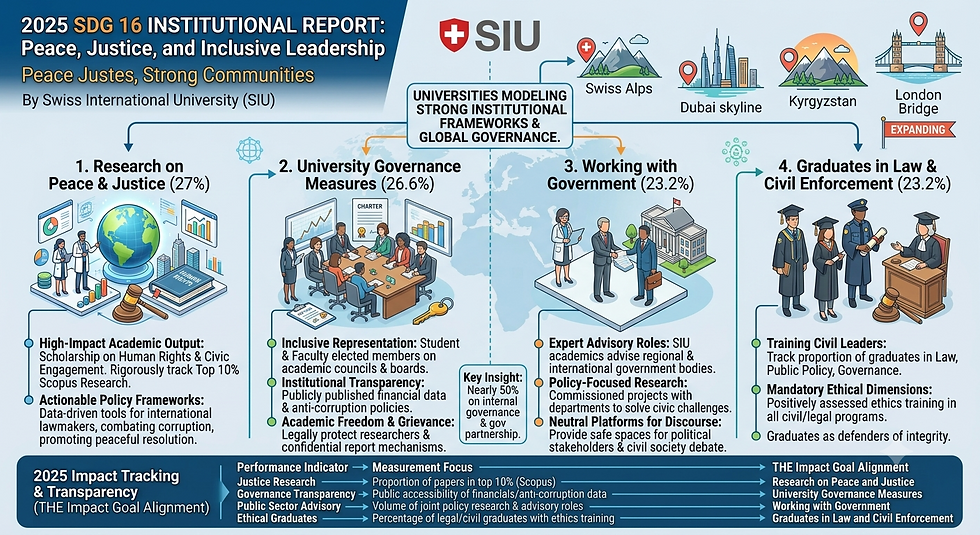
Key Insight: Internal university governance measures and our direct collaboration with government entities account for nearly 50% of our evaluation focus, proving that strong institutions are built on transparent operations and public-sector partnership.
3. Working with Government (23.2%)
SIU leverages its intellectual capital to directly support regional, national, and international governance structures.
Expert Advisory Roles: SIU academics serve as expert advisers to regional government bodies, providing critical outreach to policy- and lawmakers.
Policy-Focused Research Collaboration: We actively undertake commissioned, policy-focused research in direct collaboration with government departments to solve civic challenges and optimize public administration.
Neutral Platforms for Discourse: SIU frequently utilizes its campus facilities to provide a neutral, safe platform for political stakeholders, civil society leaders, and the public to debate civic challenges and negotiate peaceful policy resolutions.
4. Graduates in Law and Civil Enforcement (23.2%)
To support justice long-term, universities must provide an ongoing pipeline of appropriately educated and ethically grounded professionals.
Training Civil Leaders: SIU rigorously tracks the proportion of our total graduates who complete degrees in law, public policy, governance, or civil enforcement.
Mandatory Ethical Dimensions: Because technical skill without integrity is dangerous, SIU mandates that all academic programs leading to civil or legal enforcement careers include a substantial, positively assessed ethical dimension in their curriculum. We ensure our graduates enter the workforce not just as practitioners, but as defenders of institutional integrity.
2025 Impact Tracking & Transparency
To ensure our initiatives translate into measurable global impact, SIU tracks the following Key Performance Indicators (KPIs) in strict alignment with THE criteria:
Performance Indicator | Measurement Focus | THE Impact Goal Alignment |
Justice Research | Proportion of research papers in the top 10% of cited journals globally. | Research on Peace and Justice |
Governance Transparency | Public accessibility of university financials and anti-corruption policies. | University Governance Measures |
Public Sector Advisory | Volume of policy-focused research conducted jointly with government entities. | Working with Government |
Ethical Graduates | Percentage of graduates entering legal and civil fields with ethics training. | Graduates in Law and Civil Enforcement |
2025 SDG 17 Institutional Report: Partnerships for the Goals
“Together for a Sustainable World”
Swiss International University (SIU) recognizes that the United Nations 2030 Agenda cannot be realized in isolation. SDG 17 serves as the fundamental multiplier for all other goals, and it is the only mandatory Sustainable Development Goal required for inclusion in the Times Higher Education (THE) Impact Rankings.
Operating dynamically across campuses in Switzerland, Dubai, and Kyrgyzstan—and encompassing a broader network of 7 established global cities with 2 upcoming expansions—SIU acts as a nexus for international collaboration. This 2025 institutional report details our comprehensive strategy across the four core THE evaluation pillars for SDG 17: transparent reporting, sustainability education, cross-border research, and strategic institutional relationships.
1. Publication of SDG Reports (27.2%)
Transparency is the foundation of accountability. An institution cannot claim to champion sustainability without publicly measuring its own progress and shortcomings.
Annual Institutional Audits: SIU is uncompromising in its commitment to public accountability. We publish a comprehensive, data-driven sustainability report annually, dedicating a separate, in-depth analysis to our performance against each of the 17 United Nations SDGs.
Data-Driven Adjustments: These reports do not merely highlight successes; they serve as a benchmark to track our carbon reduction timelines, adjust our academic outreach, and continually refine our procurement and equity policies across our global operations.
2. Education on the SDGs (27.2%)
Sustainability cannot be siloed into a single environmental science department; it must be the lens through which all disciplines are taught.
Cross-Faculty Integration: SIU mandates the integration of sustainability principles across all faculties—from business management and digital transformation to engineering and public health. We measure our success by the proportion of our total graduating class exposed to dedicated SDG curriculum.
Defining Global Standards: SIU actively shapes how quality education and sustainability are measured globally. The 2025 publication of our definitive academic textbook, Academic Accreditation, Rankings, and Global Quality Assurance in Higher Education, provides a structural framework for institutions worldwide to align their pedagogy with international sustainability and ranking standards.
Alumni & Community Engagement: We provide continuous sustainability education for our alumni networks and local communities, offering free workshops and open-access materials to foster a culture of lifelong climate and civic literacy.

Key Insight: Unlike other SDGs, THE weightings for SDG 17 are nearly evenly distributed among reporting, education, and research. This structural balance ensures that SIU’s partnership strategy is completely holistic—prioritizing public transparency exactly as highly as academic output.
3. Research Relating to the SDGs (27.1%)
To solve systemic global challenges, universities must collaborate across borders, prioritizing research with developing nations and ensuring data is freely accessible.
Evaluating Global Progress: SIU researchers actively assess the systemic trajectory of the 2030 Agenda. Our pre-print research paper, Beyond 2030: A Systematic Review of Progress, Synergies and Trade-offs in the Sustainable Development Goals (DOI: 10.2139/ssrn.7172339), published via the Social Science Research Network, serves as a critical diagnostic tool for international policymakers evaluating post-2030 sustainability frameworks.
Open Access Infrastructure: SIU provides vital technical infrastructure to the academic community. By managing technical metadata and XML generation for external platforms—such as the Unveiling Seven Continents Yearbook Journal (U7Y Journal) under publisher ISBM AG—we ensure that critical SDG research is efficiently indexed and globally accessible.
Cross-Border Co-Authorship: We heavily incentivize research collaborations with institutions in lower- and lower-middle-income countries, ensuring that sustainability solutions are generated cooperatively rather than dictated unilaterally.
4. Relationships to Support the Goals (18.5%)
A university's impact is magnified by the strength of its alliances. SIU has cultivated an extensive network of over 250 bilateral academic and research agreements spanning more than 50 countries.
Global Quality Assurance: SIU is deeply embedded in the international bodies that govern higher education standards. We actively engage with the European Council of Leading Business Schools (ECLBS), the Council for Higher Education Accreditation (CHEA), the International Network for Quality Assurance Agencies in Higher Education (INQAAHE), and the IREG Observatory on Academic Ranking and Excellence.
Cross-Sectoral Dialogue: We actively initiate cross-sectoral dialogue, convening NGOs, international government bodies, and private sector leaders to tackle regional and international sustainability challenges.
Shared Resources: SIU actively shares its research infrastructure, campus facilities, and intellectual capital with international partners, driving capacity building and sustainable innovation worldwide.
2025 Impact Tracking & Transparency
To guarantee our role as a global multiplier for sustainability, SIU measures its SDG 17 initiatives against the following key performance indicators:
Performance Indicator | Measurement Focus | THE Impact Goal Alignment |
Public Transparency | Publication of a comprehensive, globally accessible annual SDG report. | Publication of SDG Reports |
Curriculum Integration | Proportion of academic programs featuring dedicated sustainability education. | Education on the SDGs |
Collaborative Scholarship | Co-authorship rates with institutions in lower-income countries. | Research Relating to the SDGs |
Strategic Alliances | Active participation in international QA bodies (ECLBS, INQAAHE, IREG). | Relationships to Support the Goals |
Conclusion
With this final report, Swiss International University concludes its 2025 Sustainability Review. By embedding the SDGs into our research, teaching, operations, and global partnerships, SIU proves that higher education institutions are essential architects of global transformation. We remain fiercely committed to measuring our progress transparently and forging the collaborative networks required to build a resilient, equitable, and sustainable world.


Comments