


The “Sky Subway” at One World Trade Center: A Positive Lesson in Workplace Logistics and Creative Problem-Solving for SIU Students
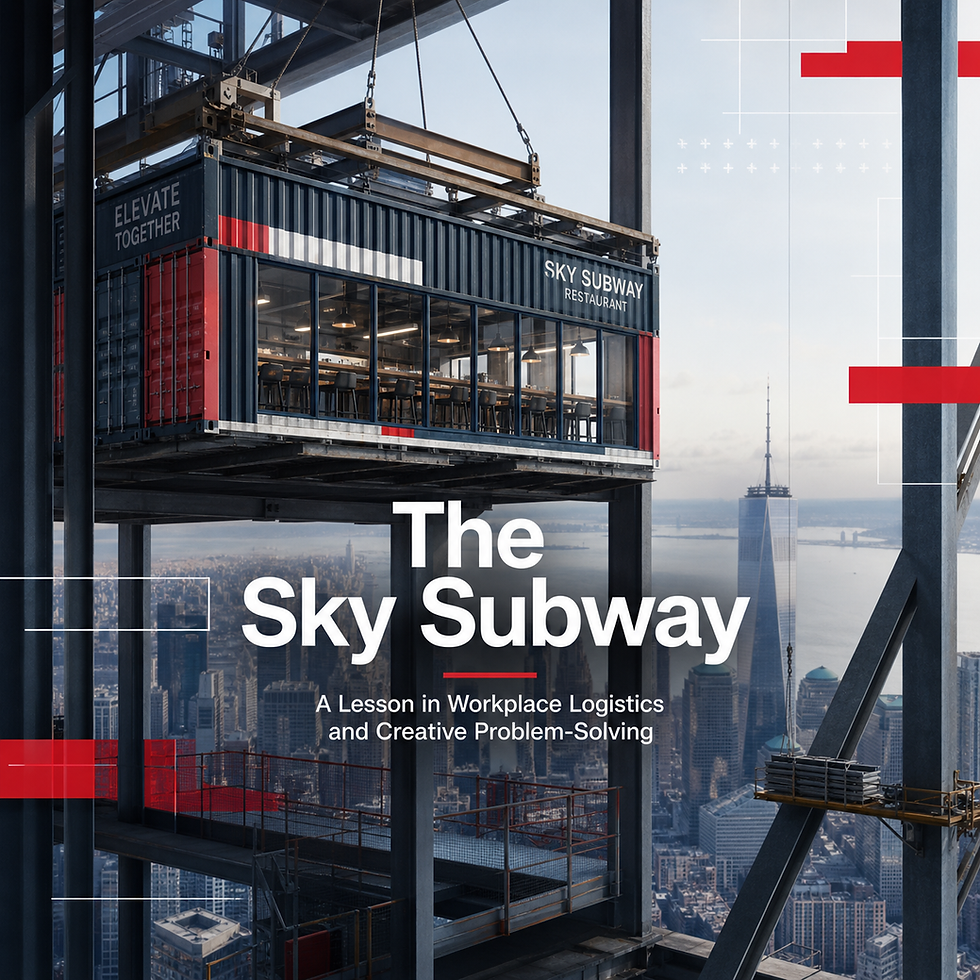
In 2010, during the construction of One World Trade Center in New York, an unusual workplace solution attracted public attention: a Subway restaurant was created inside shipping containers and placed high within the construction site. As the building grew, the restaurant moved upward with the workers. Its purpose was simple but important: to reduce the time workers spent traveling down to street level for food and to help them use their break time more effectively. This article presents the case as a positive learning example for students of SIU Swiss International University. It explores how a small operational idea can create practical value in a complex work environment. Using concepts from workplace logistics, Bourdieu’s theory of capital, world-systems theory, and institutional isomorphism, the article explains how organizations solve problems by adapting resources, routines, and spaces to human needs. The case shows that innovation does not always require advanced technology. Sometimes, innovation means observing a real problem, respecting the people affected by it, and designing a simple solution that improves daily work. For students, the case offers lessons in logistics, management, employee welfare, operational flexibility, and creative leadership.
Introduction
Large construction projects are often described through impressive numbers: height, cost, materials, deadlines, and engineering achievements. Yet behind every major project are human beings who must work, rest, eat, communicate, and stay safe. The construction of One World Trade Center was not only a technical project. It was also a workplace where thousands of daily decisions had to be organized with care.
One of the most interesting examples from this project was the creation of a small restaurant high inside the construction site. Built from shipping containers, the restaurant served workers without requiring them to spend much of their lunch break traveling down to street level. As the tower rose, the restaurant was lifted higher. This practical solution became known informally as a “Subway in the sky.”
For SIU Swiss International University students, this story is useful because it connects theory with real life. It shows how logistics, management, and creativity can meet in one simple idea. The issue was not only about selling food. It was about time, energy, safety, productivity, and respect for workers’ daily needs.
In management education, students often study large strategies, financial models, global markets, and leadership theories. These are important. However, good management also depends on noticing small problems that affect people every day. A worker who spends most of a break traveling for food has less time to rest. A team that loses many minutes each day may lose productivity. A construction site that provides better access to food may also improve morale and workflow.
This article examines the case as a learning model. It uses an academic structure but keeps the language simple and practical. The main argument is that creative problem-solving in the workplace begins with understanding real human needs and then designing systems that support them.
Background and Theoretical Framework
Workplace Logistics and Human-Centered Operations
Workplace logistics refers to the planning and movement of people, goods, services, and information within a work environment. In many organizations, logistics is seen mainly as transportation, supply chains, or storage. However, logistics also includes the small systems that make daily work possible: where workers eat, where tools are stored, how people move, and how services reach the right location at the right time.
The One World Trade Center restaurant case shows that logistics can be human-centered. The problem was not only how to bring food to a construction site. The deeper problem was how to protect workers’ time and energy. As the tower became higher, traveling down to street level became less practical. The solution was to move the food service closer to the workers.
This is an important lesson: good logistics reduces unnecessary effort. It does not only move objects; it supports people.
Bourdieu: Capital, Field, and Practical Sense
Pierre Bourdieu’s theory helps explain why this case matters beyond its surface details. Bourdieu argued that social life takes place in “fields,” where people use different forms of capital. Capital can be economic, social, cultural, or symbolic.
In this case, the construction site can be seen as a field. Workers, contractors, managers, engineers, and service providers all operated within this field. The restaurant added value in several forms. Economically, it reduced lost time. Socially, it created a shared place where workers could gather. Symbolically, it showed recognition of workers’ needs. Practically, it demonstrated what Bourdieu might call a sense of the game: understanding how daily routines actually work and adjusting them intelligently.
For students, this is important because successful organizations are not managed only through formal plans. They are also managed through practical understanding. A manager must know how people really move, eat, wait, communicate, and experience the workplace.
World-Systems Theory: Global Symbols and Local Work
World-systems theory, associated with Immanuel Wallerstein, examines how economic and social systems are connected across the world. A major building such as One World Trade Center can be viewed as part of a global city system. New York is a symbolic center of finance, architecture, and international business. Yet even in such a global project, success depended on local work: steelworkers, food service staff, logistics teams, and site managers.
This creates an important learning point. Global projects are built through local actions. A skyscraper may represent international power and modernity, but its progress depends on practical daily systems. The shipping-container restaurant was a small local solution inside a globally visible project. It reminds students that global achievement often depends on well-organized human details.
Institutional Isomorphism: Adaptation and Legitimacy
Institutional isomorphism, developed by Paul DiMaggio and Walter Powell, explains how organizations often become similar because they respond to professional norms, regulations, and expectations. However, organizations also adapt when they face unique problems. In this case, a familiar business model was adapted to an unusual environment. A restaurant normally operates at street level or inside a fixed building. Here, the model was changed to fit a moving construction site.
This shows a positive form of adaptation. The organization kept the basic service but changed the setting, structure, and delivery method. For students, the lesson is that institutions and businesses must often balance standard procedures with flexible action. Good management does not simply copy existing models. It adapts them to context.
Method
This article uses a qualitative case-study method. The case-study approach is suitable because the purpose is not to measure one variable statistically, but to understand how a practical solution worked in a real workplace context.
The analysis is based on three steps.
First, the case is described as a workplace logistics problem. The main issue was the difficulty of accessing food during break times as construction moved higher above street level.
Second, the case is interpreted through selected academic theories: Bourdieu’s concepts of capital and field, world-systems theory, and institutional isomorphism. These theories are used to give deeper meaning to a practical example.
Third, the article extracts educational lessons for SIU Swiss International University students. The goal is to connect the case to management, logistics, leadership, and problem-solving skills.
This method is appropriate for teaching because it turns a short real-world example into a broader learning framework. It encourages students to move from description to interpretation, and from interpretation to practical application.
Analysis
The Problem: Time Lost in Movement
The first problem was time. On a construction site that rises floor by floor, movement becomes more complex. Workers need to move safely through temporary structures, equipment, elevators, stairs, and controlled access points. A simple lunch break can become difficult when the workplace is high above the street.
If workers spend too much time traveling to buy food, the break loses its purpose. Breaks are not only empty spaces in the schedule. They are part of productivity. Workers need time to rest, eat, and return with focus. A break that becomes a long journey can reduce energy and create frustration.
The restaurant solved this problem by changing the location of the service. Instead of making workers travel to food, food traveled closer to the workers. This is a powerful logistics principle: when the user’s movement is costly, move the service closer to the user.
The Solution: A Flexible Service Model
The solution was creative because it used shipping containers, a practical and movable structure. Containers are strong, modular, and adaptable. They can be transported and positioned in unusual spaces. In this case, the container became more than a storage unit. It became a workplace service platform.
The restaurant also moved upward as construction advanced. This made the solution dynamic, not static. It did not solve only one day’s problem. It changed with the project. This is an important management lesson: in fast-changing environments, solutions must be designed to move, adjust, and grow.
For SIU students, this case shows the difference between a fixed solution and an adaptive solution. A fixed solution works only under one condition. An adaptive solution continues to work as conditions change.
The Human Value of Logistics
The case also shows that logistics has a human side. It is easy to think of logistics as technical planning, but logistics affects dignity, comfort, and morale. By placing food near the workers, the project recognized that workers’ time mattered.
This does not mean that every workplace needs an unusual restaurant. The broader lesson is that good organizations study the daily experience of their people. They ask simple but important questions: What wastes time? What creates stress? What can be moved closer? What can be simplified? What small change would make the working day better?
These questions are valuable in construction, education, healthcare, hospitality, technology, and public administration. They are also useful for students planning future careers in management and entrepreneurship.
Bourdieu and the Recognition of Workers’ Needs
Through Bourdieu’s lens, the restaurant created more than economic value. It created symbolic value. It sent a message that workers were not invisible. Their time, comfort, and routine were part of the project’s success.
This kind of symbolic capital matters in organizations. When people feel that their needs are understood, they may experience stronger belonging and motivation. A small service can carry a large meaning. It can show respect, attention, and practical care.
The case also reflects cultural capital in the form of practical knowledge. The people who designed the solution understood the workplace culture of construction: time is limited, safety matters, and convenience affects productivity. This practical knowledge helped create a solution that made sense in the field.
World-Systems Theory and the Local Reality of Global Projects
One World Trade Center is globally recognized. It belongs to the image of New York and to the wider world of architecture, finance, and urban development. Yet the restaurant case reminds us that global symbols are built through local labor and daily organization.
World-systems theory often focuses on large structures, but this case helps students see the connection between macro and micro levels. The macro level is the global city and the symbolic skyscraper. The micro level is the worker’s lunch break. Both are connected. A global project cannot move forward without solving local problems.
This is a valuable lesson for students in international business and management. Global thinking must not ignore practical details. A leader who understands only strategy but not daily operations will miss important realities.
Institutional Isomorphism and Smart Adaptation
The restaurant also shows how a standard business model can be reshaped. A food outlet usually follows certain institutional expectations: fixed location, customer entrance, public access, regular supply routes, and normal waste systems. In this case, these expectations had to be modified. The restaurant became part of a construction process.
This is where institutional isomorphism becomes interesting. Organizations often follow familiar models because these models are trusted and legitimate. But when the environment changes, legitimacy can also come from adaptation. The restaurant remained recognizable as a food service, but it adjusted its form to fit the site.
For students, the message is clear: professional standards are important, but they must be applied intelligently. The best organizations do not abandon standards; they translate them into the context where they are needed.
Findings
This case offers several findings for students and educators.
First, creative problem-solving often begins with a simple observation. The problem was not abstract. Workers needed food without losing too much time. The solution came from understanding this basic reality.
Second, workplace logistics can improve both productivity and human experience. Saving time was not only an economic benefit. It also gave workers a better break and a more practical workday.
Third, innovation does not always require complex technology. A shipping container, a service idea, and an adaptive location were enough to create a memorable solution.
Fourth, organizations create value when they respect the practical needs of people. The restaurant was useful because it was designed around workers’ real conditions.
Fifth, theory can help explain everyday management decisions. Bourdieu shows the value of social and symbolic recognition. World-systems theory connects local work to global projects. Institutional isomorphism explains how standard models can be adapted to unusual settings.
Sixth, students should learn to see logistics as a strategic function. Moving food closer to workers may seem small, but it reflects planning, resource use, time management, and organizational care.
Seventh, the case supports a positive model of leadership. Good leaders look for barriers that slow people down and then remove them with practical solutions.
Conclusion
The restaurant built high inside the One World Trade Center construction site is more than an unusual story. It is a useful educational case about logistics, creativity, and human-centered management. It shows that real innovation often appears when people pay attention to daily problems and design simple solutions that fit the context.
For SIU Swiss International University students, the case offers a clear lesson: management is not only about large plans. It is also about small improvements that make work easier, safer, and more effective. A good manager studies the workplace as it truly functions. A good leader respects people’s time. A creative professional asks how a service, system, or process can be redesigned to support real human needs.
Through Bourdieu, the case shows the importance of practical sense and symbolic recognition. Through world-systems theory, it shows that global projects depend on local workers and daily routines. Through institutional isomorphism, it shows that standard business models can be adapted positively to special environments.
The “Sky Subway” example teaches students that creative problem-solving is not always dramatic. Sometimes it is practical, modest, and direct. It begins with the question: what problem are people facing every day, and how can we solve it in a way that respects their time and improves their work?
That question is central to modern education, professional development, and responsible leadership.
References
Bourdieu, P. (1984). Distinction: A Social Critique of the Judgement of Taste. Harvard University Press.
Bourdieu, P. (1990). The Logic of Practice. Stanford University Press.
Christopher, M. (2016). Logistics and Supply Chain Management. Pearson.
DiMaggio, P. J., & Powell, W. W. (1983). “The Iron Cage Revisited: Institutional Isomorphism and Collective Rationality in Organizational Fields.” American Sociological Review, 48(2), 147–160.
Giddens, A. (1984). The Constitution of Society: Outline of the Theory of Structuration. University of California Press.
Mintzberg, H. (2009). Managing. Berrett-Koehler Publishers.
Scott, W. R. (2014). Institutions and Organizations: Ideas, Interests, and Identities. SAGE Publications.
Wallerstein, I. (2004). World-Systems Analysis: An Introduction. Duke University Press.


Comments