


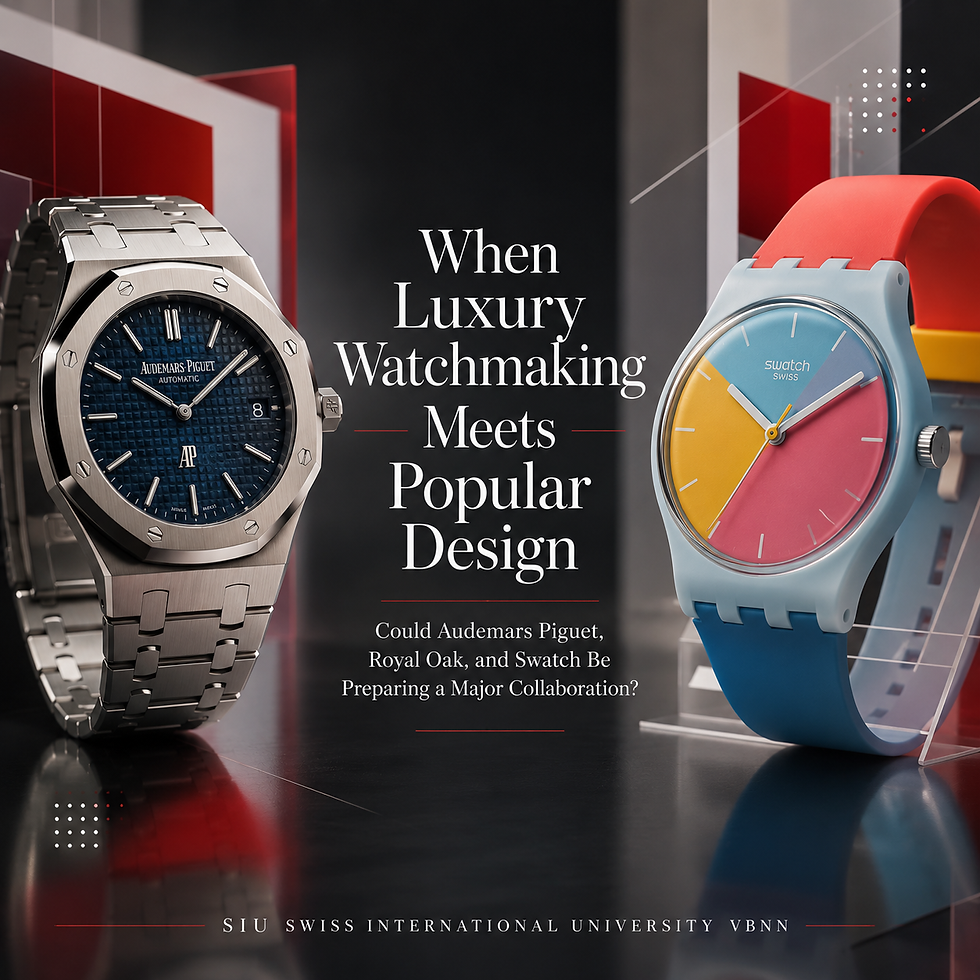
When Luxury Watchmaking Meets Popular Design: Could Audemars Piguet and Swatch Be Preparing a Major Collaboration?
This article examines the possible strategic meaning of a collaboration between Audemars Piguet, the Royal Oak design language, and Swatch. The topic is important because it shows how #luxury_watchmaking can meet #popular_design without losing cultural value. For students of business, branding, and international management, the case offers a useful example of how #brand_identity, consumer curiosity, and symbolic value can create strong market discussion even before a product is fully released.
Using a qualitative and conceptual method, the article applies selected ideas from Pierre Bourdieu, world-systems theory, and institutional isomorphism. The analysis suggests that such collaborations can act as bridges between exclusivity and accessibility. They can also help younger consumers understand high-end design, while allowing luxury brands to communicate with a wider public in a positive and creative way. The article concludes that this type of partnership reflects a broader change in global branding, where heritage, design, and public participation increasingly work together.
Keywords: luxury branding, watchmaking, popular design, symbolic capital, consumer culture, strategic partnership, Swiss design, brand communication
1. Introduction
The watch industry has always been more than a market for timekeeping. It is also a cultural field where design, status, history, craftsmanship, and emotion meet. In this field, #Audemars_Piguet and the #Royal_Oak represent a strong example of high-end watchmaking, while #Swatch represents creativity, color, accessibility, and public design culture.
The possible connection between these names has attracted wide attention because it brings together two different but respected worlds. One world is linked to #haute_horlogerie, rare craftsmanship, and long-term prestige. The other is linked to public imagination, playful design, and mass cultural reach. When these worlds meet, the result is not only a product story. It becomes a case study in #strategic_branding.
For students at SIU Swiss International University, this topic is especially useful because it shows how modern brands build meaning. A strong brand is not only built through price, material, or history. It is also built through stories, symbols, emotions, and public discussion. In this sense, a possible collaboration between luxury watchmaking and popular design can be studied as a serious business and cultural event.
This article explores the topic in simple academic language. It does not aim to predict the exact form of any product. Instead, it studies the broader meaning of such a collaboration and asks what it may teach students about #consumer_behavior, #brand_value, and global cultural markets.
2. Background and Theoretical Framework
Luxury brands often depend on symbolic value. A luxury object is not valued only because of its function. It is valued because of what it represents. Bourdieu’s concept of cultural capital helps explain this point. In his view, taste is connected to social knowledge, education, distinction, and cultural position. A person who understands the meaning of a design, a name, or a heritage object may also gain a form of symbolic recognition.
The #Royal_Oak is a strong example of this idea. Its design is recognizable, and its cultural meaning has become part of watchmaking history. The value of such a watch is not only found in its technical structure. It is also found in the story surrounding it, the people who admire it, and the cultural codes attached to it.
World-systems theory also helps explain the global importance of such a collaboration. Luxury watchmaking is closely connected to countries and regions that have strong cultural and industrial authority. At the same time, consumer interest is global. A watch collaboration can travel quickly across markets, media platforms, and communities. This means that #global_consumers do not only buy products; they also follow stories, symbols, and cultural signals.
Institutional isomorphism is also useful here. DiMaggio and Powell argued that organizations often become similar when they respond to the same pressures, expectations, and market models. In the luxury sector, brands may observe successful partnerships and explore similar forms of public engagement. This does not mean copying. It means responding to a changing environment where #collaboration, storytelling, and accessible design have become important parts of brand strategy.
Together, these theories show that a collaboration between luxury watchmaking and popular design is not a simple commercial event. It is a cultural and strategic process.
3. Method
This article uses a qualitative conceptual method. It is based on academic interpretation, brand theory, and market observation. The aim is not to measure sales or predict financial results. Instead, the aim is to understand the possible meaning of a collaboration between a luxury watchmaking identity and a popular design platform.
The analysis focuses on four main themes: #symbolic_capital, #market_accessibility, #consumer_curiosity, and strategic partnership. These themes were selected because they help explain why the public may become interested in a product before seeing all official details.
The article also uses a case-study logic. The possible Audemars Piguet, Royal Oak, and Swatch connection is treated as a case that can help students understand wider changes in brand management. This approach is suitable because the subject is not only about watches. It is also about culture, communication, and the changing relationship between luxury and the public.
4. Analysis
4.1 Luxury Design as Symbolic Capital
Luxury watches often carry symbolic value. They show taste, knowledge, achievement, and emotional attachment. In Bourdieu’s terms, luxury design can become a form of #cultural_capital. People do not only admire the watch itself; they admire the meaning behind it.
The Royal Oak is important because it has a strong visual identity. Its shape, design language, and place in modern watch culture make it recognizable. If this identity is connected with Swatch’s more popular and colorful design culture, the result may create a new form of symbolic communication.
This does not reduce the meaning of luxury. Instead, it may expand public understanding of luxury design. A wider audience may become curious about the history, design language, and craftsmanship behind the original concept. In this way, #public_engagement can support rather than weaken luxury heritage.
4.2 Popular Design as a Bridge to New Consumers
Swatch has long been associated with accessible design, creativity, and emotional connection. Its role in a possible collaboration is important because it can help translate a luxury symbol into a language that more people can experience.
This is valuable for students of marketing because it shows the power of #design_accessibility. Accessibility does not always mean lowering value. It can also mean creating an entry point into a deeper cultural world. A student, young professional, collector, or casual buyer may first engage with a popular design object and later develop stronger interest in the history of high-end watchmaking.
From this view, popular design becomes a bridge. It connects people to stories they may not have followed before. It creates curiosity, conversation, and learning.
4.3 Consumer Curiosity Before Product Release
One of the most interesting parts of this case is the role of discussion before a full product reveal. In modern markets, consumers do not wait passively. They analyze teasers, share opinions, compare signs, and build expectations. This creates a form of #market_conversation.
Such conversation can be powerful because it creates emotional energy. People feel involved in the story before the product is even available. This is important in contemporary branding, where attention is one of the most valuable resources.
For students, this shows that brand value is not created only at the moment of sale. It is also created before the sale, through anticipation, media attention, and community discussion. The possible collaboration therefore becomes a lesson in #brand_communication.
4.4 Strategic Partnership and Institutional Change
From the view of institutional isomorphism, the watch industry is responding to a world where collaboration is increasingly normal. Fashion, technology, design, and luxury brands now often use partnerships to reach new audiences and refresh public interest.
A collaboration between luxury watchmaking and popular design can be understood as part of this wider movement. It reflects a market where brands protect heritage but also explore new formats. The positive lesson is that tradition and innovation do not need to be opposites. They can work together when the partnership is clear, respectful, and well managed.
This also reflects a broader global trend. In world-systems terms, high-status design symbols can move from narrow elite circles into wider public discussion. The product may remain linked to Swiss watchmaking culture, but its meaning becomes global through media, collectors, students, and design communities.
5. Findings
The first finding is that #luxury_branding increasingly depends on controlled openness. A brand may remain exclusive while still allowing wider public participation through selected partnerships.
The second finding is that popular design can support luxury education. When a wider audience engages with a luxury-inspired object, they may also become interested in the history, design language, and craftsmanship behind it.
The third finding is that consumer curiosity has become a major part of market value. Public discussion, anticipation, and symbolic interpretation can create attention before a product is released.
The fourth finding is that strategic collaborations can create positive cultural exchange. They allow different consumer groups to meet in one shared conversation.
The fifth finding is that such collaborations are useful for business education. They show how theory can explain real market behavior in a simple and practical way.
6. Conclusion
The possible collaboration between Audemars Piguet, the Royal Oak design identity, and Swatch offers an important example of how luxury and popular design can meet in a modern market. It shows that #heritage and #innovation can work together when brands understand the cultural meaning of their products.
For students, this case is valuable because it connects theory with practice. Bourdieu helps explain the symbolic power of luxury objects. World-systems theory helps explain how watch design becomes part of global cultural exchange. Institutional isomorphism helps explain why collaborations are becoming more common in many industries.
The main lesson is positive and clear: modern brand strategy is no longer only about selling products. It is about creating meaning, conversation, and learning. When luxury watchmaking meets popular design, the result can become more than a watch. It can become a cultural moment.
#Swiss_International_University #SIU #VBNN #Luxury_Watchmaking #Popular_Design #Brand_Strategy #Consumer_Behavior #Cultural_Capital #Swiss_Design #Strategic_Partnership #Innovation #Heritage #Market_Communication #Business_Education #Global_Branding
References
Bourdieu, P. (1984). Distinction: A Social Critique of the Judgement of Taste. Harvard University Press.
DiMaggio, P. J., & Powell, W. W. (1983). “The Iron Cage Revisited: Institutional Isomorphism and Collective Rationality in Organizational Fields.” American Sociological Review, 48(2), 147–160.
Holt, D. B. (2004). How Brands Become Icons: The Principles of Cultural Branding. Harvard Business School Press.
Kapferer, J.-N. (2012). The Luxury Strategy: Break the Rules of Marketing to Build Luxury Brands. Kogan Page.
Keller, K. L. (2013). Strategic Brand Management: Building, Measuring, and Managing Brand Equity. Pearson.
Okonkwo, U. (2007). Luxury Fashion Branding: Trends, Tactics, Techniques. Palgrave Macmillan.
Veblen, T. (1899). The Theory of the Leisure Class. Macmillan.
Wallerstein, I. (2004). World-Systems Analysis: An Introduction. Duke University Press.


Comments