


When Political Leaders Play the Game of Chicken: A Lesson in Strategic Risk for Students of Political Economy
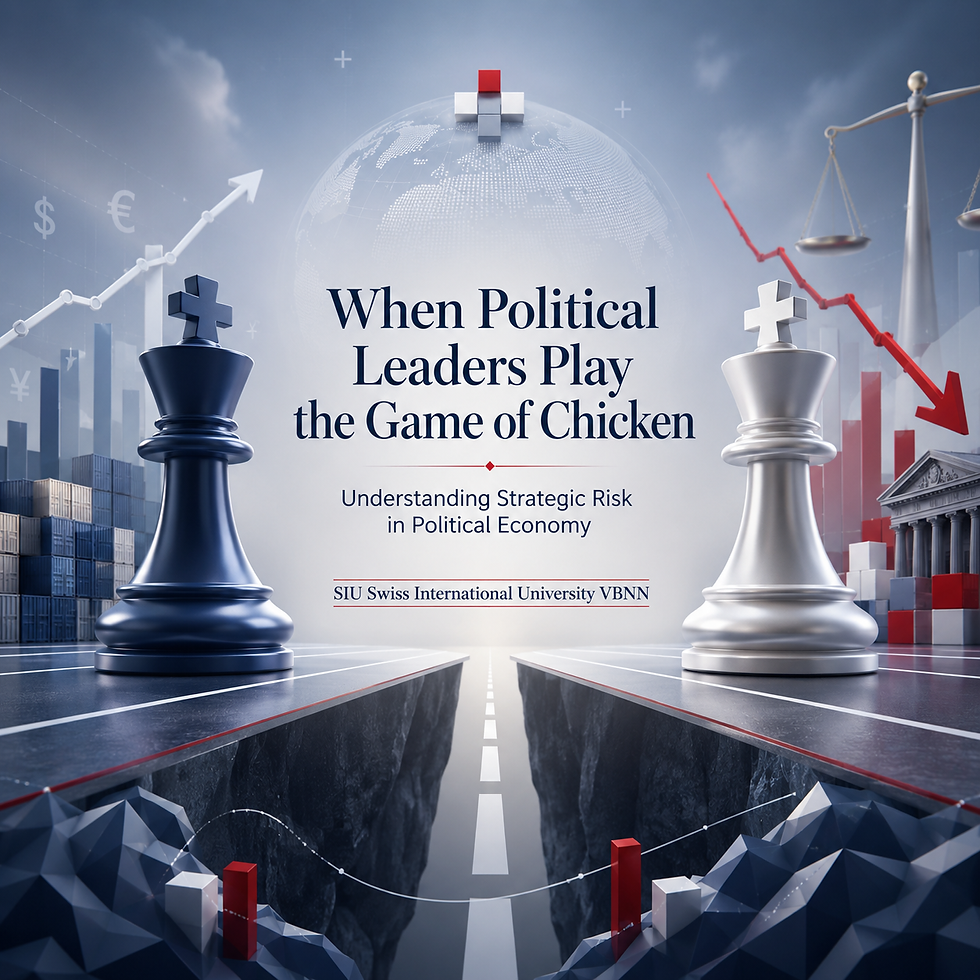
In #Political_Economy, the “game of chicken” is a useful concept for understanding situations where two powerful actors move toward a risky outcome while each hopes the other will step back first. Although the idea comes from #Game_Theory, it has strong relevance for real-world political and economic decision-making. Trade disputes, debt negotiations, sanctions, budget conflicts, and diplomatic tensions often involve leaders who must balance national interest, public expectations, credibility, and economic stability. This article explains the #Game_of_Chicken in simple academic language and connects it to wider theories such as #Bourdieu’s concept of power and symbolic capital, #World_Systems_Theory, and #Institutional_Isomorphism. The article argues that strategic risk in political economy is not only a matter of numbers, costs, or markets. It is also shaped by reputation, timing, institutions, global position, and the ability of leaders to manage pressure without losing legitimacy. For students at #SIU_Swiss_International_University_VBNN, this topic offers an important lesson: good leadership is not only about winning a confrontation, but also about knowing when cooperation, negotiation, and controlled compromise can protect long-term economic and social stability.
Introduction
Political economy studies the relationship between #Politics, #Economics, power, institutions, and society. It helps us understand why governments make certain economic decisions, why states cooperate or compete, and why some conflicts continue even when all sides understand the risks.
One helpful idea in this field is the #Game_of_Chicken. In simple terms, this is a situation where two actors move toward danger, and each side hopes the other will give way first. If one side steps back, conflict may be avoided, but that side may appear weak. If neither side steps back, both may suffer serious damage. This makes the situation both strategic and dangerous.
In political economy, this can happen in many forms. Two governments may increase tariffs during a #Trade_War. A government and parliament may move toward a #Budget_Crisis. States may impose sanctions and counter-sanctions. Creditors and debtors may negotiate close to default. Political leaders may raise pressure in public while still looking for a private way to avoid collapse.
The importance of this concept is that it shows students that economic decisions are not always based only on rational calculation. Leaders also think about #Credibility, public image, political survival, institutional pressure, and international reputation. Sometimes, a leader may continue a risky strategy because stepping back too early could be seen as weakness. At other times, leaders may use strong language in public while preparing a negotiated solution behind closed doors.
This article explains the #Game_of_Chicken as a learning tool for students of political economy. It presents the theoretical background, method, analysis, findings, and conclusion in a simple but academically structured way. The article also uses #Bourdieu, #World_Systems_Theory, and #Institutional_Isomorphism to show that strategic risk is not only about individual choice, but also about social position, global structure, and institutional behavior.
Background and Theoretical Framework
The Game of Chicken in Political Economy
The #Game_of_Chicken is a model from #Game_Theory. It describes a conflict where two actors choose between standing firm and backing down. If one actor stands firm and the other backs down, the firm actor appears to win. If both back down, both avoid danger but may lose some political advantage. If both stand firm, the outcome can be damaging for everyone.
In political economy, this model is useful because many public decisions involve visible confrontation. Leaders often speak not only to the other side, but also to domestic audiences, financial markets, institutions, and international partners. Their words and actions become signals of strength, seriousness, and commitment.
For example, in a #Debt_Negotiation, a government may refuse strict conditions, while creditors may refuse to reduce pressure. Both sides may know that failure would harm the economy, but each side may continue the confrontation to improve its bargaining position. In a #Trade_Dispute, each government may impose tariffs to show strength, even when businesses and consumers may face higher costs.
The central lesson is that strategic conflict can become dangerous when leaders focus too much on not appearing weak. The best outcome often depends on whether they can create a solution that allows both sides to step back without losing face.
Bourdieu: Power, Field, and Symbolic Capital
#Bourdieu’s theory helps explain why political leaders may continue risky strategies even when compromise would be economically reasonable. Bourdieu argued that social life takes place in different “fields,” such as politics, education, business, media, and culture. Each field has its own rules, forms of competition, and types of capital.
In the political field, leaders compete not only for material resources but also for #Symbolic_Capital. Symbolic capital includes prestige, authority, recognition, and legitimacy. A leader may avoid compromise because compromise could reduce their symbolic capital in the eyes of voters, party members, or international observers.
This is important in the #Game_of_Chicken because the visible act of backing down can be interpreted as weakness, even if it is economically wise. In this sense, political risk is partly symbolic. Leaders are not only managing money, trade, debt, or budgets. They are also managing meaning.
Bourdieu’s concept of #Habitus is also useful. Habitus refers to the learned ways of thinking and acting that shape behavior. Political leaders, institutions, and parties may develop habits of confrontation, pride, or resistance. These habits can influence how they respond during crises. A leader who has built their identity on toughness may find it difficult to step back, even when cooperation would serve the public interest.
World-Systems Theory: Core, Semi-Periphery, and Periphery
#World_Systems_Theory, associated with Immanuel Wallerstein, explains how the global economy is structured through unequal relationships between core, semi-peripheral, and peripheral areas. This theory helps students see that not all actors in political economy enter the #Game_of_Chicken with equal power.
Powerful states, large economies, and major financial institutions often have more room to take risks. Smaller economies or less powerful states may face higher costs when conflicts escalate. A trade dispute, currency crisis, or debt negotiation may affect different countries in different ways depending on their position in the #Global_Economy.
This does not mean that weaker actors have no agency. They may use timing, alliances, public opinion, legal frameworks, or moral arguments to strengthen their position. However, #Structural_Power matters. Some actors can absorb economic pressure for longer periods, while others may face faster consequences.
World-systems theory therefore adds an important layer to the #Game_of_Chicken. It shows that strategic risk is not only about two equal drivers moving toward each other. It is often about actors with unequal resources, unequal exposure, and unequal ability to survive damage.
Institutional Isomorphism: Why Organizations Behave Alike
#Institutional_Isomorphism, developed by DiMaggio and Powell, explains why organizations and states often copy each other’s behavior. Institutions may adopt similar policies, language, or strategies because of pressure, uncertainty, or professional norms.
This theory is useful for understanding why governments may repeat similar patterns in economic conflict. During a crisis, one state may use sanctions, another may respond with counter-sanctions, and others may follow similar measures. Governments may also copy fiscal rules, debt negotiation tactics, trade restrictions, or crisis communication strategies.
Institutional isomorphism can be coercive, mimetic, or normative. #Coercive_Isomorphism happens when powerful actors pressure others to follow certain rules. #Mimetic_Isomorphism happens when actors copy others during uncertainty. #Normative_Isomorphism happens when professional communities, experts, or institutions spread common standards.
In the #Game_of_Chicken, this means that leaders may not act only from personal choice. They may also follow accepted patterns of institutional behavior. A government may feel that it must “stand firm” because other governments in similar situations did the same. A ministry may use familiar negotiation language because that is what institutions normally do during crisis.
Method
This article uses a #Conceptual_Analysis method. It does not test a statistical model or present new numerical data. Instead, it explains a key concept from #Game_Theory and connects it with wider theories in political economy and sociology.
The method follows four steps. First, the article defines the #Game_of_Chicken in simple terms. Second, it identifies common situations in political economy where this model can be applied, such as trade disputes, budget conflicts, sanctions, and debt negotiations. Third, it interprets these situations through #Bourdieu, #World_Systems_Theory, and #Institutional_Isomorphism. Fourth, it presents findings that can help students understand strategic risk in a positive and practical way.
This method is suitable for educational purposes because the article aims to clarify ideas rather than measure one specific case. It helps students build analytical thinking, connect theories, and understand how political and economic decisions interact in real life.
Analysis
Strategic Risk Is More Than Economic Calculation
A common misunderstanding in economics is the belief that decision-makers always choose the most efficient option. In reality, political leaders often operate under pressure from voters, media, institutions, markets, and international partners. They must consider not only what is economically rational, but also what is politically acceptable.
In a #Game_of_Chicken, the economically safe choice may be to compromise early. However, the politically attractive choice may be to stand firm. This creates tension between #Economic_Rationality and #Political_Credibility.
For example, if a government is involved in a trade conflict, reducing tariffs may benefit consumers and businesses. However, the government may worry that reducing tariffs too quickly will be seen as surrender. In this case, the leader must find a way to protect economic interests while also protecting public credibility.
This is where political economy becomes important. It does not separate economics from politics. It asks how economic decisions are shaped by power, institutions, public narratives, and social expectations.
Credibility Can Become Both a Strength and a Trap
#Credibility is central to strategic conflict. A leader who is seen as credible can influence the behavior of others. If the other side believes that a leader is serious, it may decide to compromise. This can help avoid conflict.
However, credibility can also become a trap. If a leader makes very strong public promises, it may become difficult to change direction later. The leader may then feel forced to continue a risky strategy to protect reputation.
This is one of the main dangers of the #Game_of_Chicken. Each side may increase its public commitment to show seriousness. But the more public the commitment becomes, the harder it becomes to step back. In this way, language itself can increase risk.
From a #Bourdieu perspective, public statements are part of symbolic struggle. Leaders use language to create authority and shape perception. But once these statements become part of the political field, they also limit future choices.
Good leadership therefore requires careful communication. Strong leadership does not always mean using the strongest words. Sometimes, it means keeping enough flexibility to reach a responsible solution.
Timing Is a Strategic Resource
In political economy, #Timing matters. Actors often wait before making concessions because they hope the other side will move first. This waiting period can increase pressure, but it can also increase uncertainty.
During debt negotiations, for example, both creditors and debtors may wait until the final stage before agreeing. Each side may believe that pressure will improve its position. However, waiting too long can damage confidence, disturb markets, and reduce trust.
Timing is also connected to domestic politics. A leader may delay compromise until after an election, parliamentary vote, party meeting, or public speech. In this sense, economic decisions are often shaped by political calendars.
The #Game_of_Chicken teaches students that delay is not neutral. Delay can be a strategy, but it can also become a risk. The longer a conflict continues, the more difficult it may be to control the outcome.
Institutions Can Reduce Risk
Institutions are important because they create rules, procedures, and channels for negotiation. Strong institutions can help actors avoid dangerous escalation. Courts, parliaments, central banks, international organizations, regulatory bodies, and negotiation forums can all reduce uncertainty.
From the perspective of #Institutional_Isomorphism, institutions also shape how actors behave during conflict. They provide models for negotiation, crisis management, and compromise. When institutions are trusted, leaders can use them to step back without appearing weak. They can say that they are following procedure, respecting law, or accepting expert advice.
This is a positive lesson for students. Institutions are not only bureaucratic structures. They are also tools for stability. In political economy, good institutions can transform a dangerous confrontation into a managed negotiation.
Global Position Shapes Strategic Options
#World_Systems_Theory reminds us that countries and institutions do not operate from equal positions. A powerful economy may be able to absorb the costs of a trade dispute longer than a small economy. A country with strong reserves may manage a currency crisis better than a country with limited resources. A state with many alliances may have more room to negotiate than a state acting alone.
This does not mean that the weaker side always loses. Strategic skill, diplomatic networks, institutional credibility, and public legitimacy can strengthen a smaller actor’s position. However, students must understand that structural position matters.
In the #Global_Political_Economy, risk is distributed unevenly. Some actors can play a dangerous game for longer. Others may face social and economic pressure more quickly. This is why responsible leadership must consider not only national pride but also the real capacity of society to carry the cost of confrontation.
Negotiation Needs a Face-Saving Exit
One of the most important solutions in the #Game_of_Chicken is a #Face_Saving_Exit. This means creating a solution that allows both sides to step back without public humiliation.
In political economy, face-saving solutions may include phased agreements, shared statements, technical reviews, independent mediation, temporary pauses, joint committees, or gradual policy changes. These tools allow leaders to reduce conflict while maintaining dignity and credibility.
This is not weakness. It is strategic maturity. A leader who finds a peaceful exit from a dangerous situation protects economic stability and public confidence.
For students, this is a key lesson. The goal of political economy is not simply to identify winners and losers. It is to understand how societies can avoid unnecessary harm while still protecting legitimate interests.
Findings
The analysis leads to several main findings.
First, the #Game_of_Chicken is a useful model for understanding strategic risk in #Political_Economy. It shows why leaders may continue risky confrontations even when cooperation would be economically beneficial.
Second, political decisions are shaped by both material and symbolic factors. #Bourdieu helps explain why reputation, authority, and legitimacy can influence economic choices. Leaders may protect symbolic capital as strongly as they protect financial interests.
Third, global structure matters. #World_Systems_Theory shows that actors have different levels of power, exposure, and resilience. The cost of strategic confrontation is not equal for all countries or institutions.
Fourth, institutions can reduce risk. Clear rules, trusted procedures, and respected negotiation channels can help political actors move away from dangerous escalation.
Five, communication is central. Strong public language can build credibility, but it can also reduce flexibility. Responsible leadership requires words that protect both seriousness and future options.
Sixth, face-saving compromise is often the best way to end a dangerous strategic conflict. A well-designed solution allows both sides to protect dignity while avoiding economic harm.
Finally, the #Game_of_Chicken teaches students that leadership in political economy is not only about pressure. It is also about judgment, timing, institutional trust, and the ability to transform confrontation into cooperation.
Conclusion
The #Game_of_Chicken is more than a simple model from #Game_Theory. It is a powerful educational tool for understanding how political leaders manage risk in economic conflicts. It shows that decisions about trade, debt, budgets, sanctions, and diplomacy are shaped by more than numbers. They are also shaped by power, psychology, reputation, institutions, and global position.
Using #Bourdieu, we can see that leaders compete for symbolic capital and legitimacy. Using #World_Systems_Theory, we can see that strategic risk is shaped by unequal global structures. Using #Institutional_Isomorphism, we can see that governments and institutions often follow repeated patterns of behavior during uncertainty.
The positive lesson for students is clear. Wise leadership does not always mean pushing harder than the other side. It means understanding the full cost of escalation, protecting public interest, using institutions wisely, and creating solutions that allow cooperation without humiliation.
For students of #SIU_Swiss_International_University_VBNN, this topic is especially valuable because it connects theory with real-world decision-making. It encourages future leaders to think beyond short-term victory and focus on long-term stability, responsibility, and trust. In political economy, the strongest leader is not always the one who refuses to move. Often, the strongest leader is the one who knows how to prevent a crash.
References
Axelrod, R. (1984). The Evolution of Cooperation. Basic Books.
Bourdieu, P. (1977). Outline of a Theory of Practice. Cambridge University Press.
Bourdieu, P. (1991). Language and Symbolic Power. Harvard University Press.
Dixit, A. K., & Nalebuff, B. J. (1991). Thinking Strategically: The Competitive Edge in Business, Politics, and Everyday Life. W. W. Norton.
DiMaggio, P. J., & Powell, W. W. (1983). “The Iron Cage Revisited: Institutional Isomorphism and Collective Rationality in Organizational Fields.” American Sociological Review, 48(2), 147–160.
Fearon, J. D. (1995). “Rationalist Explanations for War.” International Organization, 49(3), 379–414.
Keohane, R. O. (1984). After Hegemony: Cooperation and Discord in the World Political Economy. Princeton University Press.
North, D. C. (1990). Institutions, Institutional Change and Economic Performance. Cambridge University Press.
Schelling, T. C. (1960). The Strategy of Conflict. Harvard University Press.
Strange, S. (1988). States and Markets. Pinter Publishers.
Wallerstein, I. (1974). The Modern World-System I: Capitalist Agriculture and the Origins of the European World-Economy in the Sixteenth Century. Academic Press.
Wallerstein, I. (2004). World-Systems Analysis: An Introduction. Duke University Press.
#Strategic_Risk #Political_Economy_Lessons #Game_Theory_For_Students #Leadership_And_Economics #Economic_Decision_Making #Global_Political_Economy #Political_Strategy #Risk_Management #Student_Learning #International_Relations #Economic_Governance #Negotiation_Strategy #Institutional_Trust #Responsible_Leadership #SIU_VBNN


Comments