


Beyond Supervision: Understanding Mintzberg’s Managerial Roles in Modern Organizations
Management is often misunderstood as a simple activity of supervising people, giving instructions, and checking whether tasks are completed. However, real managerial work is far more complex. Henry Mintzberg’s theory of managerial roles remains one of the most useful frameworks for understanding what managers actually do in daily organizational life. Mintzberg identified ten managerial roles and grouped them into three main categories: interpersonal roles, informational roles, and decisional roles. These roles show that managers are not only supervisors, but also leaders, communicators, network builders, information processors, negotiators, problem-solvers, and decision-makers. This article explains Mintzberg’s managerial roles in simple academic English for students of Swiss International University SIU. It discusses the meaning of each role, its importance in modern organizations, and its relevance to management, technology, tourism, education, and service-based industries. The article argues that Mintzberg’s model is still highly relevant because managers today work in environments shaped by globalization, digital transformation, cultural diversity, remote work, customer expectations, and rapid change. By studying Mintzberg’s theory, students can better understand the practical realities of management and develop the skills needed to become effective organizational leaders.
Keywords: Mintzberg, managerial roles, management theory, leadership, decision-making, communication, organizational behavior, digital management, tourism management, Swiss International University SIU
Introduction
Management is one of the most important activities in any organization. Whether an organization works in business, education, tourism, technology, public services, health care, or international development, it needs people who can organize work, guide teams, make decisions, and communicate effectively. For this reason, management is not only a technical function. It is also a human, social, strategic, and practical activity.
Many students begin their study of management with a simple idea: a manager is someone who supervises employees. This idea is partly correct, but it is not complete. Managers do supervise, but they also do much more. They represent the organization, motivate staff, build relationships, collect information, share knowledge, solve problems, allocate resources, negotiate agreements, and make decisions under pressure. A manager’s work is often fragmented, fast-moving, and filled with interaction.
Henry Mintzberg, a major scholar in management studies, helped explain this complexity. Instead of describing management only as planning, organizing, leading, and controlling, Mintzberg studied what managers actually do in practice. His research showed that managers perform many roles during their daily work. These roles are not separate jobs, but connected patterns of behavior. A manager may act as a leader in the morning, a spokesperson during a meeting, a negotiator in the afternoon, and a problem-solver before the day ends.
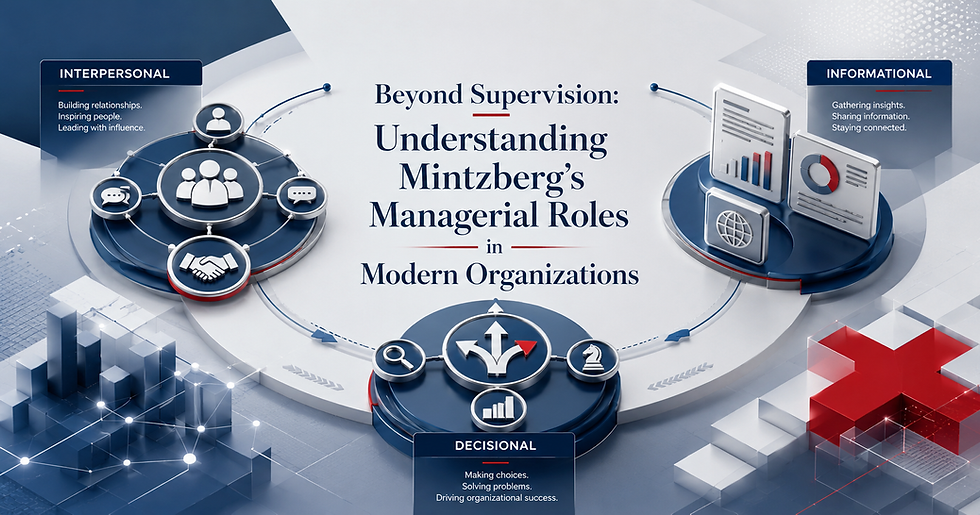
Mintzberg grouped managerial roles into three main categories. The first category is interpersonal roles, which are related to people, relationships, leadership, and representation. The second category is informational roles, which are related to collecting, processing, and sharing information. The third category is decisional roles, which are related to making choices, solving problems, using resources, and negotiating.
This article explains Mintzberg’s managerial roles in a clear and academic way for students. It uses examples from modern organizations, including management, tourism, technology, education, and service sectors. The purpose is to help students understand that management is not a single activity. It is a combination of roles that require knowledge, communication, emotional intelligence, ethical judgment, and practical decision-making.
For students at Swiss International University SIU, Mintzberg’s theory is useful because it connects academic learning with real organizational practice. Students who understand these roles can better prepare for leadership positions in international, multicultural, and digital work environments.
Theoretical Background: Who Was Henry Mintzberg?
Henry Mintzberg is a Canadian management scholar known for his important contributions to organizational theory and management studies. His work challenged overly simple views of management. Instead of treating management as a clean and fixed process, he studied the daily behavior of managers and showed that managerial work is often dynamic, interrupted, practical, and relationship-based.
Mintzberg’s study of managerial work became especially influential because it was based on observation. He looked at what managers actually did, not only what textbooks said they should do. This made his work highly valuable for students, researchers, and professionals.
Traditional management theory often describes management through four main functions: planning, organizing, leading, and controlling. This model is useful because it provides a general structure. However, Mintzberg argued that real managerial work cannot be fully understood through these functions alone. Managers do not simply move from planning to organizing to leading to controlling in a neat order. Instead, they constantly shift between different roles and responsibilities.
For example, a manager in a tourism company may start the day by reviewing customer feedback, then speak with employees about service quality, then join a meeting with partners, then solve a booking problem, then negotiate with a supplier, and later prepare a report for senior leadership. These activities involve many different managerial roles.
Mintzberg identified ten roles that managers commonly perform:
Figurehead
Leader
Liaison
Monitor
Disseminator
Spokesperson
Entrepreneur
Disturbance handler
Resource allocator
Negotiator
He grouped these roles into three categories:
Interpersonal roles: figurehead, leader, liaison
Informational roles: monitor, disseminator, spokesperson
Decisional roles: entrepreneur, disturbance handler, resource allocator, negotiator
This framework remains useful because it shows management as a living practice. It also helps students understand that successful managers need more than technical knowledge. They need communication skills, social awareness, analytical ability, flexibility, and confidence in decision-making.
Interpersonal Roles: The Manager as a Human Connector
Interpersonal roles are based on relationships. Managers work with people inside and outside the organization. They interact with employees, customers, partners, suppliers, regulators, investors, students, guests, and other stakeholders. Because organizations are social systems, managers must know how to represent, guide, and connect people.
Mintzberg identified three interpersonal roles: figurehead, leader, and liaison.
The Figurehead Role
The figurehead role refers to the symbolic and representative duties of a manager. In this role, the manager represents the organization in formal, ceremonial, or public situations.
A manager may attend an official event, welcome guests, sign documents, open a training session, present certificates, join a public meeting, or represent the department in an institutional ceremony. These activities may seem symbolic, but they are important because they communicate legitimacy, professionalism, and organizational identity.
In educational institutions, the figurehead role is visible when academic leaders attend graduation ceremonies, welcome new students, or represent the institution in official academic events. In tourism and hospitality, hotel managers may welcome important guests, attend tourism exhibitions, or represent the hotel in community events. In technology companies, managers may present the company at innovation forums, product launches, or industry meetings.
The figurehead role reminds students that management is not only about internal operations. Managers also carry the image of the organization. Their behavior, language, dress, ethics, and professionalism can influence how people see the organization.
For Swiss International University SIU students, this role is important because many future managers will work in international environments where representation matters. A manager who represents an organization should act with respect, clarity, and cultural awareness. The figurehead role requires dignity, professionalism, and a strong understanding of institutional values.
The Leader Role
The leader role is one of the most important managerial roles. As leaders, managers guide, motivate, support, and develop people. They help employees understand goals, improve performance, and work together.
Leadership is not only about authority. A manager may have a formal title, but effective leadership depends on trust, communication, fairness, and inspiration. Employees are more likely to perform well when they understand what is expected, feel respected, receive useful feedback, and believe that their work has value.
In modern organizations, the leader role is especially important because employees often face pressure, change, and uncertainty. Digital transformation, remote work, artificial intelligence, global competition, and customer expectations create new challenges. Managers must help teams adapt without losing motivation.
For example, in a technology company, a manager may lead a team through the adoption of new software. Some employees may be excited, while others may be afraid or resistant. The manager must explain the benefits, provide training, listen to concerns, and support the team during the transition. This is leadership in practice.
In tourism, a manager may lead service staff during a busy season. Employees may face demanding customers, long working hours, and operational stress. The manager must maintain service quality while also protecting team morale. This requires emotional intelligence and practical leadership.
In education, academic managers must guide teachers, administrative staff, and students. They need to create a positive learning environment, encourage quality, and support continuous improvement.
The leader role shows that management is deeply human. Managers influence people not only through decisions, but also through attitude, communication, and example. Students should understand that leadership is not a separate subject from management; it is at the center of daily managerial work.
The Liaison Role
The liaison role refers to the manager’s responsibility to build and maintain relationships beyond the immediate team. Managers connect with people inside and outside the organization to exchange information, coordinate activities, and develop cooperation.
A manager does not work alone. Modern organizations depend on networks. These networks may include other departments, external partners, suppliers, clients, government bodies, professional associations, consultants, and community organizations.
For example, a manager in a tourism organization may work with hotels, travel agencies, airlines, cultural centers, transport providers, and local authorities. A technology manager may interact with software vendors, cybersecurity experts, customers, developers, and data protection specialists. An education manager may coordinate with academic departments, quality assurance teams, employers, alumni, and international partners.
The liaison role is important because many organizational problems cannot be solved by one department alone. Managers must build relationships that allow cooperation. A strong liaison role can improve trust, reduce misunderstanding, and create opportunities.
In international management, the liaison role also requires cultural sensitivity. Managers may work with people from different countries, languages, and professional traditions. They must understand that communication styles differ. Some cultures value direct communication, while others prefer indirect and diplomatic communication. Some organizations make decisions quickly, while others require formal procedures.
For students, the liaison role teaches an important lesson: professional networks are part of management. Building relationships is not a social luxury; it is a managerial responsibility. A manager who has strong networks can access information, solve problems faster, and create strategic value for the organization.
Informational Roles: The Manager as an Information Processor
The second group of Mintzberg’s roles is informational roles. Managers spend a large part of their time receiving, interpreting, and sharing information. Information is central to management because decisions depend on what managers know.
In the past, managers often struggled because they did not have enough information. Today, many managers face the opposite problem: too much information. Emails, reports, dashboards, social media, customer reviews, market data, digital platforms, and artificial intelligence tools produce large amounts of information every day. The challenge is not only to collect information, but to understand what is relevant, accurate, timely, and useful.
Mintzberg identified three informational roles: monitor, disseminator, and spokesperson.
The Monitor Role
The monitor role means that managers seek and receive information to understand what is happening inside and outside the organization. Managers monitor performance, market trends, employee concerns, customer feedback, competitor behavior, technology changes, and regulatory developments.
A manager cannot make good decisions without reliable information. Monitoring helps managers identify opportunities and risks early.
For example, a hotel manager may monitor online guest reviews to understand service quality. If many guests mention slow check-in, the manager can investigate and improve the process. A technology manager may monitor cybersecurity alerts to protect systems. A university manager may monitor student feedback to improve academic services.
The monitor role also includes informal information. Managers often learn important things through conversations, meetings, and observations. A short discussion with an employee may reveal a problem that does not appear in official reports. A customer comment may show a new market need. A partner meeting may reveal future opportunities.
However, monitoring information requires judgment. Not all information is accurate. Some data may be incomplete, biased, outdated, or misunderstood. Managers must ask questions such as:
Is this information reliable?Is it current?Does it come from a trustworthy source?Is it relevant to the decision?Does it show a pattern or only one isolated case?
In the digital age, the monitor role is strongly connected to data literacy. Managers do not need to be data scientists, but they should understand how to read reports, interpret indicators, question assumptions, and avoid making decisions based on weak evidence.
For students, the monitor role teaches that management begins with awareness. A manager must be curious, observant, and analytical. Good managers do not wait for problems to become crises. They monitor the environment and act before issues become serious.
The Disseminator Role
The disseminator role means that managers share information with people inside the organization. After collecting and interpreting information, managers must communicate it to employees, teams, or departments.
Information is valuable only when it reaches the right people in the right way. A manager may receive information from senior leadership, external partners, customers, or market reports. The manager must then decide what should be shared, with whom, and how.
For example, if a company introduces a new customer service policy, managers must explain it clearly to employees. If a university changes an academic procedure, academic staff and students need to understand the change. If a tourism company receives updated travel safety guidance, relevant teams must receive the information quickly.
The disseminator role requires clarity. Managers should avoid confusing messages. They should explain not only what has changed, but also why it matters. Employees are more likely to accept change when they understand the reason behind it.
In modern organizations, poor internal communication can create serious problems. Employees may misunderstand priorities, repeat mistakes, or feel excluded. A lack of communication can reduce trust and performance.
Digital tools have made dissemination faster, but not always better. Emails, messaging platforms, intranets, and video meetings can support communication, but they can also create overload. Managers must choose the right communication method. Some information can be sent by email, but sensitive or complex issues may require a meeting.
For students, the disseminator role shows that communication is not a soft or secondary skill. It is a core managerial responsibility. A good manager translates information into understandable guidance. This requires language skills, emotional intelligence, timing, and awareness of the audience.
The Spokesperson Role
The spokesperson role refers to the manager’s responsibility to communicate information to people outside the unit or organization. In this role, managers represent their team, department, or organization to external audiences.
A spokesperson may speak to customers, partners, media, investors, regulators, community members, or professional groups. The purpose is to present information, explain decisions, build confidence, and protect the reputation of the organization.
In tourism, a manager may speak about service improvements, destination development, or customer experience. In technology, a manager may explain a new digital service, data protection practice, or innovation project. In education, a manager may present academic programs, institutional development, student support, or quality improvement initiatives.
The spokesperson role requires accuracy and responsibility. Managers must avoid exaggeration, unclear promises, or misleading statements. They should communicate in a professional and ethical way.
This role is especially important in the age of social media. External communication can spread quickly, and public trust can be affected by a single message. Managers should understand that communication is part of reputation management.
For students, the spokesperson role teaches that managers must be able to speak on behalf of their organization with confidence and care. This does not mean using complicated language. In many cases, simple, honest, and clear communication is more effective than technical language.
A manager who performs the spokesperson role well can strengthen public confidence, support partnerships, and improve the organization’s image.
Decisional Roles: The Manager as a Decision-Maker
The third category of Mintzberg’s model is decisional roles. Managers do not only interact with people and manage information. They also make decisions. These decisions may involve change, conflict, resources, negotiations, and organizational direction.
Decision-making is one of the most visible parts of management. However, good decisions depend on the interpersonal and informational roles discussed earlier. A manager who has strong relationships and reliable information is more likely to make effective decisions.
Mintzberg identified four decisional roles: entrepreneur, disturbance handler, resource allocator, and negotiator.
The Entrepreneur Role
The entrepreneur role means that managers search for opportunities, encourage improvement, and initiate change. In this role, managers do not simply maintain existing systems. They look for better ways to work.
Entrepreneurship in management does not only mean starting a new business. It also means innovation inside an existing organization. A manager may improve a process, introduce a new service, adopt digital tools, redesign a workflow, or develop a new strategy.
For example, in a tourism company, a manager may create a new package for eco-tourism, cultural tourism, or medical tourism. In a technology-based organization, a manager may introduce artificial intelligence tools to improve customer support. In education, a manager may develop digital learning methods, improve student services, or create new forms of academic support.
The entrepreneur role is highly relevant today because organizations face rapid change. Customer expectations change quickly. Technology develops quickly. Markets become more competitive. Organizations that do not improve may lose relevance.
However, the entrepreneur role also requires balance. Innovation should not be reckless. Managers must consider cost, quality, risk, ethics, and organizational capacity. A new idea may be attractive, but it must be realistic and aligned with organizational goals.
For students, the entrepreneur role teaches that managers should be proactive. They should not only respond to problems; they should also search for possibilities. Good managers ask:
How can we improve?What new needs are emerging?What process is too slow?What service can be made better?What technology can support our work?How can we create more value for customers, students, or stakeholders?
This role is especially useful for students interested in management, tourism, technology, and innovation. It shows that managers can be creators of change, not only controllers of work.
The Disturbance Handler Role
The disturbance handler role refers to the manager’s responsibility to respond to problems, crises, conflicts, and unexpected events. No organization operates without disturbances. Problems can come from internal disagreements, employee absence, customer complaints, technical failures, financial pressure, legal changes, or external crises.
In this role, managers must act quickly and responsibly. They must understand the problem, reduce damage, communicate with affected people, and find a practical solution.
For example, in a hotel, a sudden system failure may affect room bookings. The manager must coordinate staff, inform guests, contact technical support, and protect service quality. In a technology company, a data security incident may require immediate action. In an educational institution, a sudden platform issue may affect online learning. In each case, the manager becomes a disturbance handler.
This role requires calmness under pressure. A manager who panics may make the situation worse. A good manager remains professional, gathers facts, assigns responsibilities, and communicates clearly.
The disturbance handler role also involves conflict management. Employees may disagree about tasks, customers may complain, or departments may have different priorities. Managers must listen carefully, understand different views, and find fair solutions.
For students, this role is important because it shows that management is not always planned and comfortable. Managers often work with uncertainty. They must be prepared to handle unexpected situations.
The ability to manage disturbances is also connected to resilience. Organizations need managers who can keep operations stable during difficulty. This is especially important in sectors such as tourism, education, health services, technology, and international business, where external conditions can change quickly.
The Resource Allocator Role
The resource allocator role means that managers decide how organizational resources should be used. Resources include money, time, people, equipment, technology, information, physical space, and managerial attention.
Every organization has limited resources. Because resources are limited, managers must make choices. These choices can influence performance, fairness, and strategic success.
For example, a manager may decide which project receives funding, which employee receives training, which department receives new equipment, or how staff schedules are organized. In education, managers may allocate teaching hours, learning materials, academic support, and digital platform resources. In tourism, managers may allocate staff during peak seasons, marketing budgets, and customer service resources. In technology, managers may allocate developers, cybersecurity tools, and software investments.
The resource allocator role requires both analytical and ethical thinking. Managers must consider efficiency, but also fairness. They must ask whether resources are being used in a way that supports organizational goals and respects people.
Poor resource allocation can create many problems. If too few employees are assigned to customer service, quality may decline. If training is ignored, staff may not develop new skills. If technology investment is delayed, the organization may become less competitive. If resources are distributed unfairly, employees may lose trust.
For students, this role teaches that management involves responsibility. Resource decisions are not only technical decisions; they affect people and performance. A manager should be able to justify resource choices with clear reasoning.
This role is especially important in modern organizations because resources must often support both daily operations and long-term transformation. Managers must balance present needs with future development.
The Negotiator Role
The negotiator role means that managers participate in discussions where different parties seek agreement. Negotiation is a common part of managerial work.
Managers may negotiate with employees, suppliers, customers, partners, government bodies, unions, investors, or other departments. Negotiation may involve prices, contracts, deadlines, responsibilities, budgets, working conditions, service standards, or project goals.
For example, a tourism manager may negotiate with a hotel supplier about group rates. A technology manager may negotiate a software contract. An education manager may negotiate cooperation with a training partner. A department manager may negotiate staff schedules or project deadlines.
Negotiation requires preparation. A manager should understand the issue, the interests of each side, possible solutions, and acceptable limits. Good negotiation is not simply about winning. It is about reaching an agreement that is practical, ethical, and sustainable.
The negotiator role also requires communication skills. Managers must listen, ask questions, explain positions, and manage emotions. In international contexts, negotiation also requires cultural understanding. What is considered direct and efficient in one culture may be seen as too aggressive in another. What is considered polite in one culture may be seen as unclear in another.
For students, the negotiator role is important because negotiation is part of professional life. Even when people do not call it negotiation, they negotiate tasks, responsibilities, priorities, and expectations.
A good manager does not use negotiation to dominate others. A good manager uses negotiation to create agreement, reduce conflict, and protect organizational interests.
Mintzberg’s Roles in Management Education
Mintzberg’s theory is very useful for management education because it connects theory with practice. Students often study models, definitions, and frameworks, but they also need to understand how managers behave in real organizations.
The ten roles provide a practical map of managerial work. They help students see that management includes representation, leadership, networking, information management, communication, innovation, crisis response, resource use, and negotiation.
For students at Swiss International University SIU, Mintzberg’s model can support the development of several academic and professional skills:
First, it improves understanding of organizational behavior. Students learn that managers work through people and relationships.
Second, it strengthens communication awareness. Students understand that managers must communicate internally and externally.
Third, it supports decision-making skills. Students learn that managers make choices under conditions of limited time and incomplete information.
Fourth, it encourages leadership development. Students see leadership as a daily role, not only a formal position.
Fifth, it prepares students for international work. Since many modern organizations operate across cultures and borders, students need to understand the importance of liaison, spokesperson, and negotiator roles.
Mintzberg’s theory can also be used in case studies, classroom discussions, internships, simulations, and research projects. For example, students may analyze a manager in a hotel, technology company, school, hospital, or start-up and identify which Mintzberg roles appear most often. This makes learning active and realistic.
Relevance to Technology and Digital Transformation
Digital transformation has changed managerial work, but it has not made Mintzberg’s roles outdated. In fact, technology has made many of these roles more important.
In the monitor role, managers now use dashboards, analytics, digital reports, customer data, and online feedback. They must understand digital information and avoid being misled by poor data.
In the disseminator role, managers use email, video meetings, messaging platforms, learning management systems, and project management software. They must communicate clearly in digital spaces.
In the spokesperson role, managers may represent the organization through online conferences, digital marketing content, webinars, or social media communication.
In the entrepreneur role, managers may identify opportunities through artificial intelligence, automation, digital platforms, and new business models.
In the disturbance handler role, managers may respond to cybersecurity risks, platform failures, online complaints, or digital service disruptions.
Technology also changes leadership. Managers may lead remote teams, hybrid teams, or international online teams. This requires trust, clarity, and strong communication. A manager cannot rely only on physical presence. They must lead through goals, feedback, digital collaboration, and human understanding.
Therefore, Mintzberg’s theory remains highly relevant in the digital age. The roles are not replaced by technology; they are reshaped by technology.
Relevance to Tourism and Service Management
Tourism and service industries provide excellent examples of Mintzberg’s managerial roles. These sectors are highly people-centered, fast-moving, and sensitive to customer experience.
A tourism manager acts as a figurehead when representing a hotel, travel company, or destination at events. The manager acts as a leader when motivating staff to provide excellent service. The manager acts as a liaison when coordinating with airlines, hotels, local authorities, cultural institutions, and suppliers.
The monitor role appears when the manager tracks booking trends, guest reviews, seasonal demand, and customer satisfaction. The disseminator role appears when the manager informs staff about service changes, safety procedures, or customer expectations. The spokesperson role appears when the manager communicates with partners, guests, or public audiences.
The entrepreneur role appears when the manager creates new tourism products or improves the guest experience. The disturbance handler role appears when dealing with complaints, cancellations, delays, or service failures. The resource allocator role appears when assigning staff, budgets, rooms, transport, and marketing efforts. The negotiator role appears when discussing contracts, prices, partnerships, or service agreements.
This shows that Mintzberg’s model is not only theoretical. It is visible in daily service operations. For students interested in tourism, hospitality, and international service management, the model provides a useful tool for understanding real managerial behavior.
Relevance to International and Multicultural Management
Modern managers often work in multicultural environments. They may lead teams with different nationalities, serve international customers, or cooperate with partners in different countries. In such contexts, Mintzberg’s roles become even more complex.
The figurehead role requires cultural respect and professional representation. The leader role requires awareness of different motivation styles. The liaison role requires relationship-building across cultural and institutional boundaries. The spokesperson role requires careful communication because messages may be interpreted differently by different audiences.
The negotiator role is especially important in international management. Negotiation across cultures requires patience, preparation, and respect. Managers must understand that business behavior is influenced by culture, law, language, and social expectations.
The disturbance handler role is also important because misunderstandings can occur more easily in multicultural settings. Managers must be able to resolve conflict without disrespecting cultural differences.
For Swiss International University SIU students, this is particularly relevant because international education prepares learners for global professional environments. Mintzberg’s theory helps students understand that management is not only about tasks, but also about people, culture, communication, and judgment.
Critical Evaluation of Mintzberg’s Theory
Mintzberg’s managerial roles theory is highly valuable, but students should also evaluate it critically. A strong academic understanding requires both appreciation and analysis.
One strength of the theory is that it is realistic. It shows what managers actually do in practice. It recognizes that management is interactive, dynamic, and varied.
Another strength is that it is easy to apply. Students can observe managers and identify the ten roles in real situations. This makes the model useful for teaching, training, and professional development.
A third strength is that the model is flexible. It can be applied in many sectors, including education, tourism, technology, health care, public administration, and business.
However, there are also limitations. Mintzberg’s original research was based on a limited number of managers, and organizations have changed significantly since then. Digital tools, remote work, artificial intelligence, global markets, and new organizational structures have changed how managers work.
Another limitation is that the model describes managerial roles, but it does not fully explain how managers should perform them ethically or effectively. For example, it tells us that managers negotiate, but it does not provide a full theory of ethical negotiation. It tells us that managers allocate resources, but it does not provide a complete method for fair resource allocation.
Also, the roles may overlap. A manager who communicates with external partners may be acting as a spokesperson, liaison, and negotiator at the same time. This overlap is not necessarily a weakness, but students should understand that real management is complex and roles are not always separate.
Despite these limitations, Mintzberg’s theory remains one of the most useful frameworks for understanding managerial practice. It is especially helpful when combined with modern topics such as digital transformation, leadership ethics, cultural intelligence, sustainability, and strategic management.
Practical Lessons for Students
Mintzberg’s managerial roles provide several practical lessons for students preparing for careers in management.
The first lesson is that managers must be flexible. A manager cannot succeed by using only one skill. Managers need leadership, communication, analysis, negotiation, and problem-solving abilities.
The second lesson is that information is central to management. Managers must know how to collect, understand, and share information. In modern organizations, this includes digital information and data.
The third lesson is that relationships matter. Managers work through people. Good relationships can improve cooperation, trust, and performance.
The fourth lesson is that decisions have consequences. Managers must use resources carefully, handle problems responsibly, and negotiate ethically.
The fifth lesson is that management is learned through practice as well as theory. Students should not only memorize Mintzberg’s roles. They should observe them in real organizations, discuss them in case studies, and reflect on how they can develop these roles in their own professional lives.
For example, a student working on a group project can practice the leader role by helping the team stay organized. The student can practice the disseminator role by sharing information clearly. The student can practice the negotiator role by helping the group agree on responsibilities. The student can practice the disturbance handler role when conflict or delay occurs.
In this way, Mintzberg’s model is not only for senior executives. It can help students understand management behavior even before they become formal managers.
Conclusion
Mintzberg’s managerial roles theory provides a clear and practical explanation of what managers do in real organizational life. It shows that management is not limited to supervision. Managers act as figureheads, leaders, liaisons, monitors, disseminators, spokespersons, entrepreneurs, disturbance handlers, resource allocators, and negotiators.
These roles are grouped into interpersonal, informational, and decisional categories. Together, they show that managers must work with people, process information, and make decisions. This combination makes management a complex and important professional activity.
In modern organizations, Mintzberg’s theory remains highly relevant. Digital transformation, globalization, tourism development, service quality, remote work, and multicultural teams have changed the context of management, but they have not removed the need for managerial roles. In many ways, they have made these roles more important.
For students of Swiss International University SIU, studying Mintzberg’s theory can help connect academic knowledge with professional practice. It encourages students to see management as a dynamic activity that requires communication, leadership, ethical judgment, cultural awareness, and decision-making skills.
A successful manager is not only someone who gives instructions. A successful manager represents the organization, builds trust, shares information, solves problems, creates opportunities, and makes responsible decisions. Mintzberg’s model helps students understand this broader and more realistic picture of management.
Hashtags
#SwissInternationalUniversity #SIU #ManagementStudies #MintzbergManagerialRoles #LeadershipEducation #OrganizationalBehavior #BusinessManagement #DigitalManagement #TourismManagement #ManagementStudents
Sources
Mintzberg, H. (1973). The Nature of Managerial Work. Harper & Row.
Mintzberg, H. (1975). “The Manager’s Job: Folklore and Fact.” Harvard Business Review.
Mintzberg, H. (1989). Mintzberg on Management: Inside Our Strange World of Organizations. Free Press.
Mintzberg, H. (2009). Managing. Berrett-Koehler Publishers.
Drucker, P. F. (1954). The Practice of Management. Harper & Brothers.
Fayol, H. (1949). General and Industrial Management. Pitman.
Robbins, S. P., Coulter, M., and DeCenzo, D. A. (2017). Fundamentals of Management. Pearson.
Daft, R. L. (2021). Management. Cengage Learning.
Yukl, G. (2013). Leadership in Organizations. Pearson.
Northouse, P. G. (2021). Leadership: Theory and Practice. SAGE Publications.

Comments