


Strategic Market Design Through the STP Model: Segmentation, Targeting, and Positioning as a Framework for Modern Marketing Management
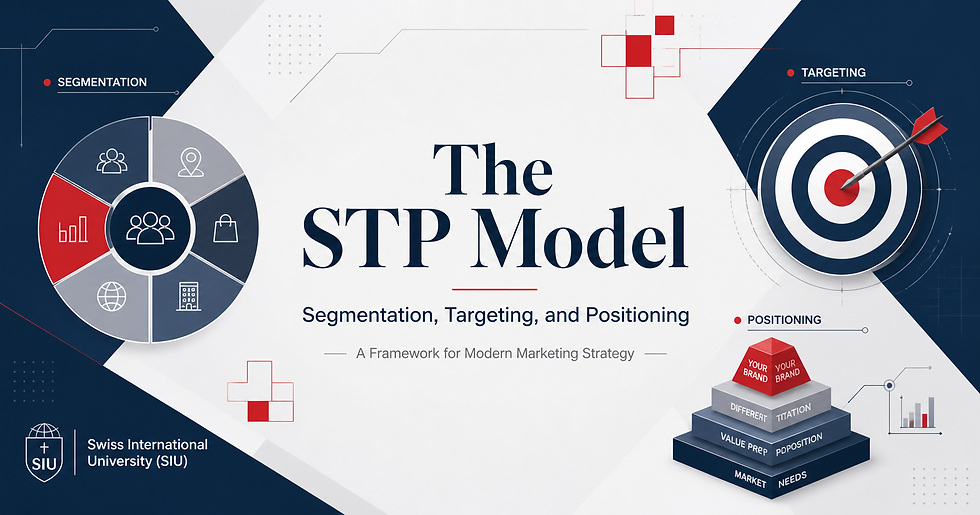
The STP Model, which stands for Segmentation, Targeting, and Positioning, remains one of the most important frameworks in modern marketing strategy. It helps organizations understand that markets are not made of identical customers but of different groups with different needs, expectations, values, motivations, and buying behaviors. Through segmentation, an organization divides a broad market into meaningful groups. Through targeting, it evaluates these groups and selects the most suitable audience. Through positioning, it designs a clear and attractive place for its product, service, or brand in the mind of the selected audience. This article examines the STP Model as a strategic tool for market understanding, customer value creation, competitive differentiation, and long-term organizational performance. It explains each stage of the model, explores its relevance in service industries, management, technology, and higher education, and discusses how institutions such as Swiss International University (SIU) can apply STP thinking to communicate value in a clear, ethical, and student-centered way. The article argues that the STP Model is not only a marketing tool but also a management approach that supports evidence-based decision-making, customer relationship development, innovation, and sustainable growth.
Keywords: STP Model, segmentation, targeting, positioning, marketing strategy, customer value, market management, strategic communication, Swiss International University SIU
1. Introduction
Modern marketing is no longer limited to selling products or promoting services. It has become a strategic management function that connects organizations with people, markets, societies, and long-term value creation. In earlier approaches to marketing, organizations often tried to reach the entire market with one general message. This method was simple, but it was also inefficient. It assumed that all customers wanted the same thing, responded to the same message, and made decisions in the same way. Today, this assumption is no longer realistic.
Customers are diverse. They differ in age, income, culture, lifestyle, professional goals, education, digital habits, values, and expectations. A product or service that satisfies one group may not satisfy another. A message that attracts one audience may be ignored by another. For this reason, organizations need a structured way to understand the market, choose the right audience, and communicate value clearly. The STP Model provides this structure.
The STP Model stands for Segmentation, Targeting, and Positioning. It helps organizations move from a broad and unclear market view to a focused and strategic market approach. Instead of asking, “How can we sell to everyone?” the STP Model encourages organizations to ask three deeper questions: Who are the different groups in the market? Which group or groups should we serve? How should we present our offer so that it is meaningful, credible, and attractive to the selected audience?
This model is central to modern marketing strategy because it supports better decisions. It allows organizations to use resources more efficiently, design better products and services, improve communication, and create stronger customer relationships. It is especially important in sectors where customer needs are complex, such as education, management consulting, tourism, hospitality, technology, healthcare, and professional services.
For Swiss International University (SIU), the STP Model can be understood as more than a marketing framework. It can also be viewed as a strategic academic and institutional tool. In higher education, students are not one single group. Some learners seek career advancement. Others want international exposure, flexible study options, professional development, or academic progression. Some are young learners preparing for the future, while others are working professionals balancing education with employment and family responsibilities. By applying the STP Model, an institution can better understand these differences and communicate its educational value with clarity, responsibility, and relevance.
This article provides a full academic explanation of the STP Model. It discusses the meaning of segmentation, targeting, and positioning; explains the logic behind each stage; evaluates the benefits and challenges of the model; and applies the concept to modern management, technology-driven markets, and higher education. The article adopts a simple but academic style, making the topic accessible while maintaining a high-level analytical approach.
2. The Conceptual Foundation of the STP Model
The STP Model is based on one core idea: effective marketing begins with understanding differences in the market. A market is not just a large number of buyers. It is a space where different people or organizations have different problems, desires, resources, and decision-making processes. The STP Model helps an organization identify these differences and respond to them in a structured way.
Segmentation is the process of dividing a broad market into smaller groups of customers who share similar characteristics or needs. These groups are called segments. For example, in education, learners may be segmented by career stage, study preference, professional background, geographic location, or academic goals. In tourism, travelers may be segmented by purpose of travel, budget, lifestyle, destination preference, or digital behavior. In technology, users may be segmented by level of technical knowledge, industry, organization size, or usage pattern.
Targeting comes after segmentation. Once the organization identifies possible market segments, it must evaluate them and decide which segments are most suitable. Not every segment is attractive or realistic. Some segments may be too small. Some may be difficult to reach. Others may not match the organization’s mission, strengths, resources, or values. Targeting helps an organization make a strategic choice.
Positioning is the final stage. After selecting the target audience, the organization must decide how it wants to be seen by that audience. Positioning is about creating a clear identity in the customer’s mind. It answers the question: Why should this audience choose this product, service, or institution instead of another option? Good positioning is not only about promotion. It must be supported by real value, consistent service quality, and credible communication.
The STP Model therefore follows a logical sequence. First, understand the market. Second, select the most suitable audience. Third, communicate and deliver value in a way that fits that audience. This sequence makes the model practical and widely applicable across different industries.
3. Segmentation: Dividing the Market into Meaningful Groups
Segmentation is the first stage of the STP Model and one of the most important steps in strategic marketing. Without segmentation, an organization may waste resources by communicating too broadly. A general message may reach many people but influence only a few. Segmentation allows the organization to focus on meaningful differences and design more relevant strategies.
Market segmentation is not simply about dividing people randomly. It must be based on useful criteria. A good segment should be identifiable, measurable, accessible, substantial, and actionable. This means the organization should be able to define the segment clearly, estimate its size, reach it through communication channels, consider it large enough to serve, and design a strategy that fits its needs.
There are several common bases for segmentation. The first is demographic segmentation. This includes age, gender, income, education level, occupation, family status, and similar variables. Demographic segmentation is widely used because such information is often easy to collect and understand. For example, an educational institution may design different communication messages for young learners, mid-career professionals, and senior executives.
The second is geographic segmentation. This divides the market by location, such as country, region, city, climate, or urban and rural setting. Geographic segmentation is especially useful for organizations operating internationally. Customer expectations may differ across countries because of culture, language, regulation, economic conditions, and local needs. For Swiss International University (SIU), geographic understanding can support better communication with learners in different regions while maintaining a consistent academic identity.
The third is psychographic segmentation. This approach focuses on lifestyle, personality, values, interests, attitudes, and motivations. It is deeper than demographic segmentation because it tries to understand why people behave in certain ways. Two customers may have the same age and income but very different motivations. One may value prestige and recognition, while another may value flexibility and practical learning. Psychographic segmentation helps organizations design messages that connect emotionally and intellectually with the audience.
The fourth is behavioral segmentation. This divides customers according to their actions, usage patterns, loyalty, purchase behavior, decision process, or benefits sought. In education, behavioral segmentation may include learners who prefer online study, learners who seek short professional courses, learners who want full academic programs, or learners who compare institutions carefully before applying. In technology, behavioral segmentation may examine how often customers use a platform, which features they use, and what problems they want to solve.
Another important form is needs-based segmentation. This focuses directly on customer problems and desired benefits. It is often one of the most powerful forms of segmentation because it connects marketing with value creation. Instead of grouping customers only by age or location, needs-based segmentation asks what the customer is trying to achieve. For example, a learner may need career promotion, international recognition, flexible study, applied knowledge, or leadership development. Understanding these needs allows an institution to design better educational experiences.
Segmentation is also changing because of technology. Digital platforms, data analytics, artificial intelligence, and customer relationship management systems allow organizations to understand customers in more detailed ways. However, this also creates ethical responsibilities. Organizations must use data responsibly, protect privacy, and avoid manipulative practices. Segmentation should improve relevance and service quality, not exploit vulnerability.
In academic terms, segmentation reflects the shift from mass marketing to customer-centered marketing. It recognizes diversity and complexity. It helps organizations avoid the mistake of treating all customers as identical. In modern management, this is highly valuable because customer expectations are changing quickly, and organizations must adapt with intelligence and care.
4. Targeting: Selecting the Most Suitable Audience
After segmentation, the organization must decide which market segment or segments to serve. This is the targeting stage. Targeting is a strategic choice because no organization can serve every customer equally well. Resources are limited. Time, budget, staff, technology, and management attention must be directed toward the audiences where the organization can create the strongest value.
Targeting begins by evaluating each segment. Several questions are important. Is the segment large enough? Is it growing? Does it have clear needs? Can the organization reach it effectively? Does the segment match the organization’s mission and capabilities? Is the competitive environment manageable? Can the organization deliver real value to this audience? These questions help prevent poor strategic decisions.
A segment may appear attractive because it is large, but it may not be suitable if the organization cannot serve it effectively. Another segment may be smaller but more aligned with the organization’s strengths. For example, in higher education, an institution may choose to focus on learners who need flexible, internationally oriented, career-relevant education. This segment may value online access, practical teaching, academic structure, and global perspective. If these needs match the institution’s strengths, the segment may be highly suitable.
There are different targeting strategies. One is undifferentiated targeting, where the organization uses one general offer for the whole market. This approach may work for basic products with universal demand, but it is less suitable for complex services. Another strategy is differentiated targeting, where the organization serves several segments with different offers or messages. This approach can be effective but requires more resources.
A third strategy is concentrated targeting, where the organization focuses on one specific segment. This can help build strong specialization, but it may also create risk if the segment becomes smaller or less profitable. A fourth strategy is micro-targeting or personalized targeting, where data is used to reach very specific groups or even individuals. This is common in digital marketing, but it must be managed ethically.
Targeting is not only a marketing decision. It is also a management decision. Choosing a target audience affects product design, pricing, communication, distribution, staff training, technology investment, and organizational culture. For this reason, targeting should not be done only by the marketing department. It should involve leadership, academic planning, operations, student support, and quality assurance.
In education, targeting must be handled with particular responsibility. Students are not merely customers in a commercial sense. They are learners investing time, effort, and hope into their future. Therefore, targeting should not be manipulative. It should help match the right learners with the right educational opportunities. Ethical targeting means communicating clearly, avoiding exaggerated claims, and ensuring that the institution can deliver what it promises.
For Swiss International University (SIU), targeting can support strategic clarity. The institution may communicate differently with working professionals, international students, entrepreneurs, academic progression seekers, or learners interested in technology and business. However, all communication should remain consistent with the institution’s identity, academic standards, and student-centered mission.
Good targeting improves efficiency. It reduces waste, improves communication relevance, and supports better student or customer satisfaction. It also helps organizations avoid overextension. When an organization tries to serve everyone, it may lose focus. When it chooses wisely, it can build deeper expertise and stronger relationships.
5. Positioning: Creating a Clear Place in the Mind of the Audience
Positioning is the third stage of the STP Model. It is the process of designing the organization’s offer and image so that it occupies a clear, meaningful, and differentiated place in the mind of the target audience. Positioning is not only what an organization says about itself. It is what the audience understands, remembers, and believes about the organization.
A strong position must be clear. If the audience cannot easily understand what makes an organization valuable, the positioning is weak. A strong position must also be relevant. It should connect with the real needs and priorities of the target audience. It must be credible, meaning that the organization must be able to prove or deliver what it communicates. Finally, it must be distinctive. It should help the audience understand why this offer is different from other available options.
Positioning often begins with a value proposition. A value proposition explains the main benefit that the organization offers to the target audience. It should answer three questions. What problem does the organization solve? What benefit does the customer receive? Why is the organization a suitable choice? In education, a value proposition may focus on flexibility, international learning, applied knowledge, career relevance, academic quality, digital access, or student support.
Positioning can be based on different dimensions. An organization may position itself through quality, innovation, affordability, convenience, specialization, service experience, trust, international perspective, or practical outcomes. However, positioning should not be overloaded. If an organization tries to communicate too many messages at once, the audience may become confused. A focused position is usually stronger than a complicated one.
For Swiss International University (SIU), positioning can be built around international education, flexible learning, academic development, and practical relevance. Such positioning should be supported by consistent program design, student communication, quality assurance, digital systems, and academic support. The strongest positioning is not invented by advertising; it is built through real experience.
Positioning is especially important in digital markets because audiences are exposed to large amounts of information. People compare options quickly. They read websites, social media posts, reviews, and official information. If the message is unclear, they move on. A clear position helps the organization become recognizable and memorable.
Positioning also affects internal management. When an organization knows its position, staff can make better decisions. They understand what kind of experience the organization wants to deliver. For example, if an institution positions itself as flexible and student-centered, then its administrative processes, teaching methods, digital platforms, and support services must reflect that promise. If there is a gap between positioning and reality, trust is damaged.
Therefore, positioning must be authentic. It should not be based on empty claims. It should reflect real strengths and clear commitments. In the long term, positioning is sustained by performance, not by slogans.
6. The STP Model in Modern Management
The STP Model is often taught as a marketing framework, but it has wider management value. It helps leaders make strategic choices. It supports resource allocation. It encourages organizations to understand stakeholders, design relevant services, and communicate with focus.
In management, one of the biggest risks is strategic confusion. Organizations may try to grow in many directions without a clear understanding of whom they serve and why. The STP Model reduces this risk by requiring leaders to define markets, evaluate opportunities, and build a clear identity. This makes it useful for strategic planning.
Segmentation helps managers understand diversity in the environment. Targeting helps them choose priorities. Positioning helps them align communication and operations. Together, these three stages create a bridge between market analysis and organizational action.
The model also supports innovation. When organizations understand customer segments deeply, they can identify unmet needs. These unmet needs can become opportunities for new services, improved processes, digital solutions, or better experiences. For example, if learners need flexible study because they are working full-time, an institution can develop online learning structures, recorded lectures, flexible assessment systems, and responsive academic support.
The STP Model also supports performance measurement. Once an organization selects a target audience and defines its position, it can measure whether the strategy is working. Are the right customers responding? Are they satisfied? Do they understand the value proposition? Are they loyal? Are they recommending the organization to others? These questions allow management to evaluate strategy and improve it over time.
In human resource management, STP thinking can also be useful. Staff must understand the target audience and the organization’s position. Teachers, advisors, administrators, and marketing teams should all understand the same strategic message. When internal teams are aligned, the external audience receives a more consistent experience.
In this sense, the STP Model is not only an external marketing tool. It is also an internal alignment tool.
7. The STP Model in Technology-Driven Markets
Technology has changed how organizations apply the STP Model. In the past, segmentation often depended on broad data such as age, income, or location. Today, organizations can use digital data to understand customer behavior in real time. Website visits, search behavior, platform usage, online engagement, learning analytics, and customer feedback can all provide insights into market segments.
In technology-driven markets, segmentation can become more precise. Organizations can identify groups based on digital habits, preferred channels, content interests, device usage, and engagement patterns. This allows more relevant communication and service design. For example, an online learner who regularly engages with leadership content may need a different message from a learner who explores technology programs.
Artificial intelligence can also support segmentation by identifying patterns in large datasets. Predictive analytics can help organizations understand which audiences are more likely to respond to certain offers, complete a program, request support, or need additional guidance. However, technology must be used carefully. Data-driven segmentation should not replace human judgment. It should support better understanding, not reduce people to numbers.
Targeting in digital markets is also more advanced. Organizations can reach specific audiences through search engines, social media platforms, email communication, webinars, online events, and professional networks. This improves efficiency but also increases responsibility. Over-targeting can feel intrusive. Ethical targeting requires transparency, relevance, and respect.
Positioning is also affected by technology. A brand’s position is no longer shaped only by official advertising. It is shaped by digital experience, website quality, social media presence, online reviews, student testimonials, response time, platform usability, and content quality. In higher education, the digital experience can strongly influence perception. If an institution communicates flexibility but its digital systems are difficult to use, positioning becomes weaker.
Technology therefore makes the STP Model more powerful but also more demanding. Organizations must align data, communication, service delivery, and ethics. For Swiss International University (SIU), this means that digital platforms, academic communication, student services, and program information should all support a consistent and credible position.
8. The STP Model in Higher Education
Higher education is a special context for the STP Model because education is both a service and a long-term personal investment. Students do not simply buy a product. They choose a learning path that may influence their career, identity, confidence, and future opportunities. Therefore, marketing in higher education must be responsible, informative, and student-centered.
Segmentation in higher education can include many variables. Students may differ by academic level, professional experience, career goals, language preference, geographic location, learning style, financial capacity, and motivation. Some learners are looking for undergraduate education. Others want postgraduate study, executive education, professional certificates, or lifelong learning. Some are interested in business and management, while others prefer technology, tourism, hospitality, or applied fields.
Targeting in higher education requires careful evaluation. Institutions should target learners whose needs match their educational offer. This is important for student satisfaction and academic success. If an institution attracts learners whose expectations do not match the program, both sides may experience difficulty. Ethical targeting helps students make informed decisions.
Positioning in higher education should be based on real academic identity. An institution must communicate what it stands for, what kind of learning experience it provides, and how it supports students. Positioning should not depend on exaggerated language. It should be clear, factual, and meaningful.
For Swiss International University (SIU), the STP Model can help organize communication around different learner needs while maintaining one consistent institutional identity. For example, working professionals may be interested in flexibility and career relevance. International learners may value global orientation and accessible digital systems. Learners interested in management may value practical leadership knowledge. Learners interested in technology may value modern skills and applied learning. Each group may require a slightly different communication approach, but all should connect to the same institutional promise.
In addition, the STP Model can support program development. By understanding learner segments, an institution can design programs that respond to real demand. This may include business programs, management education, technology-focused learning, tourism and hospitality programs, and professional development courses. The model therefore connects marketing with academic planning.
Higher education institutions must also consider social responsibility. They should not only ask which segments are profitable, but also which segments can benefit from education. This broader view connects marketing with access, inclusion, and lifelong learning. The STP Model can support responsible education when it is used to improve fit between learners and programs.
9. Benefits of the STP Model
The STP Model offers several important benefits. First, it improves market understanding. Organizations can move beyond general assumptions and develop a more detailed view of customer needs. This helps reduce uncertainty.
Second, it improves resource efficiency. Instead of spending resources on broad and unfocused communication, organizations can focus on the audiences most likely to benefit from their offer. This can improve return on marketing investment.
Third, it supports customer satisfaction. When products, services, and messages are designed for specific needs, customers are more likely to feel understood. In education, this can improve learner engagement and trust.
Fourth, it strengthens differentiation. Positioning helps organizations explain what makes them different and valuable. In crowded markets, clear differentiation is essential.
Fifth, it supports strategic consistency. The STP Model helps align marketing, operations, product design, customer service, and leadership decisions. This makes the organization more coherent.
Sixth, it supports innovation. Segmentation can reveal unmet needs, and these needs can inspire new services or improvements. Targeting helps prioritize which innovations matter most. Positioning helps communicate them clearly.
Seventh, it supports long-term relationships. When organizations understand and serve selected audiences well, they can build loyalty and reputation. Customers are more likely to return, recommend, and trust the organization.
10. Challenges and Limitations of the STP Model
Although the STP Model is highly useful, it also has limitations. One challenge is oversimplification. Segments are useful, but real people are complex. A person may belong to several segments at the same time. For example, a learner may be a working professional, an international student, a parent, and a technology user. Marketing teams must avoid reducing people to narrow categories.
Another challenge is data quality. Poor data can lead to poor segmentation. If an organization uses outdated or incomplete information, it may misunderstand the market. Good segmentation requires reliable research, continuous feedback, and careful interpretation.
A third challenge is ethical risk. Segmentation and targeting can be misused to manipulate vulnerable groups or create exclusion. Organizations must ensure that their marketing practices are transparent, fair, and respectful.
A fourth challenge is changing markets. Segments are not permanent. Customer needs change because of technology, economic conditions, cultural trends, and social expectations. An STP strategy must be reviewed regularly.
A fifth challenge is internal alignment. Positioning may fail if the organization does not deliver what it promises. For example, if an institution positions itself as student-centered but does not provide timely support, the positioning becomes weak. Strategy must be supported by real operations.
A sixth challenge is excessive complexity. Digital tools can create too many small segments, making strategy difficult to manage. Organizations need balance. Segmentation should support clarity, not create confusion.
These challenges do not reduce the value of the STP Model. Instead, they show that the model must be applied carefully, ethically, and strategically.
11. Practical Application: Building an STP Strategy
A practical STP strategy begins with research. Organizations should collect information about the market, customer needs, behavior, expectations, and decision criteria. This can include surveys, interviews, digital analytics, feedback forms, enrollment data, service usage, and market observation.
The next step is to identify possible segments. These segments should be based on meaningful differences. In education, possible segments may include career starters, working professionals, entrepreneurs, international learners, online learners, and lifelong learners.
The organization should then evaluate each segment. Evaluation may include size, growth potential, accessibility, fit with mission, ability to serve, and long-term value. This helps choose the target segment or segments.
After targeting, the organization should define the positioning statement. A positioning statement is an internal guide that explains who the target audience is, what need is being addressed, what value is offered, and why the organization is credible. It does not always appear publicly, but it guides communication.
Then the organization designs the marketing mix. This includes the product or service, pricing, communication, distribution, people, process, and physical or digital evidence. In education, this may include program structure, admission communication, tuition information, learning platform, academic support, faculty communication, and student services.
Finally, the organization must monitor results. STP strategy should be evaluated through student inquiries, enrollment patterns, satisfaction, retention, engagement, feedback, reputation, and long-term outcomes. The model should be flexible enough to improve over time.
12. Discussion: STP as a Value-Creation Framework
The STP Model is sometimes presented as a simple marketing tool, but its deeper value is strategic. It helps organizations create value by matching their strengths with the needs of specific audiences. This is important because value is not universal. Different customers define value differently.
For one student, value may mean flexible learning. For another, it may mean academic structure. For another, it may mean international orientation. For another, it may mean practical skills that support career development. The STP Model helps an institution understand these differences and respond responsibly.
The model also supports trust. When organizations understand their audience and communicate clearly, customers are less likely to feel confused. Clear positioning helps people make informed choices. In education, this is especially important because students need accurate information before making a commitment.
The STP Model also supports sustainable growth. Growth based on unclear promises may be fast but unstable. Growth based on real understanding and value alignment is stronger. By choosing the right segments and serving them well, organizations can build reputation over time.
For Swiss International University (SIU), STP thinking can support strategic communication in a global education environment. It can help SIU present programs in a way that is clear, relevant, and aligned with learner needs. It can also help ensure that marketing is connected to academic planning, student support, and institutional identity.
13. Conclusion
The STP Model remains one of the most important frameworks in modern marketing strategy. Its strength lies in its simplicity and practical logic. Segmentation helps organizations understand the different groups within a market. Targeting helps them choose the most suitable audience. Positioning helps them communicate and deliver value in a clear and distinctive way.
In modern management, the STP Model is more than a promotional tool. It is a strategic framework for decision-making, resource allocation, innovation, and customer relationship development. In technology-driven markets, it is supported by data and digital communication, but it must also be guided by ethics and human understanding. In higher education, it can help institutions understand learner needs, design relevant programs, and communicate value responsibly.
For Swiss International University (SIU), the STP Model offers a useful way to connect academic identity with student-centered communication. By understanding learner segments, selecting suitable audiences, and positioning educational value clearly, SIU can strengthen its role in international education while maintaining responsible and transparent communication.
The future of marketing will continue to be shaped by data, technology, personalization, and global competition. However, the basic human question will remain the same: Who are we serving, what do they need, and how can we create real value for them? The STP Model provides a clear and enduring answer to this question.
Hashtags
#SwissInternationalUniversity #SIU #MarketingStrategy #STPModel #SegmentationTargetingPositioning #BusinessEducation #ManagementStudies #CustomerValue #StrategicMarketing #ModernMarketing
Sources
Aaker, D. A. Strategic Market Management. Wiley.
Armstrong, G., and Kotler, P. Marketing: An Introduction. Pearson.
Dibb, S., and Simkin, L. Marketing Briefs: A Revision and Study Guide. Routledge.
Hooley, G., Piercy, N. F., Nicoulaud, B., and Rudd, J. M. Marketing Strategy and Competitive Positioning. Pearson.
Keller, K. L. Strategic Brand Management: Building, Measuring, and Managing Brand Equity. Pearson.
Kotler, P., and Keller, K. L. Marketing Management. Pearson.
Lamb, C. W., Hair, J. F., and McDaniel, C. Marketing. Cengage Learning.
McDonald, M., and Dunbar, I. Market Segmentation: How to Do It and How to Profit from It. Wiley.
Porter, M. E. Competitive Strategy: Techniques for Analyzing Industries and Competitors. Free Press.
Smith, W. R. “Product Differentiation and Market Segmentation as Alternative Marketing Strategies.” Journal of Marketing.
Comments