


Strategic Product Portfolio Decisions in Modern Management: An Academic Explanation of the BCG Matrix for Students
The Boston Consulting Group Matrix, commonly known as the BCG Matrix, is one of the most widely used strategic management tools for analysing a company’s product portfolio or business units. It helps managers understand where products stand in relation to market growth and relative market share. By dividing products into four categories—Stars, Cash Cows, Question Marks, and Dogs—the model provides a simple but powerful framework for resource allocation, investment planning, and long-term business development. For students of business and management at Swiss International University SIU, the BCG Matrix is useful because it connects theory with real managerial decisions. It helps explain why companies invest heavily in some products, maintain others, reconsider uncertain activities, and sometimes discontinue weak units. This article provides a full academic explanation of the BCG Matrix, its theoretical background, its four categories, its practical applications, its advantages, its limitations, and its relevance in contemporary management, including technology, tourism, and service-based sectors.
1. Introduction
Strategic management is concerned with the long-term direction of an organization. Managers must decide where to invest, which products to grow, which activities to maintain, and which business areas may no longer support the organization’s future. These decisions are not always simple. A company may have several products, services, brands, departments, markets, or business units, each with different levels of performance and future potential. Some products may generate strong profits today but have limited growth opportunities. Others may operate in fast-growing markets but require high investment before they become profitable.
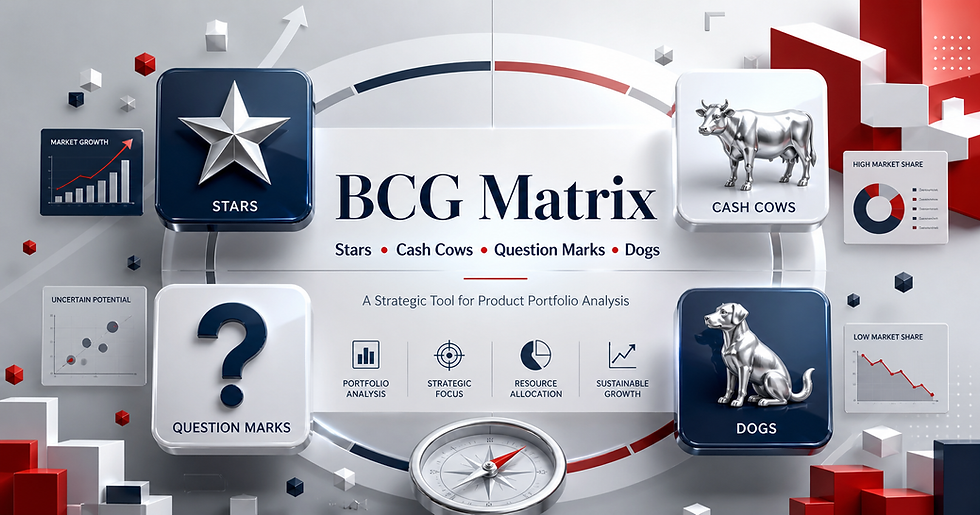
The BCG Matrix was developed to support this type of decision-making. It offers a visual and analytical method for evaluating products or business units according to two main dimensions: market growth rate and relative market share. Market growth rate reflects the attractiveness of the market, while relative market share reflects the strength of the company’s position in that market. By combining these two dimensions, the matrix places products into four categories: Stars, Cash Cows, Question Marks, and Dogs.
For students, the BCG Matrix is important because it simplifies a complex managerial reality. It teaches that not all products should receive the same level of attention or investment. A successful company must balance current profitability with future growth. It must protect strong income sources while also developing new opportunities. It must also recognize when certain activities are consuming resources without creating sufficient value.
Although the BCG Matrix was originally designed for large corporations with diversified product portfolios, its logic can be applied in many contexts. It can be used by manufacturing firms, service companies, tourism businesses, technology firms, educational institutions, and start-ups. In modern business environments, where innovation, competition, and digital transformation are changing markets quickly, the BCG Matrix remains useful as a first step in strategic analysis.
2. Theoretical Background of the BCG Matrix
The BCG Matrix is based on the idea that business units differ in their need for resources and their ability to generate cash. Some units consume cash because they require investment in marketing, technology, infrastructure, research, staff, or distribution. Other units generate cash because they already have a strong position and stable customer demand. Strategic management requires balancing these two realities.
The model is also linked to the product life cycle. Products often begin as new offerings in uncertain markets. If they succeed, they may grow rapidly and become market leaders. Later, as markets mature, growth slows, but successful products may continue to generate strong profits. Eventually, some products decline due to changes in customer needs, competition, technology, or regulation. The BCG Matrix helps managers understand where a product may stand in this broader development path.
The two main variables in the BCG Matrix are:
Market Growth Rate:
This refers to how quickly the market for a product or service is expanding. A high-growth market usually offers many opportunities but also requires high investment. For example, artificial intelligence tools, digital learning platforms, sustainable tourism services, and smart business technologies may operate in high-growth markets. A low-growth market, by contrast, may be stable but less dynamic.
Relative Market Share:
This refers to the company’s competitive strength compared with its largest competitor. A high relative market share usually means that the company has a strong position, better economies of scale, stronger brand recognition, or better customer loyalty. A low relative market share suggests that the company may be weaker in that market and may need significant investment to compete.
The combination of these two variables creates four strategic categories. Each category suggests a different managerial approach.
3. Structure of the BCG Matrix
The BCG Matrix is usually presented as a two-by-two grid. The vertical axis represents market growth rate, and the horizontal axis represents relative market share. Products in high-growth markets appear at the top of the matrix, while products in low-growth markets appear at the bottom. Products with high relative market share appear on the left, while those with low relative market share appear on the right.
The four categories are:
Stars: High market growth and high relative market share.
Cash Cows: Low market growth and high relative market share.
Question Marks: High market growth and low relative market share.
Dogs: Low market growth and low relative market share.
Each category has a different strategic meaning. Stars are strong products in attractive markets. Cash Cows are stable income generators. Question Marks are uncertain opportunities. Dogs are weak products in less attractive markets.
The value of the BCG Matrix is not only in classification. Its real value is in helping managers ask strategic questions. Should the company invest more? Should it protect an existing position? Should it improve a product? Should it exit a market? Should it use profits from mature products to support new growth areas? These questions are central to strategic management.
4. Stars: High Growth and High Market Share
Stars are products or business units that operate in fast-growing markets and have a strong competitive position. They are often seen as future leaders of the company. Because they already have high market share, they are performing well. However, because their markets are growing quickly, they usually require continued investment.
A Star may need investment in marketing, product development, technology, staff, customer service, distribution, or international expansion. The goal is to defend and strengthen its leading position while the market continues to grow. If managed well, Stars may later become Cash Cows when the market matures.
For example, in a technology company, a successful cloud-based service in a rapidly growing market may be considered a Star. It attracts many customers, grows quickly, and has a strong position against competitors. However, it may still require large investment in innovation, cybersecurity, technical support, and infrastructure.
In tourism, a sustainable travel product in a fast-growing destination may also be a Star if it has strong customer demand and a leading market position. The business may need to invest in partnerships, digital booking systems, staff training, and quality standards to maintain growth.
From a student perspective, Stars teach an important lesson: success does not mean investment can stop. In fact, successful products in fast-growing markets often need more investment, not less. If a company fails to support a Star, competitors may take advantage of the growth opportunity and reduce the company’s market position.
The strategic recommendation for Stars is usually to invest, grow, and protect leadership. However, managers must also monitor costs carefully. Not every high-growth product will become profitable immediately. A Star may generate strong revenue but still consume large amounts of cash. Therefore, managers must ensure that investment is disciplined and connected to long-term value.
5. Cash Cows: Low Growth and High Market Share
Cash Cows are products or business units that have a strong market position in a mature or slow-growing market. They may not offer rapid future growth, but they generate stable profits and cash flow. Because the market is mature, they usually require less investment than Stars. Their main role is to provide financial resources that can support other parts of the company.
A Cash Cow is valuable because it creates stability. It can finance innovation, support Question Marks, help maintain Stars, and strengthen the organization’s overall financial health. In many companies, Cash Cows are the foundation of long-term survival.
For example, a well-established professional training program with stable student demand and strong reputation may function as a Cash Cow in an educational organization. It may not grow rapidly, but it consistently attracts learners and generates income. The organization can use this income to develop new digital programs, research projects, or international initiatives.
In a tourism business, a traditional hotel service in a mature destination may be a Cash Cow if it has high occupancy, loyal customers, and efficient operations. It may not grow quickly, but it can generate reliable cash for modernization or new tourism experiences.
The strategic recommendation for Cash Cows is usually to maintain, protect, and harvest. Managers should not ignore Cash Cows simply because they are not exciting or innovative. Their role is essential. However, companies should avoid overinvesting in them when the market has limited growth potential. The focus should be on efficiency, customer satisfaction, quality control, and cost management.
Cash Cows also teach students that strategic value is not always about growth. Stability can be just as important. A company that only focuses on new opportunities may become financially weak. A company that protects its Cash Cows can create the resources needed for innovation and future expansion.
6. Question Marks: High Growth and Low Market Share
Question Marks are products or business units in fast-growing markets where the company has a weak position. They are called Question Marks because their future is uncertain. They may become Stars if the company invests successfully and gains market share. However, they may also fail and consume resources without producing sufficient returns.
Question Marks are among the most difficult categories for managers. They require careful analysis. The market may be attractive, but the company may not yet have the capabilities, brand recognition, technology, distribution, or customer trust needed to compete effectively. Managers must decide whether to invest heavily, reposition the product, form partnerships, or withdraw.
For example, a company may launch a new artificial intelligence service in a market that is growing quickly. However, if the company has low market share and faces strong competition, this service may be a Question Mark. It has potential, but it needs investment and strategic clarity.
In tourism, a new wellness tourism package in a growing market may also be a Question Mark. Demand may be increasing, but the company may not yet have enough reputation, partnerships, or operational experience to become a leader.
In education, a new online program in an emerging field may be a Question Mark. The topic may be in demand, but the institution must invest in curriculum design, digital systems, academic quality, marketing, and student support before it can become successful.
The strategic recommendation for Question Marks is selective investment. Managers should not invest in all Question Marks equally. They should evaluate which ones have the best chance of becoming Stars. This requires market research, competitor analysis, financial forecasting, and an honest assessment of organizational capabilities.
Question Marks teach students that opportunity and success are not the same. A growing market may be attractive, but it does not guarantee that every company will succeed. Good strategy requires choosing carefully.
7. Dogs: Low Growth and Low Market Share
Dogs are products or business units with low market share in low-growth markets. They usually have weak competitive positions and limited future potential. They may generate little profit, or they may even consume resources that could be used more effectively elsewhere.
The term “Dog” may sound negative, but in strategic management it simply refers to a category of business activity. Not every Dog must be immediately closed. Some may still serve a useful purpose, such as supporting customer relationships, completing a product range, or maintaining a presence in a specific market. However, managers must be careful not to allow Dogs to drain resources without strategic justification.
For example, a traditional service that few customers use and that operates in a declining market may be classified as a Dog. If it requires staff, marketing, administration, and maintenance but does not create meaningful value, the company may need to reduce investment or discontinue it.
In technology, an outdated software product with few users and limited market demand may be a Dog. In tourism, an old travel package that no longer matches customer preferences may fall into this category. In education, a short course with very low enrolment and limited relevance to current market needs may also be considered a Dog.
The strategic recommendation for Dogs is usually to divest, reduce, reposition, or maintain only if there is a clear reason. Managers may discontinue the product, sell the business unit, merge it with another offering, or redesign it for a new market. The decision should be based on evidence, not emotion.
Dogs teach students an important managerial lesson: organizations must be willing to make difficult decisions. Keeping every product forever can weaken the whole organization. Strategy requires focus. Resources are limited, and managers must use them where they can create the greatest value.
8. Resource Allocation and Portfolio Balance
The BCG Matrix is especially useful because it connects product analysis with resource allocation. Companies do not have unlimited money, time, people, or managerial attention. They must decide how to distribute resources across different activities.
A balanced portfolio may include Cash Cows that generate financial stability, Stars that drive current growth, selected Question Marks that represent future opportunities, and very few Dogs that are either strategically justified or being phased out. The goal is not to have only Stars. That would be unrealistic and expensive. The goal is to create a healthy balance between present income and future development.
Cash Cows can finance Stars and selected Question Marks. Stars may become future Cash Cows. Question Marks may become Stars if investment succeeds. Dogs may be removed or redesigned to release resources.
This portfolio logic is useful for students because it shows that strategy is dynamic. Products can move from one category to another over time. A Question Mark can become a Star. A Star can become a Cash Cow. A Cash Cow can become a Dog if the market declines and the company loses relevance. Therefore, managers must review the portfolio regularly.
9. Application in Technology Management
Technology markets often change quickly. New platforms, software, digital tools, artificial intelligence applications, cybersecurity services, and data solutions may grow rapidly. However, technology products also face strong competition and short life cycles. The BCG Matrix can help technology managers evaluate which innovations deserve investment.
A new digital platform with strong user growth and high market share may be a Star. A mature software product with loyal clients and stable revenue may be a Cash Cow. A new artificial intelligence feature in a growing but competitive market may be a Question Mark. An outdated system with low demand may be a Dog.
Technology firms must be careful with Question Marks. Many new ideas appear attractive because the market is growing, but not all of them will succeed. Managers must evaluate technical feasibility, customer value, scalability, data security, and competitive advantage.
The BCG Matrix also helps technology managers avoid overdependence on old products. A mature product may generate cash today, but if technology changes, it may decline quickly. Therefore, profits from Cash Cows should support innovation and future capabilities.
10. Application in Tourism and Hospitality Management
Tourism and hospitality businesses often manage several services, such as hotel rooms, event packages, wellness programs, digital booking services, travel experiences, restaurant operations, and destination partnerships. The BCG Matrix can help managers understand which services are growing, which are stable, and which need reconsideration.
A popular eco-tourism package in a rapidly growing destination may be a Star. A well-established hotel service in a mature market may be a Cash Cow. A new wellness retreat concept may be a Question Mark if demand is growing but the company has low market share. An old package with low demand and limited growth may be a Dog.
Tourism markets are affected by customer preferences, economic conditions, digital platforms, sustainability concerns, travel regulations, and global events. Therefore, portfolio analysis is useful. It allows tourism managers to avoid relying only on one service or one market segment.
For students, tourism examples make the BCG Matrix easier to understand because tourism products are often visible and practical. A travel service can be successful today but outdated tomorrow. Managers must constantly evaluate demand, quality, competition, and future trends.
11. Application in Education and Training Services
The BCG Matrix can also be applied to education and training services, especially in institutions that offer multiple programs, short courses, executive education, online learning, and professional development activities. For Swiss International University SIU, such strategic thinking can help students understand how educational institutions may evaluate academic offerings and learner needs.
A study program in a rapidly growing professional field with strong enrolment may be seen as a Star. A well-established program with stable demand may function as a Cash Cow. A new program in an emerging field may be a Question Mark if the market is promising but student demand is not yet proven. A course with low enrolment and limited relevance may be a Dog unless it serves a special academic or social purpose.
However, education must not be reduced only to financial analysis. Academic quality, student development, social value, employability, and institutional mission are also important. Therefore, when applying the BCG Matrix to education, managers should combine it with ethical and academic judgment.
This is an important lesson for students: management tools are helpful, but they must be used responsibly. A matrix can support decisions, but it cannot replace professional judgment, educational values, or long-term institutional responsibility.
12. Advantages of the BCG Matrix
The BCG Matrix has several advantages that explain why it remains popular in management education and practice.
First, it is simple and easy to understand. Students and managers can quickly learn the four categories and apply them to different business situations.
Second, it supports strategic thinking. It encourages managers to look beyond individual products and consider the whole portfolio.
Third, it connects market attractiveness with competitive strength. This helps managers understand that success depends both on external conditions and internal capabilities.
Fourth, it supports resource allocation. It helps organizations decide where to invest, where to maintain, where to select carefully, and where to reduce involvement.
Fifth, it encourages long-term planning. By showing how products may move between categories, the matrix helps managers think about future development.
Sixth, it can be used in different sectors. Although it was developed for business corporations, it can also support analysis in technology, tourism, education, healthcare, services, and non-profit contexts.
13. Limitations of the BCG Matrix
Despite its usefulness, the BCG Matrix has limitations. Students must understand these limitations to avoid using the model too mechanically.
First, the matrix uses only two variables: market growth and relative market share. Real business performance is more complex. Profitability, customer loyalty, brand strength, innovation capability, regulation, sustainability, and social value may also be important.
Second, high market share does not always mean high profit. A company may have strong market share but still face high costs or weak margins.
Third, market growth does not always mean market attractiveness. A fast-growing market may also be risky, unstable, or highly competitive.
Fourth, the model may oversimplify products by placing them into fixed categories. In reality, some products may be between categories or may require deeper analysis.
Fifth, the model may encourage short-term financial thinking if used carelessly. For example, a product classified as a Dog may still have strategic, educational, ethical, or brand value.
Sixth, the matrix assumes that Cash Cows can finance Stars and Question Marks. This may not always be true, especially for small organizations or industries with limited profit margins.
Therefore, the BCG Matrix should be used as a starting point, not as the final decision-making tool. It should be combined with other frameworks such as SWOT analysis, PESTEL analysis, Porter’s Five Forces, product life cycle analysis, financial analysis, and stakeholder analysis.
14. The BCG Matrix and Modern Strategic Thinking
Modern business environments are more complex than when the BCG Matrix was first developed. Digital transformation, sustainability, artificial intelligence, globalization, remote work, changing consumer values, and economic uncertainty have changed how organizations compete. However, the basic question remains the same: how should an organization allocate its limited resources across different opportunities?
The BCG Matrix remains relevant because it helps managers organize this question clearly. It encourages disciplined thinking. It helps prevent emotional decision-making. It also encourages managers to review whether their product portfolio is balanced.
In modern management, the matrix can be adapted. For example, market growth may include digital adoption growth, sustainability demand, international learner demand, or professional skills demand. Relative market share may include brand visibility, platform strength, learner satisfaction, service quality, or technological capability.
This flexible application makes the model useful for students. They can apply it not only to traditional products but also to services, digital platforms, academic programs, research activities, tourism experiences, and professional training.
15. Ethical and Responsible Use of the BCG Matrix
Strategic tools should be used responsibly. Managers must remember that decisions affect employees, customers, students, partners, and communities. A product portfolio decision is not only a financial decision; it can also have human and social consequences.
For example, discontinuing a product may affect employees who work on it. Closing a course may affect students who need that subject. Reducing investment in a service may affect customer satisfaction. Therefore, the BCG Matrix should be used with ethical awareness.
Responsible use means asking additional questions:
Does this product serve an important social or educational purpose?
Does it support the organization’s mission?
Can it be improved rather than discontinued?
Are there stakeholders who will be negatively affected?
Is the decision based on reliable evidence?
Are there long-term consequences beyond short-term profit?
For Swiss International University SIU students, this ethical perspective is essential. Management education should not only teach tools. It should also teach responsible judgment.
16. Example of a BCG Matrix Analysis
Consider a fictional educational services organization that offers four types of programs:
A digital business program with high enrolment growth and strong market position.A traditional management program with stable demand and strong reputation.A new artificial intelligence short course with growing demand but low current enrolment.An outdated administrative course with low demand and limited market growth.
Using the BCG Matrix, the digital business program may be a Star. It needs continued investment to maintain growth and quality. The traditional management program may be a Cash Cow. It provides stability and supports the institution’s financial base. The artificial intelligence short course may be a Question Mark. It has potential, but the organization must decide whether to invest in curriculum, marketing, and technology. The outdated administrative course may be a Dog. It may need redesign, integration into another course, or discontinuation.
This simple example shows how the BCG Matrix supports strategic discussion. It does not automatically make the decision, but it helps managers organize the decision.
17. Lessons for Students
The BCG Matrix provides several important lessons for students of business and management.
First, organizations must think in portfolios, not only in individual products. A company may have some products that grow quickly, some that generate stable income, and some that are uncertain or weak.
Second, growth requires investment. A product in a growing market may not be profitable immediately, but it may be important for the future.
Third, stable products are valuable. Cash Cows may not be exciting, but they are often essential for financial strength.
Fourth, uncertainty must be managed carefully. Question Marks should be analysed deeply before large investment decisions are made.
Fifth, weak products should not be ignored. Dogs may consume resources and reduce organizational focus.
Sixth, management tools should be used with judgment. No model can replace critical thinking, evidence, ethics, and experience.
18. Conclusion
The BCG Matrix remains one of the most important and accessible tools in strategic management. By classifying products or business units into Stars, Cash Cows, Question Marks, and Dogs, it helps managers evaluate portfolio balance and make better resource allocation decisions. Its strength lies in its simplicity, clarity, and ability to connect market conditions with organizational competitiveness.
For students at Swiss International University SIU, the BCG Matrix is more than a diagram. It is a way of thinking about strategic choice. It explains why organizations invest in some areas, maintain others, test new opportunities, and sometimes withdraw from weak activities. It also teaches that strategy requires balance between present performance and future potential.
However, the matrix should not be used mechanically. It has limitations and must be combined with other analytical tools and responsible managerial judgment. Modern organizations operate in complex environments where technology, sustainability, customer expectations, and social responsibility matter. Therefore, the BCG Matrix should be seen as a helpful starting point for analysis, not a complete answer.
In education, business, tourism, technology, and service management, the BCG Matrix continues to offer valuable insights. It helps students understand how managers think, how resources are allocated, and how organizations build sustainable portfolios. When used carefully, it supports better strategic decisions and encourages a more disciplined approach to long-term organizational success.
Sources
Henderson, B. D. The Product Portfolio. Boston Consulting Group.
Kotler, P., Keller, K. L., and Chernev, A. Marketing Management.
Johnson, G., Scholes, K., and Whittington, R. Exploring Corporate Strategy.
Grant, R. M. Contemporary Strategy Analysis.
Ansoff, H. I. Corporate Strategy.
Porter, M. E. Competitive Strategy.
Barney, J. B. Gaining and Sustaining Competitive Advantage.
Wheelen, T. L., Hunger, J. D., Hoffman, A. N., and Bamford, C. E. Strategic Management and Business Policy.
Hill, C. W. L., Schilling, M. A., and Jones, G. R. Strategic Management: Theory and Cases.
Mintzberg, H., Ahlstrand, B., and Lampel, J. Strategy Safari.

Comments