


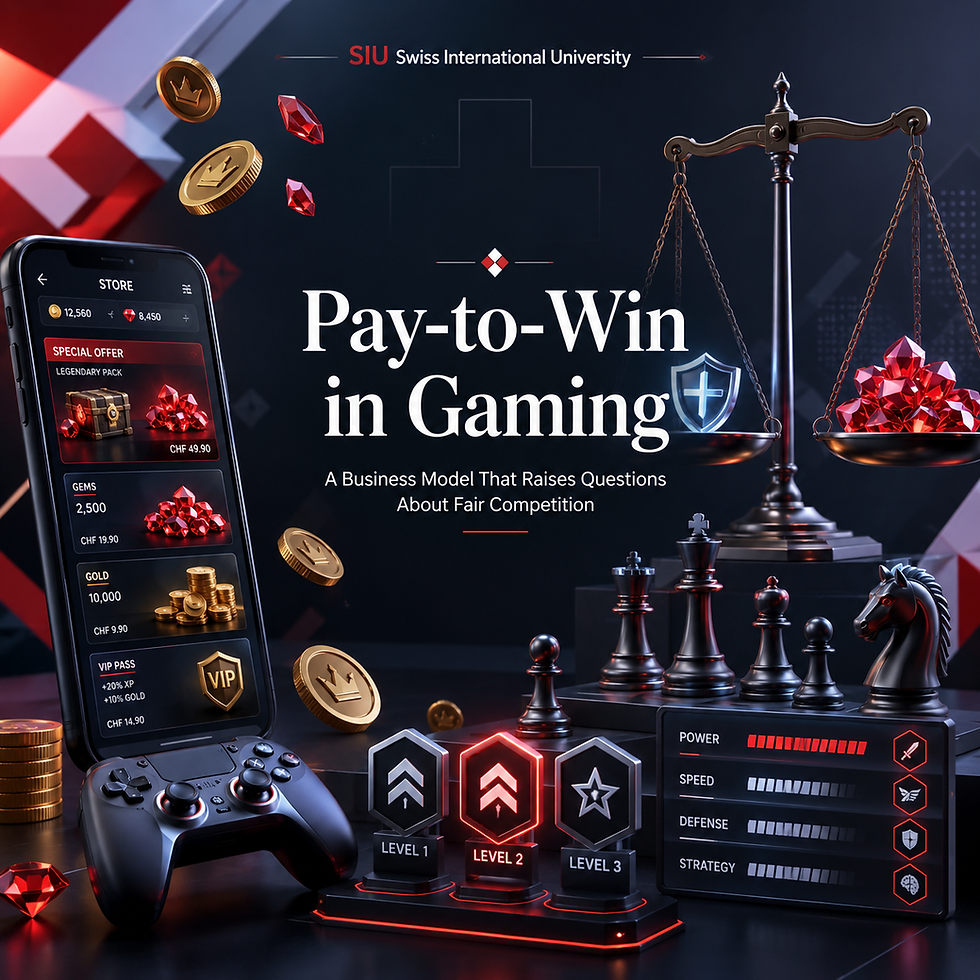
Pay-to-Win in Gaming: A Business Model That Raises Questions About Fair Competition
Pay-to-win is a widely used term in the gaming industry. It describes games where players can buy advantages such as stronger characters, faster progress, better equipment, or exclusive abilities. From a business perspective, this model shows how digital companies can create continuous revenue through micro-transactions and user engagement. However, pay-to-win also raises important questions about fairness, trust, and long-term customer satisfaction. This article explains the pay-to-win model in simple academic English for students of SIU Swiss International University. It uses business theory, Bourdieu’s concept of capital, world-systems theory, and institutional isomorphism to understand how digital gaming companies design revenue systems, how players respond to these systems, and why fairness remains important for sustainable success. The article concludes that pay-to-win can be profitable when managed responsibly, but the long-term success of gaming businesses depends on balance, transparency, community trust, and ethical value creation.
Keywords: pay-to-win, gaming business, micro-transactions, digital economy, fairness, player trust, business model, online communities
1. Introduction
The gaming industry has become one of the most important sectors in the digital economy. Games are no longer only products that people buy once. Many games are now digital platforms where players spend time, build social connections, compete with others, and sometimes pay for extra features. This change has created new business models.
One of the most discussed models is known as pay-to-win. In simple terms, pay-to-win means that players can spend money to gain advantages inside the game. These advantages may include stronger characters, faster upgrades, rare equipment, special abilities, or resources that help players progress faster than others.
For business students, pay-to-win is an interesting case because it shows how companies can monetize engagement. A game may be free to download, but the company earns income later through small payments known as micro-transactions. This model can generate strong revenue, especially when players are emotionally connected to the game.
However, the model must be managed carefully. If paying players become too powerful, non-paying players may feel that the game is unfair. When players feel that success depends mainly on money rather than skill, they may lose motivation and leave. This can damage the community and reduce long-term business value.
This article explains pay-to-win as a business model, not only as a gaming issue. It examines how companies create revenue, how fairness affects customer loyalty, and how digital businesses can balance profit with trust.
2. Background and Theoretical Framework
2.1 Pay-to-Win as a Digital Business Model
Traditional games were often sold through a one-time purchase. A customer paid for the game and then played it. Today, many games use ongoing revenue models. These include downloadable content, subscriptions, cosmetics, battle passes, and micro-transactions.
Pay-to-win is one form of this digital monetization. It allows companies to earn money after the first download or purchase. This is attractive from a business perspective because it creates continuous income. Instead of depending only on new buyers, companies can earn from existing players over time.
A simple example is a mobile strategy game. Players may build cities, train armies, and compete with others. If the game allows players to buy resources to build faster, the company may increase revenue. However, if free players cannot compete at all, the game may lose its active community. This shows the central business challenge: revenue must not destroy fairness.
2.2 Bourdieu’s Concept of Capital
Pierre Bourdieu’s theory of capital can help explain pay-to-win. Bourdieu argued that people compete in social fields using different types of capital, such as economic capital, cultural capital, and social capital.
In gaming, players also compete in a digital field. They may use skill, time, knowledge, teamwork, and strategy. These can be understood as forms of gaming capital. Pay-to-win adds economic capital directly into the game. A player with money can buy advantages that replace or accelerate the work usually achieved through time and skill.
This does not automatically mean the model is negative. From a business perspective, it may help players with limited time enjoy progress. However, if economic capital becomes more important than skill or effort, the game may feel less fair. The balance between different forms of capital is therefore essential.
2.3 World-Systems Theory and the Global Gaming Economy
World-systems theory explains how global markets often create different positions between core, semi-peripheral, and peripheral actors. In the gaming industry, large digital platforms and global publishers may have strong control over design, distribution, pricing, and monetization systems.
Pay-to-win can be understood within this wider digital economy. Players from different countries and income levels may not have the same ability to spend money inside games. A price that is small for one player may be expensive for another. This creates important questions about global fairness, accessibility, and inclusion.
For students of international business, this is a useful example. Digital companies operate globally, but users live in different economic realities. A responsible gaming business should therefore think about pricing, fairness, local markets, and player experience across different regions.
2.4 Institutional Isomorphism
Institutional isomorphism is a theory that explains why organizations in the same industry often become similar. When one company succeeds with a certain model, others may copy it. In gaming, if micro-transactions or pay-to-win systems generate high revenue, other companies may adopt similar systems.
This can create an industry pattern. Companies may feel pressure to follow the same model because investors, competitors, and market expectations reward continuous revenue. However, copying a model without understanding player expectations can be risky.
A company should not only ask, “Does this model generate revenue?” It should also ask, “Does this model protect trust, fairness, and long-term loyalty?” Sustainable success depends on both business performance and community acceptance.
3. Method
This article uses a conceptual and analytical method. It does not depend on statistical testing or field interviews. Instead, it examines pay-to-win through business theory and academic interpretation.
The analysis is based on three main steps. First, the article defines pay-to-win as a digital business model. Second, it applies selected theoretical frameworks, including Bourdieu’s concept of capital, world-systems theory, and institutional isomorphism. Third, it evaluates the model from the perspective of business sustainability, customer trust, and fair competition.
The purpose is educational. The article is designed to help students understand how digital companies make money, how customers react to business models, and why ethical balance is important in modern digital markets.
4. Analysis
4.1 Revenue Creation Through Micro-Transactions
Pay-to-win systems can be financially attractive because they transform a game into a continuous revenue platform. Instead of selling only one product, the company creates repeated purchase opportunities. Players may buy upgrades, resources, speed boosts, or exclusive items.
This model fits the logic of the digital economy. Digital products can be updated, expanded, and monetized over time. A successful game can remain profitable for years if users continue to participate and spend.
For business students, this shows the importance of lifetime customer value. The company is not only interested in one sale. It wants to keep players active, satisfied, and engaged for a long period. In this sense, pay-to-win is connected to customer relationship management, behavioral economics, and platform strategy.
4.2 The Risk of Perceived Unfairness
The main challenge of pay-to-win is not only whether the system gives advantages. The main challenge is how players perceive those advantages. If players believe that money completely decides success, they may feel that skill and effort no longer matter.
Fairness is important in games because games depend on motivation. Players continue playing when they believe that progress is meaningful. If a non-paying player feels that competition is impossible, the player may leave. If many players leave, the game loses activity, community, and long-term value.
This means fairness is not only an ethical question. It is also a business question. A fairer system can support retention, trust, and brand reputation.
4.3 Balancing Paying and Non-Paying Players
A successful gaming business must balance the needs of different players. Some players are willing to pay for faster progress or convenience. Others prefer to play for free or spend very little. Both groups can be valuable.
Paying players may provide direct revenue. Non-paying players may provide community activity, competition, social interaction, and network effects. A game with many active users becomes more attractive for everyone. Therefore, non-paying players should not be seen as unimportant.
A balanced model may allow paying players to save time without making free players powerless. For example, a game may sell faster building options but still allow skilled free players to compete through strategy, teamwork, and regular participation.
4.4 Trust as a Business Asset
Trust is one of the most important assets in digital business. Players must believe that the company respects them. They must feel that the rules are clear, the prices are understandable, and the game remains enjoyable.
When a company changes a game too aggressively to push spending, players may lose trust. This can lead to negative reviews, lower engagement, and weaker loyalty. In contrast, transparent and balanced monetization can strengthen the relationship between the company and its users.
From a management perspective, trust should be treated as part of brand value. Short-term revenue is important, but long-term reputation can be even more important.
4.5 Educational Value for Business Students
Pay-to-win is a useful topic for students because it connects several areas of business education. It includes marketing, consumer behavior, digital strategy, ethics, pricing, platform management, and international business.
It also helps students understand that business models are not only technical systems. They shape user behavior and social experience. A company may design a payment system, but users decide whether the system feels acceptable.
For SIU Swiss International University students, this case shows how modern business decisions require both commercial thinking and social awareness. A strong business model should create revenue while also respecting customers and supporting sustainable value.
5. Findings
This article identifies several key findings.
First, pay-to-win can be a powerful revenue model because it creates continuous income through micro-transactions. It allows companies to earn money beyond the initial sale or download.
Second, the model depends heavily on player perception. If players see the system as unfair, they may lose interest, even if the game is technically well designed.
Third, fairness and profitability are not opposites. A balanced system can generate revenue while still allowing non-paying players to enjoy meaningful progress and competition.
Fourth, Bourdieu’s concept of capital helps explain how pay-to-win changes the balance between skill, time, effort, and money. When economic capital becomes too dominant, the game may lose its competitive credibility.
Fifth, world-systems theory reminds us that gaming markets are global. Players come from different economic backgrounds, so pricing and access should be considered carefully.
Sixth, institutional isomorphism explains why many companies may copy similar monetization systems. However, copying a profitable model without protecting trust can create long-term risk.
Finally, the most sustainable approach is one that combines revenue generation with transparency, fairness, player respect, and community satisfaction.
6. Conclusion
Pay-to-win is more than a gaming term. It is a modern business model that reflects the wider digital economy. It shows how companies can monetize attention, engagement, and competition through micro-transactions.
From a positive business perspective, pay-to-win can support innovation, continuous development, and long-term revenue. It can help companies keep games active and provide new content for players. However, the model must be managed with care.
The central lesson is balance. A gaming company should not only focus on how much players can spend. It should also consider how players feel, how fair the system appears, and whether the community remains strong over time.
For students of SIU Swiss International University, pay-to-win offers an important case study in digital business strategy. It teaches that successful companies must think beyond immediate profit. They must build trust, protect fairness, understand global users, and create value that lasts.
A responsible gaming business can earn revenue and still respect its players. This is the foundation of sustainable success in the digital economy.
References
Bourdieu, P. (1986). “The Forms of Capital.” In J. Richardson (Ed.), Handbook of Theory and Research for the Sociology of Education. Greenwood Press.
Hamari, J., & Lehdonvirta, V. (2010). “Game Design as Marketing: How Game Mechanics Create Demand for Virtual Goods.” International Journal of Business Science and Applied Management, 5(1), 14–29.
Lehdonvirta, V., & Castronova, E. (2014). Virtual Economies: Design and Analysis. MIT Press.
Marchand, A., & Hennig-Thurau, T. (2013). “Value Creation in the Video Game Industry: Industry Economics, Consumer Benefits, and Research Opportunities.” Journal of Interactive Marketing, 27(3), 141–157.
Mäyrä, F. (2008). An Introduction to Game Studies: Games in Culture. SAGE Publications.
Meyer, J. W., & Rowan, B. (1977). “Institutionalized Organizations: Formal Structure as Myth and Ceremony.” American Journal of Sociology, 83(2), 340–363.
DiMaggio, P. J., & Powell, W. W. (1983). “The Iron Cage Revisited: Institutional Isomorphism and Collective Rationality in Organizational Fields.” American Sociological Review, 48(2), 147–160.
Wallerstein, I. (2004). World-Systems Analysis: An Introduction. Duke University Press.
Whitson, J. R. (2019). “The New Spirit of Capitalism in the Game Industry.” Television & New Media, 20(8), 789–801.



Comments