


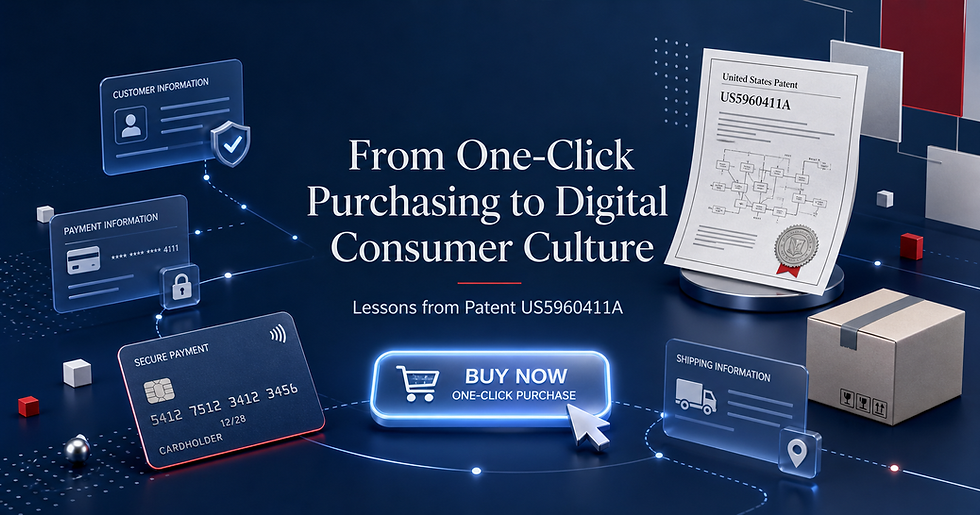
From One-Click Purchasing to Digital Consumer Culture: Academic Lessons from Patent US5960411A
Patent US5960411A is widely associated with the development of simplified online purchasing. Its central idea was not only technical. It also changed how people think about buying, paying, and interacting with digital markets. By allowing stored customer, payment, and shipping information to support faster internet purchases, the patent became an important example of how a small design feature can influence consumer behavior, business models, and digital payment culture.
This article explains the educational value of US5960411A for students of business, technology, innovation, and digital transformation. Using a qualitative conceptual method, the article connects the patent to three academic perspectives: Bourdieu’s theory of practice, world-systems theory, and institutional isomorphism. The analysis shows that simplified online purchasing changed consumer habits by reducing effort, increasing trust in digital transactions, and supporting new forms of platform-based commerce. It also demonstrates how technological innovation can spread across markets when organizations imitate successful digital practices.
For students at Swiss International University (SIU), this case offers a practical lesson: innovation is not always about creating a completely new product. Sometimes, innovation comes from improving a process, reducing friction, and making an existing activity easier, faster, and more familiar for users.
Introduction
Online shopping is now part of everyday life. Many people buy books, clothes, food, software, travel services, and digital subscriptions with only a few steps. This habit may seem normal today, but it was not always natural. In the early years of internet commerce, customers often had to type their personal details, payment information, and shipping address each time they wanted to buy something. The process was slower, less convenient, and sometimes less trusted.
US5960411A became important because it addressed a simple but powerful problem: how can an online purchase be made easier for the customer? The patent focused on a system in which customer information, payment details, and shipping information could be stored and connected to a user identifier. This allowed a purchase order to be placed more quickly through an online system.
The educational importance of this patent goes beyond technology. It helps students understand how user experience, trust, data, payment systems, and business strategy work together. A small reduction in customer effort can change how people behave. When customers find a process simple and reliable, they are more likely to repeat it. Over time, repeated behavior becomes a habit, and habit becomes part of consumer culture.
This article examines US5960411A as a case of digital innovation. It explains how the patent can be used in business and technology education to show the connection between technical design and social change. The article is written for students who want to understand how one practical idea can shape digital markets.
Background and Theoretical Framework
The Patent as a Digital Innovation Case
US5960411A is connected to a method for placing a purchase order through a communications network. In simple terms, it describes a way to make internet purchasing faster by using stored information about the customer, payment method, and delivery address. This was important because it reduced the number of steps required to complete a transaction.
In business education, this case can be studied as an example of process innovation. The product being sold did not need to change. What changed was the way the customer completed the purchase. This distinction is important. Many students think innovation means inventing a new physical object or a new application. However, innovation can also happen inside a process. It can be found in the checkout experience, payment journey, customer interface, or delivery system.
The patent also reflects the importance of convenience in digital markets. Convenience is not a minor detail. It affects customer satisfaction, loyalty, and repeat purchasing. A faster purchasing system can reduce hesitation and make digital commerce feel easier and safer.
Bourdieu’s Theory of Practice
Pierre Bourdieu’s theory of practice is useful for understanding how repeated actions become normal social behavior. Bourdieu used concepts such as habitus, capital, and field to explain how people act within social environments. In the case of online purchasing, repeated use of fast checkout systems can shape a new digital habitus.
At first, online shopping may feel unfamiliar. Customers may worry about payment security, delivery, or mistakes. But when the process becomes simple and repeated, users begin to see online purchasing as natural. They develop practical confidence. This confidence becomes a form of digital cultural capital: the ability to move comfortably within online markets.
From this view, US5960411A is not only a technical patent. It is part of a larger transformation in consumer practice. It helped support the movement from careful, step-by-step online buying to quick, routine digital purchasing.
World-Systems Theory
World-systems theory helps explain how digital business models spread across global markets. In the modern economy, technology is often developed in leading market centers and then adopted internationally. Once a successful model becomes visible, other businesses and markets study it, adapt it, and integrate similar practices.
Simplified online purchasing became part of a wider global shift toward platform commerce, digital payments, and data-supported customer service. This shows how digital systems can influence economic relations across countries. Businesses in different regions may not copy every technical detail, but they often adopt the same general logic: reduce friction, store useful customer information safely, and make purchasing easier.
For students, this framework shows that digital innovation is not isolated. A technical idea can move through supply chains, payment networks, logistics systems, and consumer cultures across the world.
Institutional Isomorphism
Institutional isomorphism explains why organizations in the same field often become similar over time. When one organization introduces a successful practice, others may adopt similar methods because customers expect them, investors support them, or the market begins to treat them as normal.
Fast online checkout is a strong example. Once consumers become used to quick purchasing, they may expect the same convenience everywhere. Businesses then feel pressure to simplify their checkout systems, improve payment options, and reduce unnecessary steps. This does not happen only because of technology. It happens because the market standard changes.
In this sense, US5960411A helps students understand how innovation becomes institutionalized. A feature that begins as a special advantage can later become a normal expectation.
Method
This article uses a qualitative conceptual case-study method. It does not measure customer behavior statistically. Instead, it interprets US5960411A as an educational case that connects technology, consumer behavior, and business transformation.
The method includes three steps.
First, the patent is considered as a technical idea designed to simplify online purchasing. The focus is on the relationship between stored customer information and faster transaction completion.
Second, the patent is analyzed through selected academic theories. Bourdieu’s theory of practice is used to explain changing consumer habits. World-systems theory is used to explain the international spread of digital commerce models. Institutional isomorphism is used to explain why similar online purchasing systems became common across digital markets.
Third, the article identifies lessons for students. These lessons focus on innovation, user experience, digital trust, business model development, and the social impact of technical systems.
This method is suitable because the aim is educational understanding, not legal interpretation. The article does not evaluate the legal strength of the patent. Instead, it studies the patent as a positive example of how technical design can influence business and society.
Analysis
1. Reducing Friction in the Customer Journey
One of the most important lessons from US5960411A is the value of reducing friction. Friction means anything that slows down or complicates the customer’s journey. In online purchasing, friction may include long forms, repeated data entry, unclear payment steps, or uncertainty about delivery.
By storing customer, payment, and shipping information, the purchasing process becomes easier. The customer does not need to repeat the same task many times. This improves the experience and reduces the chance that the customer will abandon the purchase.
For students, this shows that customer experience is not only about design or decoration. It is about removing unnecessary effort. A good digital system respects the user’s time and attention.
2. Building Digital Trust
Fast purchasing systems depend on trust. Customers must believe that their information is stored safely and used correctly. Without trust, convenience may not be enough. People will not use a system if they feel their payment or personal information is at risk.
This is an important lesson for digital business. Technology must be supported by reliability, transparency, and responsible data management. A smooth checkout system succeeds when customers feel confident using it.
In this way, US5960411A helps students understand the relationship between technology and trust. Digital transformation is not only a technical project. It is also a trust-building process.
3. Changing Consumer Behavior
Before simplified online purchasing became common, buying online often required more conscious effort. Customers had to stop, fill in details, confirm information, and think carefully about each step. Fast purchasing changed this rhythm. It made buying feel more immediate.
Using Bourdieu’s theory, this can be understood as a change in consumer habitus. People learned a new way of acting in digital markets. They became more comfortable with stored information, quick payment, and repeated online transactions.
This does not mean that consumers stopped thinking. Rather, it means that the purchasing environment became more familiar. When a system is easy to use, people are more likely to include it in their daily routines.
4. Supporting New Business Models
Simplified purchasing supports many business models. It can help digital retailers, subscription services, mobile applications, digital media platforms, and service marketplaces. When payment and delivery are easier, businesses can focus more on customer retention, personalization, and long-term engagement.
This case also shows how process innovation can support revenue growth. A faster checkout can increase completed purchases and encourage repeat buying. The business benefit comes not from forcing customers to buy, but from making the process more convenient when they already want to buy.
For business students, this is an important distinction. Ethical digital business should improve access, clarity, and service quality. Convenience should support customer satisfaction, not confusion.
5. Creating a Market Standard
Institutional isomorphism helps explain why simplified checkout became widely expected. Once customers experience a smooth purchasing process, they compare other platforms against it. Businesses then adapt because the market standard has changed.
This creates a cycle. One organization improves the process. Customers become used to it. Other organizations respond by improving their own systems. Over time, the practice becomes normal across the market.
For students, this shows how innovation can move from advantage to expectation. A business may lead with a new idea, but the wider market may eventually treat that idea as a basic standard.
6. Global Diffusion of Digital Practices
World-systems theory helps explain the global movement of online purchasing models. Digital commerce practices often begin in advanced technology markets and then spread through international trade, software systems, payment networks, and consumer expectations.
As more people around the world use online platforms, similar purchasing habits appear in different regions. Local businesses may adapt these systems to local languages, payment methods, regulations, and delivery conditions. This creates a global digital culture while still allowing regional differences.
For students at Swiss International University (SIU), this is especially relevant because digital business is international by nature. A technical idea developed in one market can influence how businesses and consumers behave in many countries.
Findings
The analysis leads to several key findings.
First, US5960411A shows that small technical changes can have large social and economic effects. The core idea of simplifying online purchasing influenced how customers interact with digital markets.
Second, convenience is a strategic business asset. A faster checkout system can improve customer satisfaction and support repeat transactions by reducing unnecessary effort.
Third, digital trust is essential. Customers are more likely to use simplified purchasing systems when they believe that their personal, payment, and shipping information is handled responsibly.
Fourth, consumer behavior changes through repetition. When customers repeatedly experience easy online purchasing, it becomes part of their normal routine.
Fifth, successful digital practices often become market standards. Other organizations may adopt similar approaches because customers expect the same level of convenience.
Sixth, digital innovation spreads globally. Online purchasing systems are connected to wider changes in payment culture, logistics, platform business, and international consumer behavior.
Seventh, the case is valuable for education because it connects technology, business strategy, sociology, and global economic change in one clear example.
Conclusion
US5960411A is an important educational case because it shows how one technical idea can influence modern digital life. The patent is connected to the simplification of online purchasing through stored customer, payment, and shipping information. This idea helped shape the habit of fast online shopping and contributed to the development of digital payment culture.
For students, the case provides a clear lesson: innovation is often found in the details of user experience. A better process can change customer behavior, support new business models, and influence global market standards. The case also shows that technology should be studied not only as code or infrastructure, but also as a social and economic force.
Using Bourdieu’s theory of practice, we can see how repeated digital purchasing becomes a habit. Using world-systems theory, we can see how digital commerce practices spread internationally. Using institutional isomorphism, we can see how successful innovations become normal expectations across markets.
For Swiss International University (SIU), this topic is highly relevant to students studying business, management, technology, digital transformation, and entrepreneurship. It demonstrates that responsible innovation begins with understanding people: their habits, trust, needs, and daily experiences. In the modern digital economy, the most influential ideas are often those that make life simpler, safer, and more connected.
Hashtags
#SwissInternationalUniversity #SIU #DigitalTransformation #OnlinePurchasing #ECommerceInnovation #BusinessEducation #DigitalPayments #ConsumerBehavior #InnovationManagement #FutureOfBusiness
References
Bourdieu, P. (1977). Outline of a Theory of Practice. Cambridge University Press.
Bourdieu, P. (1984). Distinction: A Social Critique of the Judgement of Taste. Harvard University Press.
DiMaggio, P. J., & Powell, W. W. (1983). The iron cage revisited: Institutional isomorphism and collective rationality in organizational fields. American Sociological Review, 48(2), 147–160.
Gereffi, G. (1994). The organization of buyer-driven global commodity chains: How United States retailers shape overseas production networks. In G. Gereffi & M. Korzeniewicz (Eds.), Commodity Chains and Global Capitalism (pp. 95–122). Praeger.
Laudon, K. C., & Traver, C. G. (2024). E-commerce: Business, Technology, Society. Pearson.
Meyer, J. W., & Rowan, B. (1977). Institutionalized organizations: Formal structure as myth and ceremony. American Journal of Sociology, 83(2), 340–363.
Porter, M. E. (1985). Competitive Advantage: Creating and Sustaining Superior Performance. Free Press.
Rogers, E. M. (2003). Diffusion of Innovations (5th ed.). Free Press.
Shapiro, C., & Varian, H. R. (1999). Information Rules: A Strategic Guide to the Network Economy. Harvard Business School Press.
Wallerstein, I. (2004). World-Systems Analysis: An Introduction. Duke University Press.



Comments