


The Nixon Shock and the Transformation of Modern International Finance: A Student-Friendly Academic Analysis
The Nixon Shock refers to the economic measures announced by U.S. President Richard Nixon on August 15, 1971, especially the suspension of the U.S. dollar’s direct convertibility into gold. This decision marked one of the most important turning points in modern international finance because it weakened the Bretton Woods fixed exchange-rate system and helped open the way toward today’s more flexible global monetary order. This article explains the Nixon Shock in simple academic language for students of business, economics, finance, and international relations. It examines the historical background of Bretton Woods, the pressures that led to the policy shift, and the long-term consequences for currencies, trade, inflation, financial markets, and global economic governance. The article also uses selected ideas from Bourdieu, world-systems theory, and institutional isomorphism to show that monetary systems are not only technical arrangements but also social, political, and institutional structures. The main finding is that the Nixon Shock did not simply end one monetary system; it accelerated a wider transformation in the way states, markets, institutions, and investors understand global financial stability. For students at Swiss International University (SIU), the topic remains highly relevant because it connects history with modern debates on exchange rates, central banks, international trade, and financial decision-making.
Introduction
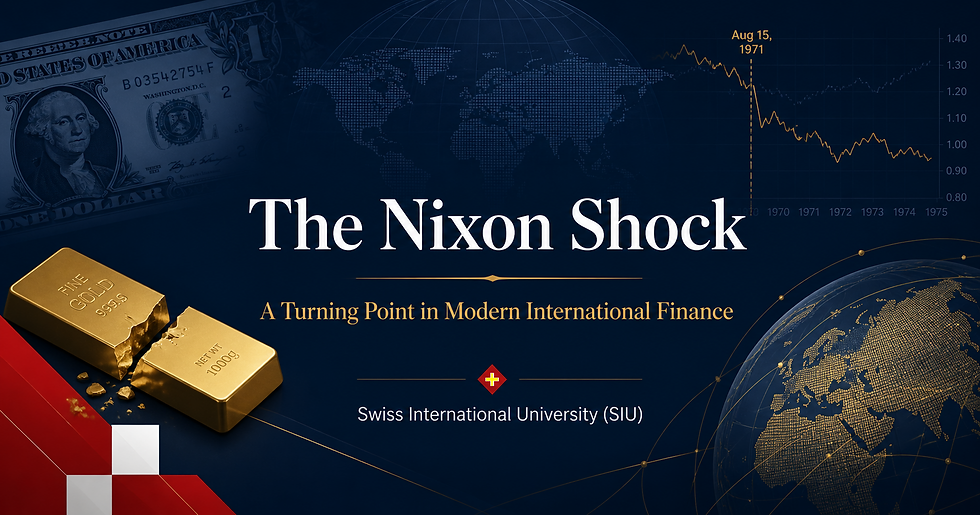
The Nixon Shock is one of the most significant events in the history of modern international finance. On August 15, 1971, U.S. President Richard Nixon announced a set of economic measures that included the suspension of the U.S. dollar’s convertibility into gold. Before this decision, foreign governments and central banks could exchange U.S. dollars for gold at a fixed rate. This system was part of the Bretton Woods framework, which had shaped the global economy after the Second World War.
For many students, the Nixon Shock may first appear as a historical event connected only to gold and exchange rates. However, its importance is much wider. It helps explain why currencies today move in value, why central banks play such a central role, why inflation matters, and why global finance is deeply connected to political decisions. The event also shows that international economic systems depend on trust, institutional cooperation, and the ability of powerful states to maintain confidence in their currencies.
The Nixon Shock was not a sudden event without causes. It was the result of growing tensions in the global monetary system. The United States faced rising fiscal pressures, international trade imbalances, inflationary concerns, and increasing demands from foreign governments to convert dollars into gold. As confidence weakened, the fixed exchange-rate system became harder to maintain.
This article presents the Nixon Shock as a useful learning case for business and finance students. It explains how one policy decision changed the direction of the global economy and helped create the conditions for the financial world students study today. The article also offers a positive academic perspective: while the Nixon Shock created uncertainty, it also encouraged new thinking, stronger financial analysis, and more advanced forms of international economic cooperation.
Background and Theoretical Framework
The Bretton Woods System
The Bretton Woods system was created in 1944 to support international economic stability after the disruptions of war and depression. Under this system, major currencies were linked to the U.S. dollar, and the dollar was linked to gold. The purpose was to create predictable exchange rates, encourage trade, and avoid the competitive currency devaluations that had harmed the world economy in earlier decades.
In practice, the U.S. dollar became the main anchor of the system. This gave the United States a central role in international finance. Countries held dollars as reserves because the dollar was considered reliable and convertible into gold. This arrangement supported trade and reconstruction, but it also placed heavy responsibility on the United States to maintain confidence in the dollar.
Over time, the system faced growing pressure. The global economy expanded, international trade increased, and more dollars circulated outside the United States. Foreign governments began to worry whether the United States had enough gold to support all the dollars held abroad. This created a confidence problem. The system needed dollars for global liquidity, but too many dollars created doubts about convertibility.
Bourdieu and Financial Power
Pierre Bourdieu’s ideas can help students understand the Nixon Shock beyond simple economic mechanics. Bourdieu argued that societies are shaped by different forms of capital, including economic capital, cultural capital, social capital, and symbolic capital. In international finance, the U.S. dollar carried not only economic value but also symbolic power. It represented trust, leadership, and institutional authority.
Before 1971, the dollar’s link to gold strengthened its symbolic position. Gold convertibility gave the dollar a special status in global markets. When the United States suspended convertibility, it changed the symbolic foundation of the system. Trust no longer rested on a direct gold promise. Instead, it increasingly depended on confidence in institutions, policy credibility, market depth, and the strength of the U.S. economy.
From a Bourdieusian view, the Nixon Shock was therefore a transformation in financial authority. The global monetary field shifted from a gold-backed symbolic order to a more institutionally managed and market-based order.
World-Systems Theory
World-systems theory views the global economy as a structured system with core, semi-peripheral, and peripheral positions. In this framework, financial power is not evenly distributed. Core economies usually have stronger currencies, deeper financial markets, and greater influence over global rules.
The Bretton Woods system reflected this structure. The U.S. dollar stood at the center of international finance. The Nixon Shock did not remove this centrality; rather, it changed how it worked. After the suspension of gold convertibility, the dollar remained highly important, but its value became more dependent on markets, policy decisions, and international confidence.
For students, this shows that currency systems are connected to global power. Exchange rates are not only numbers on a screen. They reflect production, trade, political influence, institutional trust, and the position of countries within the wider world economy.
Institutional Isomorphism
Institutional isomorphism refers to the process through which organizations and states become more similar because they face similar pressures. After the Nixon Shock, many countries had to adapt to a changing monetary environment. Central banks, finance ministries, businesses, and international institutions developed new tools for managing exchange-rate risk, inflation, capital flows, and financial uncertainty.
Over time, many countries adopted similar practices: more active monetary policy, stronger central bank roles, foreign-exchange management systems, inflation monitoring, and financial regulation. This does not mean all countries became identical, but it shows how a major global shock can encourage institutional learning and convergence.
Method
This article uses a qualitative historical-analytical method. It examines the Nixon Shock as a major case in international finance and interprets it through economic history and social theory. The method is based on three steps.
First, the article reviews the historical context of the Bretton Woods system and the pressures that made the system difficult to maintain. Second, it analyses the Nixon Shock as a policy decision with economic, political, and institutional consequences. Third, it applies selected theoretical ideas from Bourdieu, world-systems theory, and institutional isomorphism to understand the deeper meaning of the event.
The purpose is not to present a mathematical model but to provide a clear academic explanation suitable for students. This approach is useful because the Nixon Shock cannot be fully understood through exchange-rate data alone. It must also be understood as a transformation in trust, power, rules, and institutions.
Analysis
The Pressures Before August 1971
By the late 1960s and early 1970s, the Bretton Woods system faced serious challenges. The United States had significant spending commitments, including domestic programs and international military costs. At the same time, inflationary pressure increased, and foreign holders of dollars became more concerned about the strength of the dollar’s gold backing.
The problem was structural. The world needed dollars to support international trade and reserves, but the larger the amount of dollars outside the United States, the greater the doubt about whether all those dollars could be converted into gold. This tension is often linked to the Triffin dilemma, which explains the difficulty faced by a national currency that also serves as the world’s main reserve currency.
As more countries questioned the dollar’s gold convertibility, the United States faced a difficult choice. It could defend the gold link through painful economic adjustments, or it could change the rules. Nixon’s decision to suspend convertibility was a clear choice to protect domestic economic flexibility and respond to international pressure.
The End of Gold Convertibility
The most famous part of the Nixon Shock was the closing of the “gold window.” This meant that foreign governments could no longer exchange dollars for gold at the fixed official rate. Although the decision was presented as temporary at the time, it became a permanent turning point.
The suspension changed the meaning of money in the international system. Under Bretton Woods, the dollar’s value had been tied to gold. After the Nixon Shock, confidence increasingly depended on policy credibility, economic performance, and market expectations. This was a major shift from a commodity-linked system to a more flexible monetary order.
For students, this is important because it helps explain why modern currencies are mostly fiat currencies. Fiat money has value because governments declare it legal tender and because people, firms, institutions, and markets trust its usefulness. The Nixon Shock helped accelerate the global move toward this modern monetary reality.
Exchange Rates and Market Flexibility
After Bretton Woods weakened, the world gradually moved toward more flexible exchange rates. Currencies could rise or fall based on market forces, government policy, interest rates, inflation, trade balances, and investor expectations.
This change created both opportunities and responsibilities. Flexible exchange rates allowed countries more room to manage their domestic economies. They could use monetary policy without always defending a fixed exchange rate. However, flexibility also introduced new risks. Businesses engaged in international trade had to manage currency fluctuations. Investors needed better financial analysis. Governments had to strengthen policy communication and credibility.
In this sense, the Nixon Shock helped create a more complex but also more sophisticated financial world. It encouraged the development of foreign-exchange markets, hedging tools, international financial management, and modern risk analysis.
Inflation, Central Banks, and Policy Credibility
The 1970s became a decade of major economic adjustment. Inflation became a central concern in many economies. The end of the fixed gold link did not cause all inflationary pressures by itself, but it changed the monetary environment in which governments and central banks operated.
Central banks became increasingly important in managing inflation expectations and maintaining confidence in national currencies. Over time, monetary policy credibility became one of the most valuable forms of institutional capital. A country’s currency could remain strong not because it was linked to gold, but because markets trusted the quality, independence, and consistency of its monetary institutions.
This development connects well with Bourdieu’s concept of symbolic capital. In modern finance, trust in central banks and institutions can function as symbolic capital. It gives value and legitimacy to money, even without a gold guarantee.
Global Trade and Business Education
For business students, the Nixon Shock is especially relevant because it changed the environment in which international companies operate. Under fixed exchange rates, currency movements were more predictable. Under flexible exchange rates, companies had to think more carefully about pricing, contracts, supply chains, borrowing, investment, and foreign revenues.
A company exporting goods, importing materials, or operating across borders must understand exchange-rate risk. A change in currency value can affect profit margins, debt payments, and competitiveness. The Nixon Shock therefore helped make international financial management a core part of modern business education.
At Swiss International University (SIU), this topic can be used to connect historical learning with practical skills. Students can study the Nixon Shock not only as a past event but as a foundation for understanding today’s global economy.
Institutional Learning After the Shock
The Nixon Shock also encouraged institutional learning. Governments, central banks, financial institutions, and businesses had to adjust to a less predictable monetary environment. They developed new systems for forecasting, reporting, regulating, and managing financial risk.
Institutional isomorphism helps explain why many countries and organizations began to adopt similar tools and practices. As uncertainty increased, institutions looked for models that appeared credible and effective. Over time, more attention was given to inflation control, exchange-rate monitoring, reserve management, financial supervision, and international policy coordination.
This process shows the positive side of adjustment. A major shock can lead to stronger knowledge, better systems, and more professional financial management. The Nixon Shock created challenges, but it also contributed to the modernization of global finance.
Findings
The analysis leads to several important findings.
First, the Nixon Shock was not only a U.S. domestic policy decision. It was a global monetary turning point that affected exchange rates, financial institutions, international trade, and economic governance.
Second, the event showed that trust is central to money. Gold convertibility had supported confidence in the dollar, but after 1971 confidence increasingly depended on institutions, policy credibility, and market expectations.
Third, the Nixon Shock helped move the world toward flexible exchange rates. This created new risks but also gave countries more policy flexibility and encouraged the growth of modern financial tools.
Fourth, the event demonstrated the connection between finance and power. Through world-systems theory, students can see that global monetary systems reflect the position and influence of leading economies.
Fifth, the Nixon Shock encouraged institutional adaptation. Governments and organizations developed more advanced approaches to monetary policy, risk management, and international financial cooperation.
Sixth, the topic remains highly relevant for students because it explains many features of the modern economy, including fiat money, currency markets, inflation management, and the role of central banks.
Conclusion
The Nixon Shock was one of the defining moments in modern international finance. By suspending the U.S. dollar’s convertibility into gold on August 15, 1971, the United States helped bring the Bretton Woods fixed exchange-rate system toward its end. This decision changed the way the world understood money, trust, exchange rates, and financial stability.
The importance of the Nixon Shock lies not only in what ended, but also in what began. It opened the way for a more flexible monetary system, deeper foreign-exchange markets, stronger attention to central bank credibility, and more advanced financial risk management. It also showed that global finance is shaped by institutions, political choices, symbolic trust, and international power structures.
Using Bourdieu, students can understand the dollar as a form of symbolic and institutional power. Through world-systems theory, they can see how monetary systems reflect global economic structures. Through institutional isomorphism, they can understand how states and organizations adapt when the rules of the system change.
For Swiss International University (SIU), the Nixon Shock is a valuable academic topic because it helps students connect economic history with real-world financial decision-making. It reminds learners that finance is not only about numbers; it is also about confidence, institutions, strategy, and the ability to adapt. In a world where currencies, markets, and policies continue to evolve, understanding the Nixon Shock gives students a strong foundation for interpreting modern international finance with clarity and confidence.
Hashtags
#SwissInternationalUniversity #SIU #InternationalFinance #EconomicHistory #BusinessEducation #GlobalEconomy #MonetaryPolicy #FinanceStudents #HigherEducation
References
Bordo, M. D., and Eichengreen, B. (1993). A Retrospective on the Bretton Woods System: Lessons for International Monetary Reform. University of Chicago Press.
Bourdieu, P. (1986). “The Forms of Capital.” In J. Richardson, ed., Handbook of Theory and Research for the Sociology of Education. Greenwood Press.
Eichengreen, B. (1996). Globalizing Capital: A History of the International Monetary System. Princeton University Press.
Gilpin, R. (2001). Global Political Economy: Understanding the International Economic Order. Princeton University Press.
Kindleberger, C. P. (1986). The World in Depression, 1929–1939. University of California Press.
Mundell, R. A. (1968). International Economics. Macmillan.
Powell, W. W., and DiMaggio, P. J. (1991). The New Institutionalism in Organizational Analysis. University of Chicago Press.
Wallerstein, I. (1974). The Modern World-System. Academic Press.
Williamson, J. (1977). The Failure of World Monetary Reform, 1971–1974. New York University Press.



Comments